
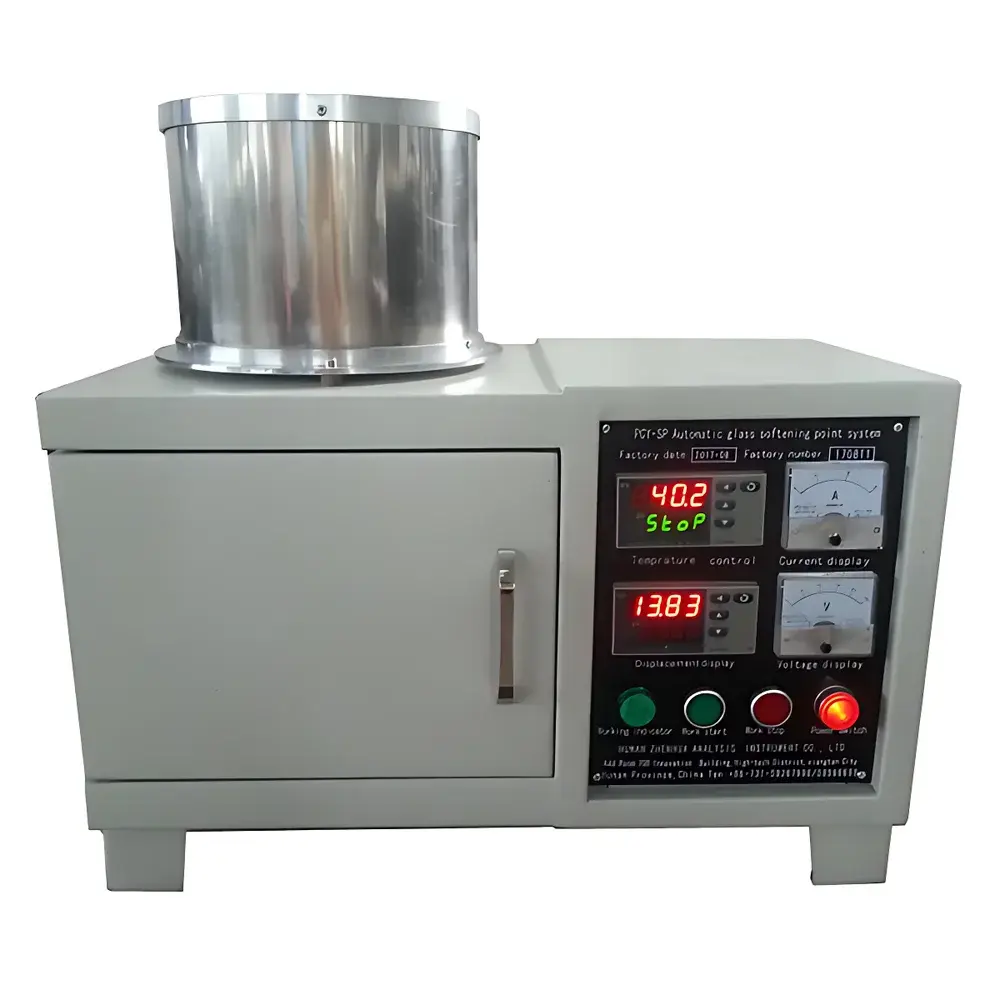
PCY-SP Automatic Fiber Suspension Method Glass Softening Point Tester
| Origin | Hunan, China |
|---|---|
| Manufacturer Type | Authorized Distributor |
| Origin Category | Domestic (China) |
| Model | PCY-SP |
| Pricing | Available Upon Request |
| Max Operating Temperature | 1000 °C (1200 °C Furnace Limit) |
| Temperature Control | Dual K-Type Thermocouples (Control + Sample Sensing) |
| Control System | Intelligent PID with Programmable Ramp Rates & Segmented Profiles |
| Temperature Accuracy | ±1 °C |
| Heating Element | Ni–Cr (2080) Resistance Wire (Theoretical Max: 1350 °C) |
| Displacement Detection | Optical Grating-Based Linear Encoder |
| Displacement Accuracy | ±0.5% FS |
| Data Acquisition | Real-Time PC-Based System |
| Software Platform | Windows 7/XP Compatible (Bilingual UI), ASTM C338–Compliant Workflow & Reporting Engine |
Overview
The PCY-SP Automatic Fiber Suspension Method Glass Softening Point Tester is an engineered solution for precise determination of the softening temperature of glass fibers and amorphous inorganic materials, operating in strict accordance with ASTM C338—Standard Test Method for Softening Point of Glass. Unlike traditional ring-and-ball or penetration-based methods, this instrument implements the fiber suspension technique: a vertically suspended glass fiber specimen is heated under controlled thermal conditions while its axial elongation is continuously monitored via high-resolution optical grating displacement sensing. The softening point is defined as the temperature at which the fiber exhibits a specified rate of viscous deformation—typically identified by the inflection point in the first derivative of the elongation–temperature curve. This principle leverages the viscoelastic transition behavior of glassy materials above their transformation range, making the PCY-SP particularly suitable for quality control in optical fiber preform manufacturing, specialty glass R&D, and refractory material characterization.
Key Features
- Dual thermocouple architecture: Independent K-type thermocouples for furnace zone control and direct sample surface temperature monitoring ensure thermal fidelity and eliminate gradient-related uncertainty.
- Programmable PID temperature profiling: Supports multi-segment ramp-hold sequences with user-defined heating rates (e.g., 1–10 °C/min), enabling reproducible thermal histories aligned with ASTM C338 procedural requirements.
- Optical grating displacement sensor: Contactless, non-invasive tracking of fiber elongation with full-scale accuracy better than ±0.5%, minimizing mechanical loading artifacts and drift over extended test durations.
- Ni–Cr (2080) heating element: High-stability resistance wire capable of sustained operation up to 1000 °C, with furnace-rated capacity to 1200 °C and theoretical limit of 1350 °C—providing margin for high-transition-temperature glasses.
- Real-time derivative analysis: On-the-fly computation of dL/dT enables automatic identification of the softening point without post-processing, reducing operator dependency and inter-laboratory variability.
Sample Compatibility & Compliance
The PCY-SP accommodates standard cylindrical glass fiber specimens (diameter 0.5–1.2 mm, length 40–60 mm) suspended freely between two refractory supports. It is validated for use with soda-lime, borosilicate, aluminosilicate, and rare-earth-doped optical glasses. All operational protocols—including calibration routines, data logging intervals, and report generation—conform to ASTM C338–22. The system architecture supports GLP-compliant documentation: audit trails, user access levels, electronic signatures, and immutable raw data storage are implemented within the software framework to facilitate FDA 21 CFR Part 11 readiness when deployed in regulated environments.
Software & Data Management
The proprietary Windows-based application provides bilingual (English/Chinese) interface navigation and implements a deterministic ASTM C338 workflow—from specimen setup and thermal profile definition to real-time curve visualization and automated softening point extraction. Raw displacement and temperature time-series data are saved in open CSV format; reports export as PDF or XLSX with embedded metadata (operator ID, calibration date, instrument serial number, environmental conditions). Version-controlled software updates include enhanced noise filtering algorithms for low-signal elongation detection and configurable pass/fail thresholds against internal specification limits. Data integrity safeguards include cyclic redundancy checks (CRC) on acquisition buffers and timestamped database journaling.
Applications
- Quality assurance of optical fiber preforms during draw tower feedstock qualification
- Thermal stability assessment of glass-ceramic sealants used in solid oxide fuel cells (SOFCs)
- Comparative softening behavior studies of recycled container glass versus virgin melt batches
- Development of low-expansion glasses for astronomical mirror substrates
- Validation of thermal history effects on phase separation kinetics in immiscible glass systems
FAQ
What standards does the PCY-SP comply with?
ASTM C338 is fully implemented in both hardware control logic and software reporting structure. Optional IQ/OQ documentation packages are available for GMP-aligned validation.
Can the system measure softening points above 1000 °C?
The furnace is rated for continuous operation up to 1000 °C; short-term excursions to 1200 °C are permitted for calibration verification, but long-term testing above 1000 °C may reduce thermocouple lifespan and compromise displacement sensor thermal stability.
Is the displacement sensor calibrated traceably to national standards?
Yes—each optical grating encoder is supplied with NIST-traceable calibration certificate covering linearity, hysteresis, and repeatability across its full measurement range.
Does the software support networked data archiving?
The application includes configurable UNC path mapping and supports integration with enterprise LIMS via standardized ODBC drivers and structured XML export templates.
What maintenance is required for the heating element and sensor subsystems?
Ni–Cr wire elements require no scheduled replacement under normal use; annual verification of thermocouple EMF output and grating encoder zero-drift is recommended using certified reference sources.



