
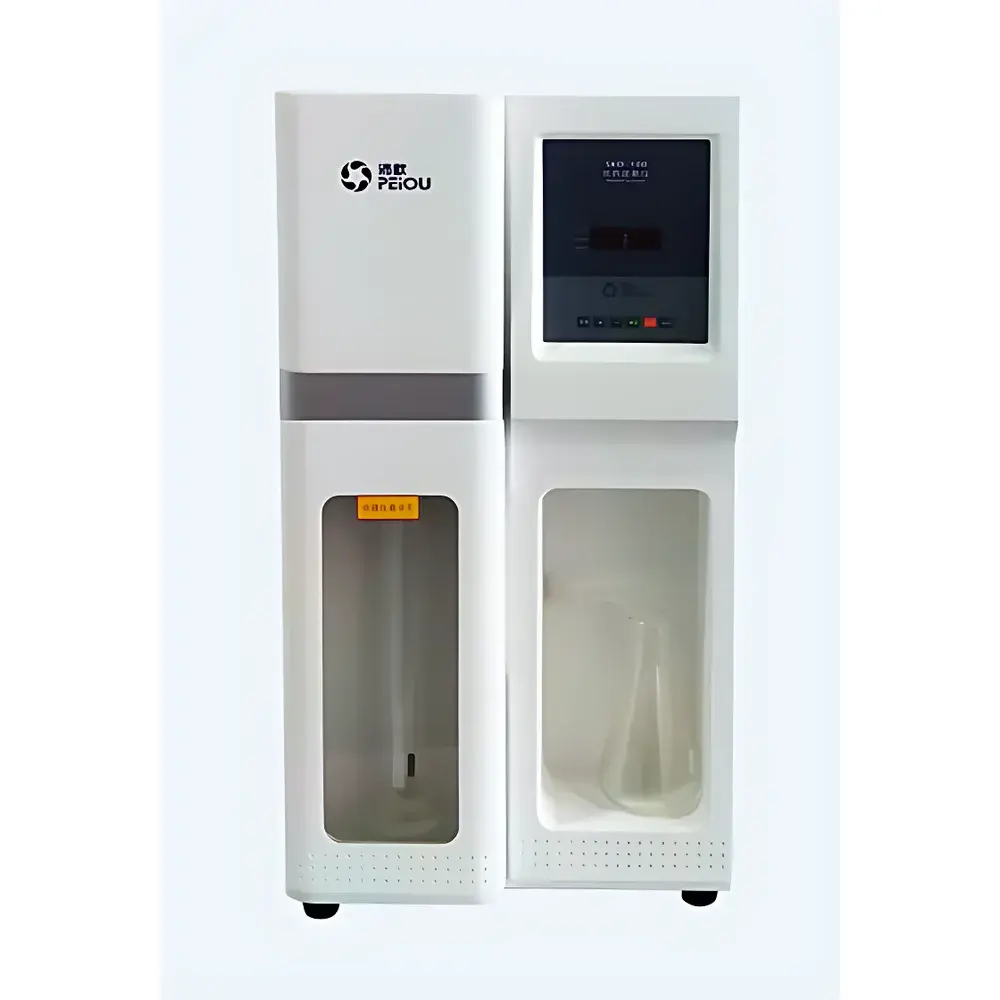
Peiou SKD-100 Automated Kjeldahl Nitrogen Analyzer
| Brand | Peiou |
|---|---|
| Origin | Shanghai, China |
| Model | SKD-100 |
| Principle | Kjeldahl Method |
| Nitrogen Range | 0.1–240 mg N |
| Repeatability | RSD ≤ 0.5% |
| Detection Limit | 0.1–240 mg N |
| Recovery Rate | >99.5% |
| Sample Capacity | ≤6 g (solid) or ≤16 mL (liquid) |
| Distillation Time | 3–8 min/sample |
| Distillation Flow Rate | 15–30 mL/min |
| Alkali Addition Time | 0–99 s |
| Distillation Duration Setting | 0–99 min |
| Power Adjustment | 0–1500 W |
| Data Storage | 10 programmable distillation/alkalization protocols |
| Safety Features | Real-time liquid-level monitoring, overpressure protection, dry-run prevention, emergency stop |
| Housing Material | Integrated ABS engineering plastic enclosure |
| Tubing | Acid- and alkali-resistant custom polymer tubing (≥3-year service life) |
| Dimensions | 370 × 300 × 680 mm |
| Net Weight | 15 kg |
| Power Supply | AC 220 V ±10%, 50 Hz |
| Water Supply | ≥0.15 MPa pressure, ≤20 °C inlet temperature |
Overview
The Peiou SKD-100 Automated Kjeldahl Nitrogen Analyzer is an integrated, benchtop instrument engineered for precise, high-throughput nitrogen quantification in compliance with ISO 8968, AOAC 981.10, ASTM D1122, and USP <467> methodologies. Based on the classical Kjeldahl digestion–distillation–titration principle, the SKD-100 automates the critical alkaline distillation step following acid digestion, enabling accurate conversion of ammonium salts to free ammonia gas, which is subsequently trapped in boric acid solution for titrimetric or colorimetric analysis. Designed specifically for food, feed, agricultural, environmental, and pharmaceutical laboratories, the system delivers traceable, auditable results under GLP and GMP-aligned operational frameworks. Its fully automated workflow eliminates manual intervention during alkali addition, steam generation, condensation, and distillate collection—significantly reducing analyst exposure to hazardous reagents while ensuring inter-batch consistency.
Key Features
- Corrosion-immune housing: Monolithic ABS engineering plastic chassis, injection-molded as a single unit, providing full electrical insulation and resistance to concentrated H2SO4, NaOH, and H2O2—eliminating galvanic corrosion, leakage, and grounding risks in aggressive chemical environments.
- Pressure-driven alkali delivery: A regulated pneumatic system applies constant pressure to the alkali reservoir, dispensing consistent volumes without mechanical pumps—removing pump degradation, clogging, and flow drift over time.
- Stable steam generation: Adjustable heating power (0–1500 W) with real-time pressure regulation ensures balanced vapor output and prevents sample back-suction or foaming-induced carryover.
- Intelligent self-cleaning: Dedicated rinse cycles for both distillation chamber and alkali pathways reduce cross-contamination and maintain long-term accuracy across high-volume testing.
- Programmable operation: Ten user-defined methods store parameters including preheating duration, alkali volume/timing, distillation time, condensate volume, and power ramp profiles—supporting method transfer and SOP enforcement.
- Embedded safety architecture: Dual-level liquid-level sensing prevents dry-heating of the distillation flask; overpressure relief valves and emergency stop functionality meet IEC 61010-1 requirements for laboratory equipment safety.
Sample Compatibility & Compliance
The SKD-100 accommodates solid samples up to 6 g and liquid samples up to 16 mL per run, making it suitable for cereals, dairy powders, meat products, forage, soil extracts, wastewater digests, and pharmaceutical excipients. All wetted components—including tubing, condenser, and distillation head—are constructed from chemically inert, high-temperature-resistant polymers certified for prolonged contact with 40% NaOH and 98% H2SO4. The system supports full audit trails when interfaced with LIMS or validated titration platforms, and its deterministic timing logic aligns with FDA 21 CFR Part 11 data integrity expectations for electronic records and signatures.
Software & Data Management
The embedded microcontroller logs timestamped event sequences—including start/stop times, alkali dosing confirmation, distillate volume, and fault alerts—for each analysis. Data export is supported via RS-232 serial interface to external PCs running compliant titration software (e.g., Metrohm OMNIS, Hanna HI902C). No proprietary cloud platform or vendor-dependent firmware updates are required; all method editing and calibration verification occur locally via LED keypad navigation. Internal memory retains 10 complete method configurations with version-stamped parameter sets, facilitating internal validation and regulatory review.
Applications
The SKD-100 is routinely deployed in QC laboratories for routine protein content determination in raw materials and finished goods (e.g., wheat gluten, soy isolates, infant formula), volatile basic nitrogen (VBN) assessment in seafood freshness evaluation, ammonium salt quantification in fertilizer formulations, and total Kjeldahl nitrogen (TKN) measurement in municipal wastewater and compost leachates. It also serves academic research groups conducting method development for alternative nitrogen sources in aquaculture feeds or validating rapid digestion protocols for high-fiber botanical matrices.
FAQ
Does the SKD-100 require external titration equipment?
Yes—the SKD-100 performs only the distillation step; endpoint detection requires either manual titration or integration with an automatic titrator.
Can the instrument be validated per IQ/OQ/PQ protocols?
Yes—its deterministic timing, repeatable alkali delivery, and digital event logging support formal installation, operational, and performance qualification against defined acceptance criteria.
What maintenance intervals are recommended for tubing and seals?
The proprietary acid/alkali-resistant tubing is rated for ≥3 years of continuous use under standard operating conditions; no scheduled replacement is required within that period.
Is the SKD-100 compatible with ISO/IEC 17025-accredited workflows?
Yes—when operated with calibrated glassware, certified reference materials (e.g., glutamic acid CRM), and documented method verification, it fulfills technical requirements for accredited nitrogen testing.
How does the system prevent carryover between samples?
Automated post-distillation rinsing of both the distillation chamber and alkali delivery path removes residual ammonium salts and caustic residues prior to the next run.





