
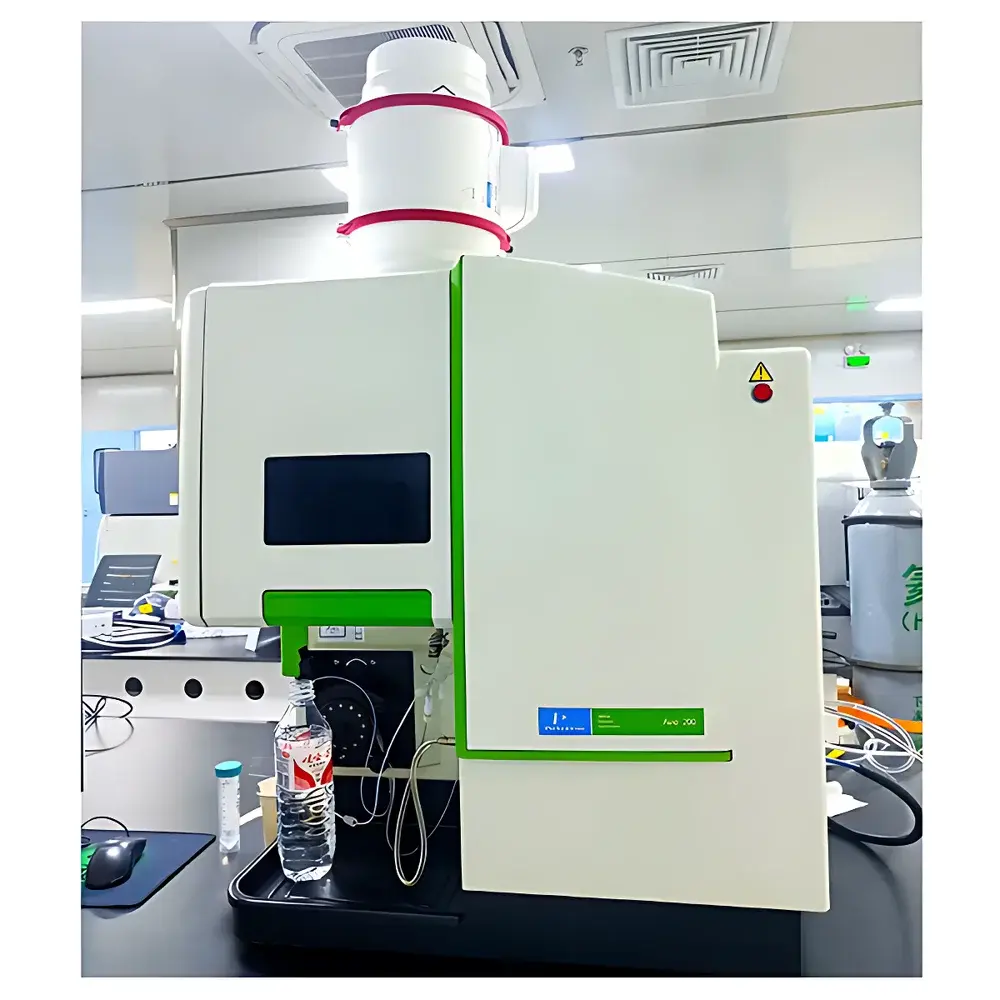
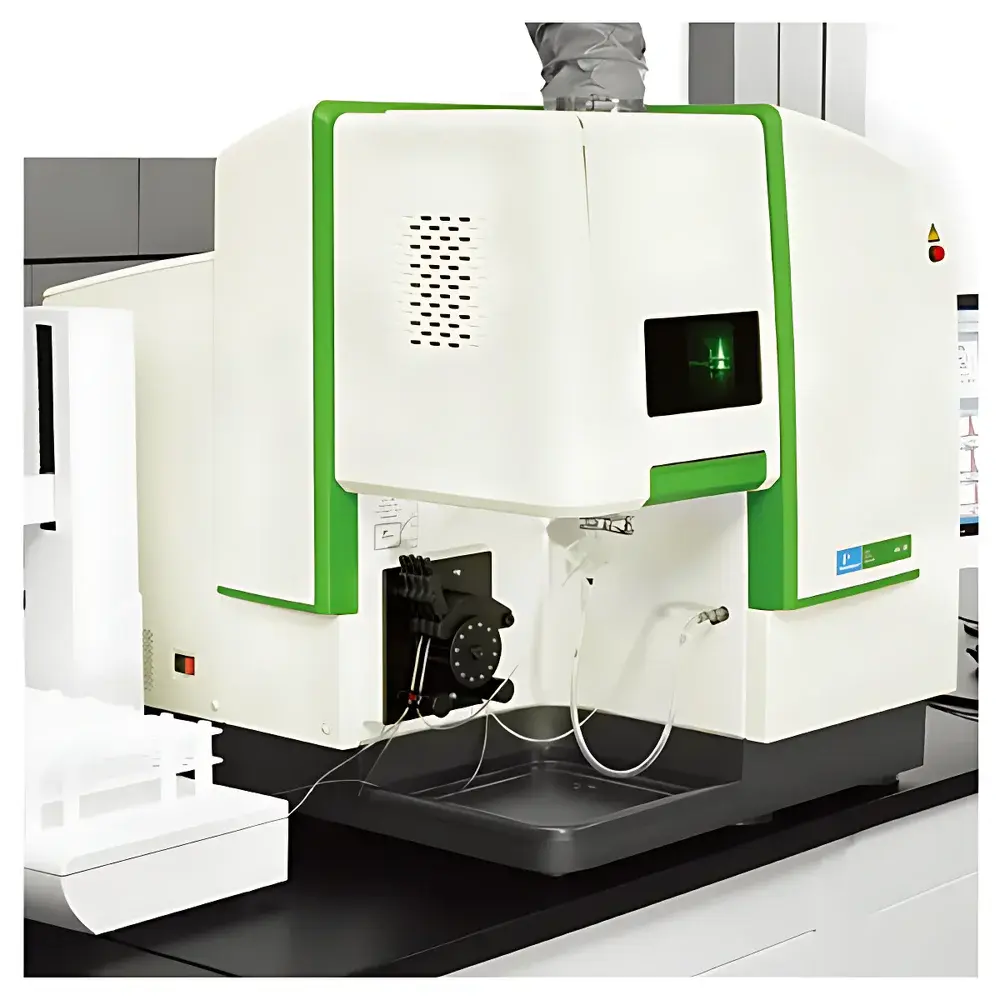
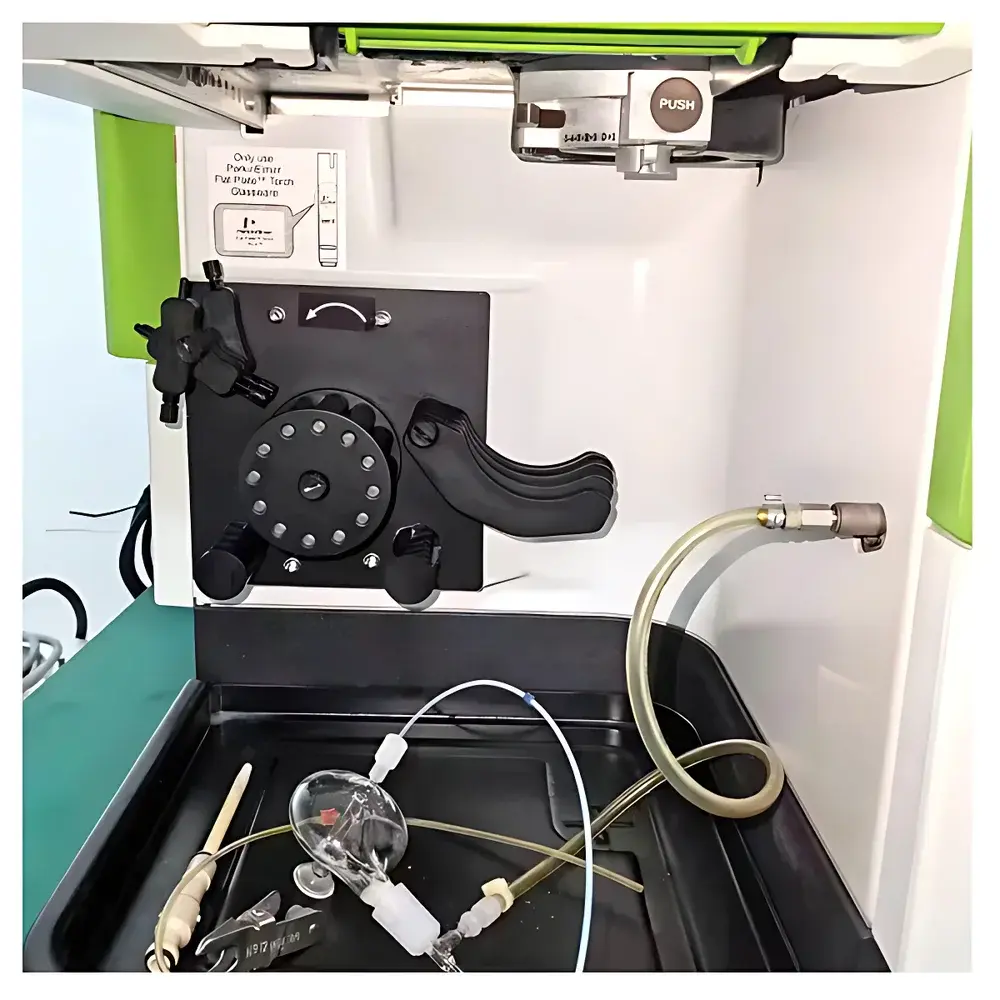
PerkinElmer Avio™ 200 Inductively Coupled Plasma Optical Emission Spectrometer
| Brand | PerkinElmer |
|---|---|
| Origin | USA |
| Model | Avio 200 |
| Instrument Type | Full-Spectrum Simultaneous ICP-OES |
| Detection Limit | 0.003 ng/mL (typical, e.g., Mg II 279.553 nm) |
| Precision (RSD) | ≤1% at 1 µg/L |
| Stability (RSD over 4h) | ≤1% |
| Wavelength Range | 110–900 nm |
| Optical Resolution | ≤0.007 nm (FWHM at 200 nm) |
Overview
The PerkinElmer Avio™ 200 is a compact, full-spectrum simultaneous inductively coupled plasma optical emission spectrometer (ICP-OES) engineered for high-performance elemental analysis in demanding laboratory environments. Utilizing robust flat-plate plasma technology and a vertically oriented, air-cooled RF torch, the system generates a stable, matrix-tolerant plasma with exceptional thermal resilience—enabling direct analysis of high-solids, high-salt, and organic-rich samples without dilution or extensive sample preparation. Its core measurement principle relies on wavelength-dispersive optical emission spectroscopy: analyte atoms and ions in the 6,000–10,000 K argon plasma are excited and emit element-specific photons across the ultraviolet to near-infrared spectrum (110–900 nm), which are resolved by a high-fidelity echelle grating and detected simultaneously by a thermoelectrically cooled CCD detector. This architecture ensures true multi-element capability with no sequential scanning delay, delivering quantitative results for up to 70 elements in under 60 seconds per sample.
Key Features
- Flat Plate™ Plasma Technology: Replaces conventional copper load coils with a solid-state, air-cooled flat RF coil—eliminating water cooling requirements, reducing argon consumption by up to 50% (typical flow: 10–12 L/min total), and extending operational uptime.
- True Dual-View Simultaneous Observation: Patented axial and radial viewing paths operate concurrently without optical switching or signal loss; all wavelengths—including challenging VUV lines below 190 nm (e.g., P 178.222 nm) and NIR lines above 750 nm—are measured with full spectral resolution and sensitivity.
- PlasmaCam™ Integrated Color Imaging System: Real-time, high-resolution visual monitoring of plasma morphology, nebulizer spray pattern, and torch alignment—enabling remote method development, troubleshooting, and preventive maintenance verification.
- PlasmaShear™ Axial Interference Removal: A proprietary air-shear gas curtain physically separates the cool plasma tail plume during axial viewing—suppressing molecular band interferences (e.g., OH, N₂, ArO) without auxiliary argon gas, cones, or high-maintenance vacuum extraction.
- Tool-Free Vertical Torch Adjustment: Quick-release torch base allows on-the-fly optimization of observation height and nebulizer gas flow—even during active analysis—supporting diverse sample introduction systems (concentric, cross-flow, microconcentric nebulizers; cyclonic, Scott-type, or chilled spray chambers).
- Full-Spectrum CCD Detection: 1,024 × 1,024-pixel back-illuminated CCD captures complete spectra from 110–900 nm in a single exposure; real-time background correction adjacent to each analytical line improves accuracy and lowers detection limits.
Sample Compatibility & Compliance
The Avio 200 is validated for direct analysis of complex matrices including biological fluids (serum, urine), alcoholic beverages, petrochemicals (naphtha, lubricants), food extracts (soy sauce, fish tissue), and high-salinity solutions (up to 30% w/v NaCl). Its robust plasma design minimizes carbon deposition and salt buildup, ensuring long-term stability during routine QC/QA workflows. The system supports full compliance with international regulatory frameworks: method validation aligns with ISO/IEC 17025:2017 requirements; data integrity features—including electronic signatures, audit trails, and user-access controls—meet FDA 21 CFR Part 11 and EU Annex 11 expectations. Routine operation adheres to ASTM D1976, EPA Method 200.7/200.8/6010D, and ISO 11885 standards for trace metal quantification in environmental, clinical, and industrial samples.
Software & Data Management
Syngistix™ for ICP Software provides an intuitive, workflow-driven interface designed for both novice and expert users. It enables method setup via guided wizards, automated calibration curve generation (linear, quadratic, or weighted regression), internal standard normalization (up to 3 IS elements), and real-time interference correction using stored spectral libraries. All raw spectral data—including full interferograms, background-subtracted intensities, and integration windows—are retained in open-format .csv and .spc files for secondary processing or third-party statistical analysis. Audit trail logs record every user action (method edits, calibration updates, result approvals) with timestamps and operator IDs, supporting GLP/GMP documentation requirements. Optional Syngistix Enterprise modules provide LIMS integration (via ASTM E1384 or HL7), instrument fleet monitoring, and automated report generation compliant with ISO/IEC 17025 clause 7.8.2.
Applications
- Direct quantification of Pb and As at sub-ppb levels in 30% NaCl brines for marine sediment leachate testing.
- Multi-element profiling (Na, K, Ca, Mg, Fe, Zn, Cu) in undiluted human serum and urine—eliminating pre-dilution errors and improving throughput.
- Organotin speciation support via hydride generation coupling (e.g., TBT, DBT, MBT in footwear leachates and seafood hydrolysates).
- Chlorine determination at 894.800 nm in pharmaceutical excipients at 1 ppm level, with spectral deconvolution to resolve Cl–Ar overlaps.
- Cesium detection at 894.347 nm in nuclear fuel cycle samples at 1 ppb—leveraging axial view and PlasmaShear™ for optimal S/N ratio.
- Automated quality control charting with real-time internal standard drift visualization and auto-flagging of out-of-spec results per ISO 8258 Shewhart criteria.
FAQ
What is the typical argon consumption rate for the Avio 200 during routine operation?
The system operates at 10–12 L/min total argon flow—approximately half that of conventional ICP-OES instruments—enabled by Flat Plate™ plasma technology.
Can the Avio 200 analyze samples with >10% total dissolved solids (TDS)?
Yes; its vertical torch geometry, robust plasma, and PlasmaShear™ interference removal allow direct analysis of samples containing up to 30% NaCl or equivalent high-matrix loads without clogging or signal suppression.
Does the system support EPA-compliant methods such as Method 200.8?
Yes; factory-installed method templates, certified reference material (CRM) libraries, and built-in QC checks (blanks, duplicates, spikes, continuing calibration verification) fully support EPA 200.8, 6010D, and 6020B workflows.
Is spectral interference correction automated in Syngistix software?
Yes; the software applies real-time, line-specific background correction using adjacent pixel regions and includes optional multivariate interference correction models for complex overlapping emissions.
What maintenance intervals are recommended for the CCD detector and plasma torch?
The thermoelectrically cooled CCD requires no routine maintenance; the vertical torch assembly is rated for ≥1,000 hours of continuous operation and features field-replaceable center tubes with self-aligning mechanics—no tools or realignment required.




