
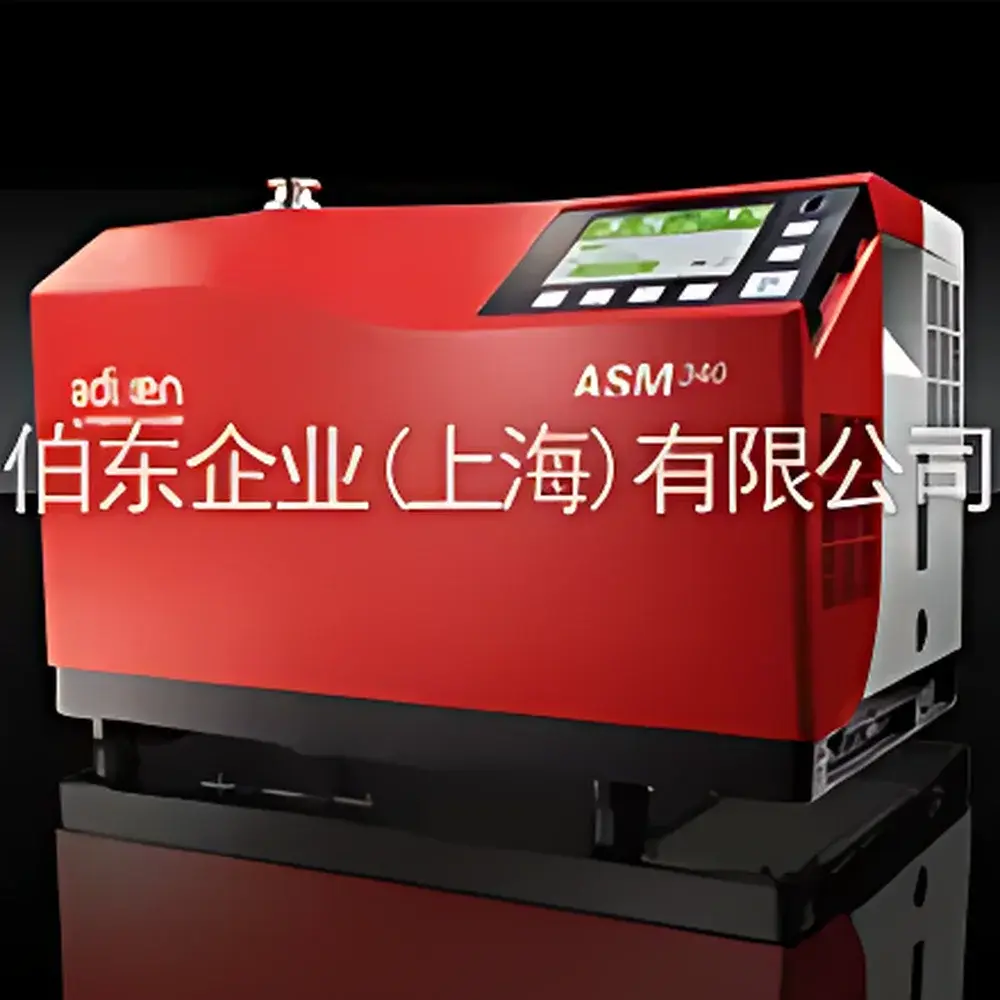
Pfeiffer ASM 340 Helium Mass Spectrometer Leak Detector for Gas Pipeline Integrity Testing
| Brand | Pfeiffer Vacuum |
|---|---|
| Origin | USA (Manufactured under German engineering standards) |
| Model | ASM 340 |
| Detection Limit | ≤5 × 10⁻¹³ Pa·m³/s |
| Application | Vacuum-mode helium leak testing of pressurized natural gas distribution piping systems |
| Compliance | Designed to support ISO 10648-2, ASTM E1795, and EN 1330-8 compliant leak verification protocols |
| Pumping Configuration | Compatible with Splitflow 80 turbo-molecular pump + backing pump (e.g., Leybold DUA series) |
Overview
The Pfeiffer ASM 340 Helium Mass Spectrometer Leak Detector is a high-sensitivity, vacuum-integrated analytical instrument engineered for quantitative detection and precise localization of sub-micron leaks in pressurized gas transmission systems—particularly natural gas pipelines used in municipal infrastructure, industrial fuel delivery, and aerospace propulsion subsystems. Operating on the principle of magnetic sector mass spectrometry, the ASM 340 selectively ionizes helium atoms introduced at suspected leakage sites and separates them via mass-to-charge ratio (m/z = 4), achieving exceptional signal-to-noise discrimination against background nitrogen, oxygen, and hydrocarbon species. Unlike ambient-pressure bubble testing or pressure-decay methods—which suffer from poor repeatability, operator dependency, and inability to resolve leaks below 10⁻⁸ Pa·m³/s—the ASM 340 enables trace-level leak quantification down to 5 × 10⁻¹³ Pa·m³/s under optimized vacuum conditions (typically <1 × 10⁻³ mbar base pressure). Its modular architecture supports both fixed-installation integration into automated test cells and portable field deployment for on-site pipeline integrity audits.
Key Features
- High-resolution magnetic sector mass analyzer with quadrupole-assisted ion optics for stable helium ion current measurement
- Vacuum-integrated design compatible with standard turbo-molecular pumping stations (e.g., Pfeiffer Splitflow 80 + dry backing pump)
- Dual-mode operation: sniffer probe mode for localized leak pinpointing and vacuum chamber mode for batch testing of assembled pipe segments
- Real-time analog output (0–10 V) and digital RS-232/RS-485 interfaces for integration into SCADA-based pipeline monitoring systems
- Automatic zero stabilization and background compensation algorithms to minimize drift during extended operational cycles
- IP54-rated enclosure suitable for controlled industrial environments including fabrication cleanrooms and utility vaults
Sample Compatibility & Compliance
The ASM 340 is validated for use with metallic (stainless steel 316L, carbon steel ASTM A106), polymeric (PE80/PE100 HDPE), and composite gas-carrying components operating at working pressures up to 10 MPa. It meets functional safety requirements aligned with IEC 61508 SIL-2 for critical infrastructure inspection tools. All calibration procedures follow NIST-traceable helium flow standards (e.g., certified orifice leak standards per ISO 20487). The system supports audit-ready documentation generation required under ISO/IEC 17025 accredited laboratory practices and complies with EU Pressure Equipment Directive (PED 2014/68/EU) Annex I essential safety requirements for leak verification instrumentation.
Software & Data Management
The ASM 340 operates with Pfeiffer’s proprietary LeakTest Control Suite v4.2, providing configurable test sequences, multi-point logging (timestamped leak rate, location coordinates, operator ID), and CSV/PDF report export. Raw spectral data is retained with full metadata (pump status, chamber pressure, filament emission current) to satisfy FDA 21 CFR Part 11 electronic record integrity requirements. Optional Ethernet/IP and OPC UA modules enable seamless connectivity to enterprise MES platforms for statistical process control (SPC) of weld joint acceptance criteria across large-scale pipeline manufacturing lines.
Applications
- Final acceptance testing of welded and flanged joints in NG distribution mains prior to hydrostatic commissioning
- In-service inspection of buried pipeline sections using tracer gas injection and surface sniffing protocols (ASTM D999/D1598)
- Quality assurance of cryogenic LNG transfer hoses and valve manifolds in refueling stations
- Leak mapping of complex manifold assemblies in turbine fuel supply systems (e.g., aerospace ground support equipment)
- Verification of hermeticity in smart meter housings and pressure-regulator diaphragms exposed to H₂S-containing biogas streams
FAQ
What vacuum level is required for optimal sensitivity during pipeline testing?
A base pressure ≤1 × 10⁻³ mbar is recommended; this is typically achieved within 60–90 seconds using a Splitflow 80 turbo pump backed by an oil-free dry pump.
Can the ASM 340 detect leaks in insulated or coated pipe sections?
Yes—helium’s high diffusivity allows it to permeate thin polymer coatings and thermal insulation jackets; localized spraying remains effective unless barrier layers exceed 1 mm thickness.
Is helium recovery supported to reduce operational costs?
The ASM 340 does not include integrated helium recycling; however, its low helium consumption (<5 mL/min during sniffer operation) makes external recovery systems economically viable for high-throughput facilities.
How is measurement uncertainty quantified for regulatory reporting?
Uncertainty budgets are calculated per GUM (JCGM 100:2008) incorporating contributions from calibration standard accuracy (±2.5%), pumping speed variation (±1.8%), and background helium concentration (±0.7%). Typical expanded uncertainty (k=2) is ±6.1% at 1 × 10⁻¹² Pa·m³/s.
Does the system support remote diagnostics and firmware updates?
Yes—via secure TLS-encrypted web interface accessible through authenticated corporate networks; all updates comply with IEC 62443-3-3 cybersecurity certification requirements.
Related Products





