
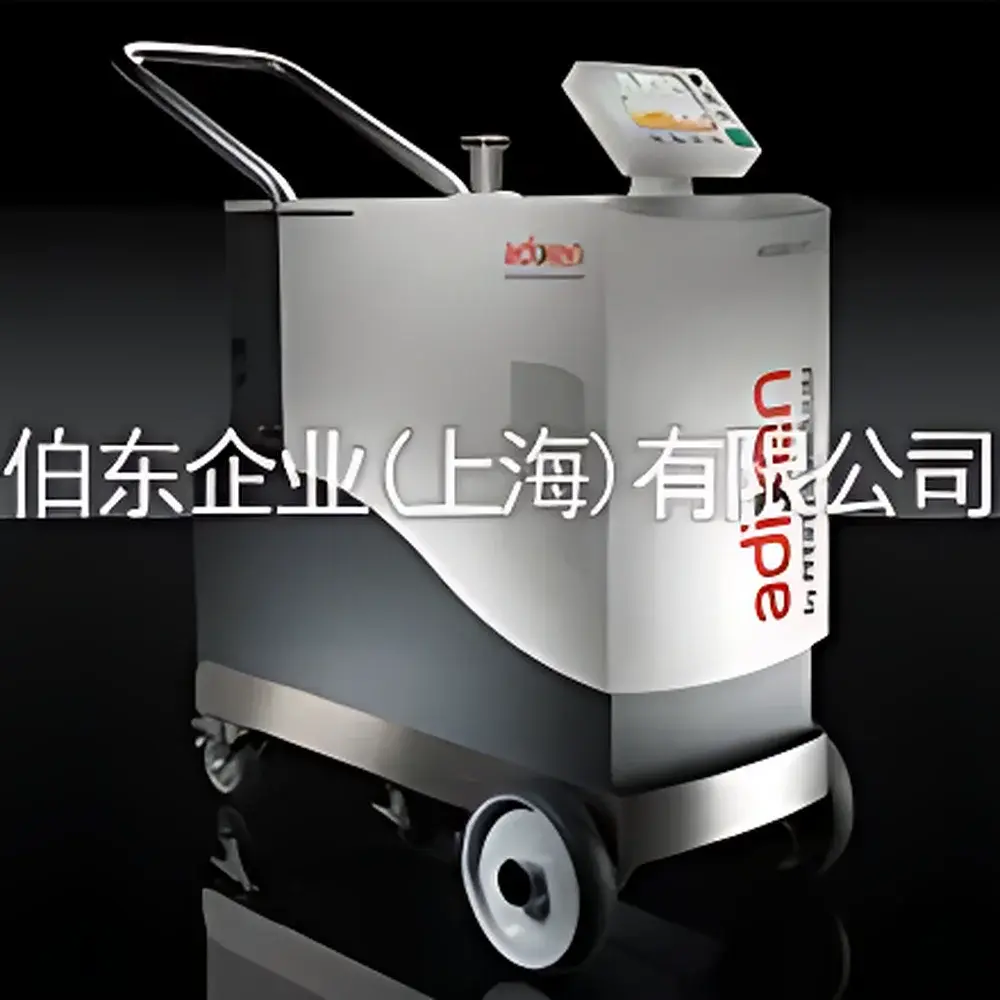
Pfeiffer ASM 380 Mobile Helium Mass Spectrometer Leak Detector
| Brand | Pfeiffer Vacuum |
|---|---|
| Origin | France |
| Model | ASM 380 |
| Helium Detection Limit (Vacuum Mode) | 5×10⁻¹³ Pa·m³/s |
| Helium Pumping Speed | 7 L/s |
| Background Pumping Speed (Forepump) | 35 m³/h |
| Maximum Inlet Pressure | 15 mbar |
| Response Time | <1 s |
| Operating Noise Level | 53 dB(A) |
| Dimensions (W×D×H) | 1065 × 455 × 1025 mm |
| Weight | 110 kg |
| Detection Gases | He, ³He, H₂ |
| Detection Modes | Vacuum Mode & Sniffer (Probe) Mode |
| Display | 360° Full-Color Touchscreen |
| Data Storage | SD Card |
| Vacuum System | ACP 40 Dry Scroll Forepump + High-Speed Turbomolecular Pump |
| I/O Options | Configurable I/O Board, Bluetooth, Wi-Fi, Ethernet |
Overview
The Pfeiffer ASM 380 Mobile Helium Mass Spectrometer Leak Detector is a high-performance, transportable analytical instrument engineered for quantitative detection and localization of minute helium leaks in vacuum and pressurized systems. Based on quadrupole mass spectrometry operating at unit mass resolution (m/z = 4), the ASM 380 selectively ionizes and separates helium atoms from background gas species using electron impact ionization and mass filtering. Its integrated turbomolecular pump—designed with industry-leading rotational speed and compression ratio—delivers exceptional helium transmission efficiency and long-term stability. Combined with the oil-free ACP 40 dry scroll forepump, the system ensures contamination-free operation critical for ultra-high-vacuum (UHV) environments and cleanroom-sensitive applications such as semiconductor fabrication and pharmaceutical equipment validation. The ASM 380 achieves a base helium detection limit of 5×10⁻¹³ Pa·m³/s in vacuum mode and 1×10⁻⁸ Pa·m³/s in sniffer mode—meeting or exceeding ISO 20484:2017 requirements for leak detector performance verification.
Key Features
- Mobile platform with reinforced chassis, oversized front casters, and low center of gravity for stable maneuverability across laboratory floors, cleanrooms, and production lines
- Dual-mode operation: vacuum-integrated testing (e.g., chamber evacuation + helium spray) and handheld sniffer probe localization
- Real-time 360° full-color touchscreen interface with intuitive graphical navigation, customizable alarm thresholds, and multi-language support
- Automatic internal calibration routine executed at power-on and available on-demand during standby—no external reference gas required
- Low-noise design (53 dB(A)) compliant with ISO 7779 and EN ISO 4871, enabling continuous operation in acoustically sensitive QC labs
- Robust filament architecture and optimized turbomolecular pump bearings ensure extended service intervals and reduced total cost of ownership
- Modular I/O architecture supporting optional Bluetooth 5.0, IEEE 802.11n Wi-Fi, 10/100BASE-T Ethernet, and configurable digital/analog I/O board for PLC integration
Sample Compatibility & Compliance
The ASM 380 is validated for use across diverse sample geometries and pressure regimes—from sealed microelectronic packages (10 m³). It complies with key international standards including ASTM E493 (Standard Practice for Leak Detection Using Helium Mass Spectrometry), ISO 10110-7 (Optics and photonics – Preparation of drawings for optical elements), and EU Machinery Directive 2006/42/EC. For regulated industries, its firmware supports audit-trail-enabled operation per FDA 21 CFR Part 11 when paired with compliant data acquisition software. All electrical components meet CE, UL 61010-1, and RoHS 3 directives. The helium-specific detection pathway eliminates cross-sensitivity to hydrogen or water vapor—critical for GLP/GMP-compliant validation protocols in pharmaceutical and medical device manufacturing.
Software & Data Management
Data logging is performed internally via removable industrial-grade SD card (up to 32 GB), capturing timestamped leak rate values, system status flags, pump temperatures, and calibration history. Optional Pfeiffer Vacuum Control Software (PVCS) enables remote monitoring, script-based automated test sequences, and export to CSV, XML, or PDF formats compatible with LIMS and MES platforms. Each measurement record includes embedded metadata (operator ID, test ID, environmental conditions) to satisfy traceability requirements under ISO/IEC 17025. Firmware updates are delivered via secure HTTPS channel with SHA-256 signature verification. No cloud dependency is required for core functionality—ensuring data sovereignty and network isolation where mandated.
Applications
- Semiconductor: Wafer handling chambers, ALD/CVD reactor seals, vacuum load locks, and reticle storage cabinets
- Photovoltaics: Encapsulant integrity verification of PERC and TOPCon solar cells; edge seal inspection of thin-film modules
- Aerospace: Cryogenic propellant line welds, satellite thermal vacuum chamber integrity, and composite pressure vessel certification
- Medical Devices: Hermeticity testing of implantable electronics (pacemakers, neurostimulators), sterilization trays, and drug delivery pumps
- Automotive: EV battery module housings, HVAC evaporator cores, and fuel cell stack gasket assemblies
- Research Infrastructure: Particle accelerator beamline flanges, synchrotron end-station vacuum manifolds, and fusion experiment diagnostic ports
- Industrial Vacuum Systems: Diffusion pump oil contamination screening, gate valve seat leakage mapping, and flexible bellows fatigue assessment
FAQ
What vacuum level is required before initiating a vacuum-mode leak test?
A base pressure ≤1×10⁻² mbar is recommended prior to helium introduction to ensure optimal signal-to-noise ratio and minimize residual gas interference.
Can the ASM 380 detect gases other than helium?
Yes—it supports detection of deuterium (m/z = 2), hydrogen (m/z = 2, overlapping), and helium-3 (m/z = 3) with appropriate tuning; however, helium remains the primary calibrated species per ISO 20484.
Is the ACP 40 forepump serviceable in the field?
Yes—the scroll pump features user-replaceable wear parts (scroll sets, inlet filters) with documented procedures and no specialized tools required.
Does the system support integration into automated production lines?
Yes—via configurable digital I/O (TTL/24 V), Modbus TCP, or EtherNet/IP protocols, enabling synchronization with robotic handlers and PLC-controlled helium spray nozzles.
How often does the turbomolecular pump require maintenance?
Under typical usage (≤8 h/day, clean environment), bearing inspection is recommended every 20,000 hours; full overhaul intervals exceed 40,000 hours per manufacturer specifications.





