
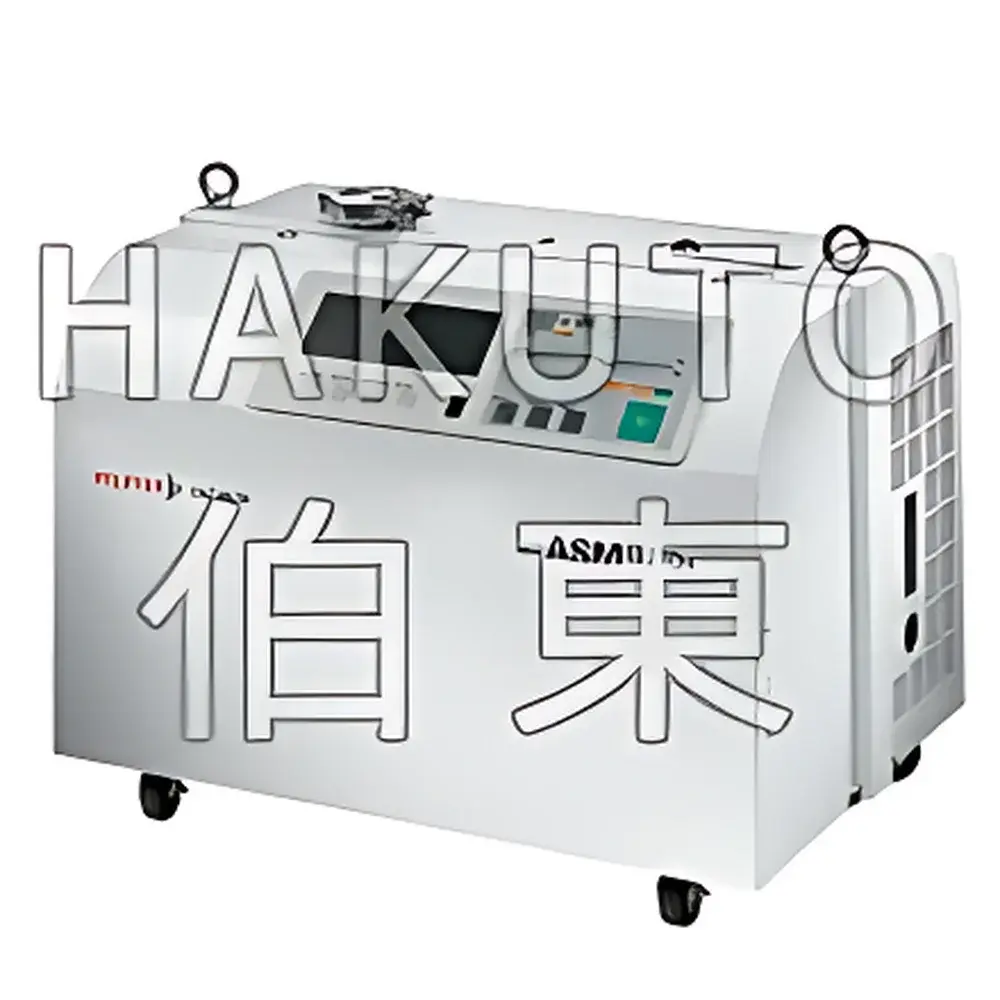
Pfeiffer Vacuum ASM 182 Helium Mass Spectrometer Leak Detector
| Brand | Pfeiffer Vacuum |
|---|---|
| Origin | France |
| Model | ASM 182 T / ASM 182 TD+ |
| Forevacuum Pump Speed | 20–25 m³/h (oil-sealed or dry scroll) |
| Helium Throughput | 4.4 L/s |
| Minimum Detectable Leak Rate (He) | 5×10⁻¹³ Pa·m³/s (vacuum mode), 1×10⁻⁸ Pa·m³/s (sniffer mode) |
| Inlet Flange | DN 40 ISO-KF |
| Max Inlet Pressure | 6 hPa |
| Power Supply | 200–240 V, 50/60 Hz (also available 110–130 V variants) |
| Warm-up Time | ≤4 min |
| Weight | 76–88 kg |
| Dimensions (L×W×H) | 594×434×444 mm (T) / 601×487×456 mm (TD+) |
Overview
The Pfeiffer Vacuum ASM 182 is a high-performance helium mass spectrometer leak detector engineered for precision vacuum integrity verification across demanding industrial and R&D environments. Operating on the principle of magnetic sector mass spectrometry, it selectively ionizes and separates helium atoms (mass-to-charge ratio m/z = 4) from background gas molecules, enabling detection of helium tracer gas at sub-attomole levels. Its dual-mode architecture supports both vacuum-integrated testing (hard-line connection to evacuated test objects) and localized sniffer-mode inspection—making it uniquely suited for production line integration, field service, and laboratory-grade QA/QC validation. Designed and manufactured in France under strict ISO 9001-certified processes, the ASM 182 series delivers metrological traceability, long-term signal stability, and immunity to common process interferences such as water vapor, hydrocarbons, or nitrogen fluctuations.
Key Features
- Two configuration variants: ASM 182 T (oil-sealed forepump, 20 m³/h) and ASM 182 TD+ (dry scroll forepump, 25 m³/h), offering flexibility for oil-sensitive or cleanroom applications.
- High helium throughput of 4.4 L/s ensures rapid response time and low detection limits—even when evaluating large-volume components (e.g., heat exchangers, vacuum chambers, or aerospace fuel systems).
- Ultra-low background signal (<1×10⁻¹³ Pa·m³/s equivalent helium) combined with fast signal recovery (<1 s rise time) enables repeatable quantification of minute leaks without drift or hysteresis.
- Foldable front and rear access panels simplify maintenance, calibration, and sensor replacement—reducing mean time to repair (MTTR) and supporting GLP/GMP-compliant service records.
- Robust mechanical design with vibration-damped internal mounting, IP20-rated enclosure, and reinforced aluminum chassis ensures operational reliability in factory-floor environments with ambient temperature swings (15–35 °C) and electromagnetic noise.
- Standard DN 40 ISO-KF inlet port allows direct integration with existing vacuum manifolds, custom test fixtures, or automated handling systems via ISO-standard flanges and sealing protocols.
Sample Compatibility & Compliance
The ASM 182 is compatible with a broad spectrum of test object geometries—from microelectronic packages and optical passive components (e.g., isolators, circulators) to large-scale vacuum vessels, welded piping assemblies, and hermetically sealed sensors. It meets critical industry requirements including ASTM E493 (Standard Practice for Leak Testing), ISO 10648-2 (Leak Detection – Vocabulary and Classification), and EN 1330-8 (Non-destructive Testing – Leak Testing). When operated in accordance with validated SOPs and calibrated using certified helium standards (e.g., NIST-traceable leak standards), data generated by the ASM 182 satisfies regulatory expectations for audit trails under FDA 21 CFR Part 11 (when paired with compliant software), EU Annex 11, and ICH Q9 quality risk management frameworks.
Software & Data Management
The ASM 182 TD+ variant includes an integrated graphical user interface (GUI) with multilingual support (English, German, French, Japanese, Chinese), real-time trend plotting, and configurable alarm thresholds. All models support RS-232, USB, and optional Ethernet connectivity for integration into SCADA, MES, or LabVantage platforms. Raw spectral data, leak rate logs, timestamped event markers, and pump status parameters are exportable in CSV or XML format. Optional Pfeiffer Vacuum HiPace Control Suite enables remote diagnostics, firmware updates, and synchronized multi-instrument monitoring—facilitating centralized fleet management across distributed manufacturing sites.
Applications
- Aerospace: Verification of propulsion system welds, cryogenic tank integrity, and avionics housing seals.
- Automotive: Testing of EV battery enclosures, fuel rail assemblies, brake vacuum boosters, and HVAC evaporator cores.
- Electronics: Hermeticity validation of MEMS devices, laser diode housings, fiber optic couplers, and RF shielding cans.
- Energy & Industrial: Inspection of heat exchanger tubesheets, nuclear coolant loop components, and semiconductor process chamber gaskets.
- Medical Devices: Final QC of implantable device housings (e.g., pacemakers, neurostimulators) per ISO 11607 and AAMI TIR17.
- Research Infrastructure: Leak checking of ultra-high vacuum beamlines, synchrotron end stations, and fusion reactor diagnostic ports.
FAQ
What is the difference between ASM 182 T and ASM 182 TD+?
The ASM 182 T uses an oil-sealed rotary vane forepump (20 m³/h), while the TD+ integrates a dry scroll forepump (25 m³/h) for oil-free operation—critical where hydrocarbon contamination must be avoided.
Can the ASM 182 detect leaks in pressurized systems?
Yes—using sniffer probe mode, it detects helium escaping from pressurized test objects at ambient pressure; sensitivity is optimized for leak rates ≥1×10⁻⁸ Pa·m³/s in this configuration.
Is calibration traceable to national standards?
All factory calibrations are performed using NIST-traceable helium permeation standards; users may perform interval verification with certified reference leaks meeting ISO 20485 specifications.
Does the instrument support automated pass/fail reporting?
Yes—via digital I/O signals and configurable limit logic, the ASM 182 can trigger external PLCs or reject mechanisms upon threshold violation, enabling full inline 100% inspection.
What maintenance intervals are recommended?
Forepump oil change every 3,000 operating hours (T model); dry scroll pump requires no routine lubrication (TD+); mass spectrometer filament replacement typically occurs after 10,000 hours of cumulative operation.




