
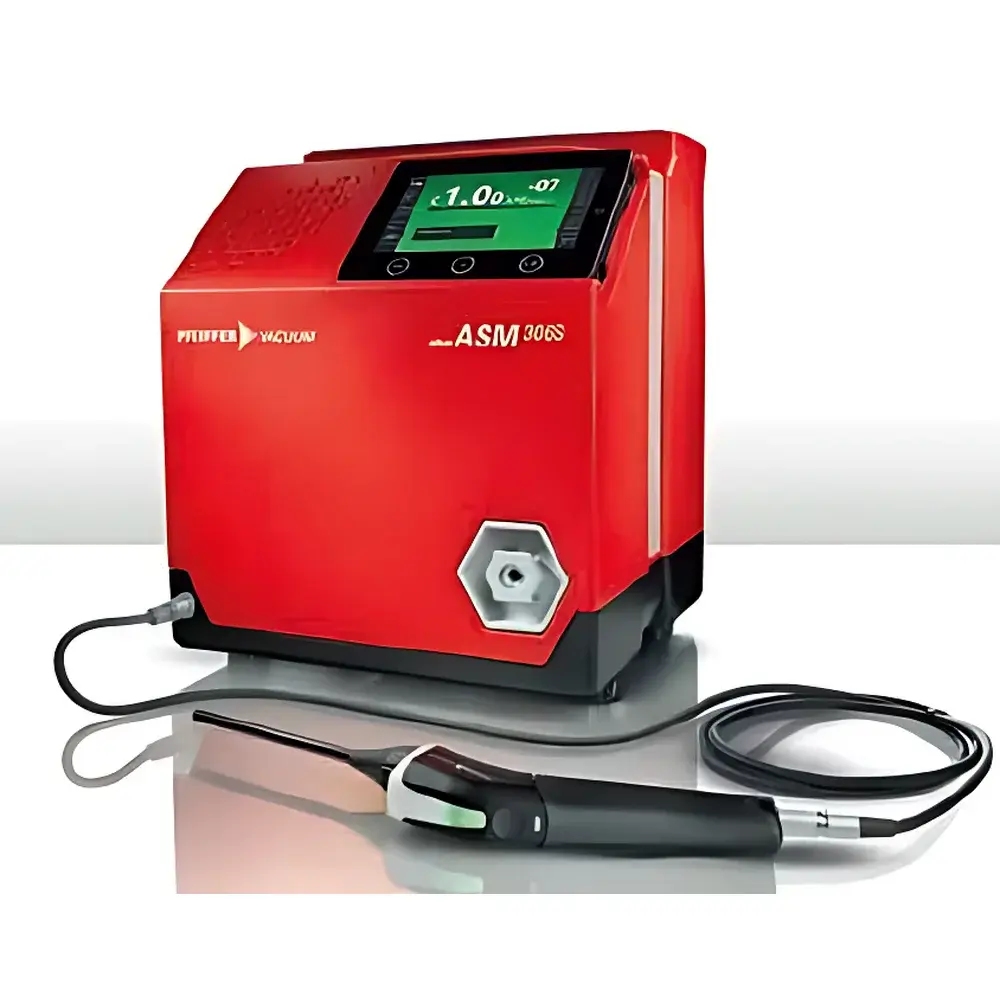
Pfeiffer Vacuum ASM306S Helium/Hydrogen Dual-Gas Sniffer Leak Detector
| Brand | Pfeiffer Vacuum |
|---|---|
| Origin | France |
| Model | ASM306S |
| Minimum Detectable Leak Rate (He) | 1×10⁻⁷ mbar·L/s |
| Minimum Detectable Leak Rate (H₂) | 5×10⁻⁷ mbar·L/s |
| Startup Time | 2 min |
| Response Time | < 1 s |
| Sniffer Probe Flow Rate | 300 sccm ± 10% |
| Noise Level | 55 dB(A) |
| Interfaces | RS-232, I/O, Fieldbus options (optional Ethernet) |
| Operating Temperature | 10–40 °C |
| Power Supply | 100–240 V, 50/60 Hz |
| Power Consumption | 300 VA |
| Weight | 22 kg |
| Dimensions (L×W×H) | 350 × 305 × 421 mm |
Overview
The Pfeiffer Vacuum ASM306S is a high-performance, dual-gas sniffer-type leak detector engineered for precision quantitative and qualitative leak assessment in industrial production, quality assurance, and maintenance environments. Based on quadrupole mass spectrometry (QMS) technology, it simultaneously detects helium (⁴He) and hydrogen (H₂) tracer gases—enabling flexible gas selection without hardware modification. Its core detection principle relies on ionization of tracer gas molecules in the ion source, mass separation via a radiofrequency-driven quadrupole filter, and selective amplification of target ions at mass-to-charge ratios of m/z = 4 (helium) or m/z = 2 (hydrogen). This architecture delivers stable sensitivity down to 1×10⁻⁷ mbar·L/s for helium and 5×10⁻⁷ mbar·L/s for hydrogen under optimized, degassed conditions—meeting stringent requirements for vacuum integrity verification across sealed systems such as refrigeration circuits, heat exchangers, and pressurized fluid components.
Key Features
- True dual-gas capability: seamless switching between helium and hydrogen detection modes via software configuration—no recalibration or hardware change required.
- Ergonomic high-flow sniffer probe: designed for operator comfort during extended manual scanning; available in multiple lengths (standard and extended variants) with hydrophobic filtration to minimize interference from ambient moisture and particulate contamination.
- Rapid system readiness: full operational status achieved within 2 minutes after power-on, minimizing downtime during shift changes or line reconfiguration.
- Sub-second response time (<1 s): enables real-time feedback during dynamic scanning, critical for identifying localized leaks in complex geometries or moving assemblies.
- Compact footprint and lightweight chassis (22 kg): facilitates integration into automated test stations, mobile QA carts, or confined service areas without structural reinforcement.
- Intuitive 7-inch capacitive touchscreen interface: supports multilingual menu navigation, customizable measurement units, and context-sensitive help—reducing operator training time and error rates.
Sample Compatibility & Compliance
The ASM306S is compatible with standard industrial tracer gases supplied via regulated cylinders or integrated gas delivery modules. It complies with IEC 61000-6-2 (electromagnetic immunity) and IEC 61000-6-4 (emission standards), and its electrical safety design conforms to IEC 61010-1 for laboratory and industrial equipment. While not certified as a medical device or intrinsically safe instrument, its operation adheres to ISO 10859 (leak detection terminology and methodology) and supports traceability frameworks aligned with ISO/IEC 17025 accredited testing laboratories. For regulated manufacturing (e.g., HVAC-R component production), audit-ready data export and configurable user access levels support GLP/GMP documentation practices.
Software & Data Management
The embedded firmware supports direct data logging to internal memory (up to 10,000 test records) with timestamp, operator ID, and environmental parameters (ambient temperature, pressure). Optional Ethernet and fieldbus interfaces enable integration with MES/SCADA platforms for real-time pass/fail reporting and SPC charting. Export formats include CSV and XML for post-processing in statistical analysis tools. The system maintains an immutable audit trail of all calibration events, parameter modifications, and user logins—fully compliant with FDA 21 CFR Part 11 requirements when deployed with validated IT infrastructure and electronic signature protocols.
Applications
- Refrigeration and air-conditioning (RAC) manufacturing: leak verification of compressors, evaporators, condensers, and capillary tubing prior to charge.
- Automotive thermal management systems: validation of EV battery cooling plates, HVAC manifolds, and refrigerant lines.
- Industrial gas handling: integrity testing of valves, regulators, pressure vessels, and cryogenic transfer lines.
- Energy infrastructure: inspection of heat exchanger tube sheets, expansion tanks, and solar thermal absorber panels.
- Electronics packaging: hermeticity screening of MEMS enclosures, laser diode housings, and sensor modules where hydrogen offers cost-effective alternative to helium.
FAQ
What tracer gases does the ASM306S support?
Helium (⁴He) and hydrogen (H₂) are fully supported through identical hardware and software pathways—no additional sensors or consumables required.
Is hydrogen detection quantitatively equivalent to helium detection?
Hydrogen provides comparable spatial resolution but exhibits slightly lower sensitivity (5×10⁻⁷ mbar·L/s vs. 1×10⁻⁷ mbar·L/s for He) due to background signal interference; however, its low cost and non-asphyxiating nature make it suitable for high-volume production screening.
Can the ASM306S be integrated into an automated test cell?
Yes—via optional I/O expansion boards (RSAS00A2MM9A) or Ethernet-enabled variants (RSAS00A4MM9A), enabling PLC-triggered start/stop, analog output of leak rate, and digital pass/fail signals.
Does the instrument require periodic calibration with certified leak standards?
Annual verification using NIST-traceable calibrated leaks is recommended per ISO 9001 and internal QA procedures; factory calibration certificates are provided with each unit.
What environmental conditions affect measurement stability?
Ambient temperature fluctuations >±2 °C/min or relative humidity >85% may induce baseline drift; operation within 10–40 °C and <70% RH ensures optimal repeatability.





