
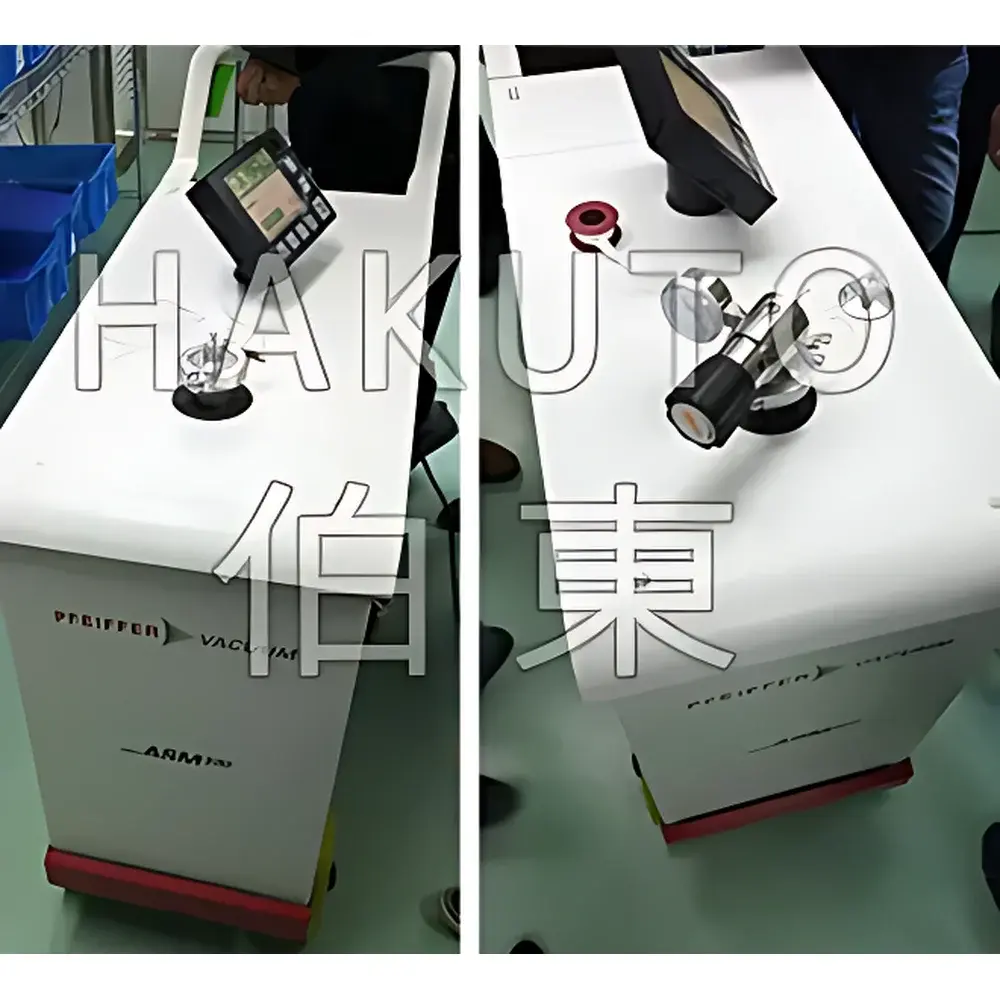
Pfeiffer Vacuum ASM390 Mobile Helium Mass Spectrometer Leak Detector
| Brand | Pfeiffer Vacuum |
|---|---|
| Origin | France |
| Model | ASM390 |
| Minimum Detectable Leak Rate (Vacuum Mode) | 1×10⁻¹² mbar·L/s |
| Minimum Detectable Leak Rate (Sniffer Mode) | 1×10⁻⁸ mbar·L/s |
| Helium Pumping Speed | 10 L/s |
| Forepump Type | Dry, Non-Contact Scroll Pump |
| Forepump Speed | 35 m³/h |
| Detectable Gases | ⁴He, ³He, H₂ |
| Compliance | Designed for Semiconductor Industry Vacuum Integrity Requirements |
Overview
The Pfeiffer Vacuum ASM390 is a mobile helium mass spectrometer leak detector engineered for high-sensitivity, quantitative leak detection in critical vacuum and pressurized systems. It operates on the principle of magnetic sector mass spectrometry, selectively ionizing and separating helium atoms (mass-to-charge ratio m/z = 4) from background gases with high mass resolution and low background interference. In vacuum mode—where the test object is evacuated and connected directly to the instrument’s inlet—the ASM390 achieves a minimum detectable leak rate of 1×10⁻¹² mbar·L/s, enabling verification of ultra-high-integrity components such as pressure regulators used in semiconductor gas delivery systems. Its compact, integrated architecture combines a dry scroll forepump and a turbomolecular pump, eliminating oil contamination risks and ensuring compatibility with cleanroom environments and ISO Class 5–7 facilities.
Key Features
- Integrated dry scroll forepump (35 m³/h) and turbomolecular pump—no oil vapor backstreaming, suitable for UHV-compatible applications and GMP-compliant manufacturing lines
- Dual-mode operation: high-sensitivity vacuum mode (1×10⁻¹² mbar·L/s) and flexible sniffer mode (1×10⁻⁸ mbar·L/s) for localized leak pinpointing
- Real-time helium-specific detection with 10 L/s pumping speed at the mass filter—optimized signal-to-noise ratio for trace helium quantification
- Rugged, mobile chassis with ergonomic handle and casters—designed for deployment across fab tool qualification, R&D labs, and production line QC stations
- Embedded microcontroller with intuitive touchscreen interface—supports user-defined alarm thresholds, automatic zero calibration, and leak rate trend logging
- Modular I/O architecture—RS232, Ethernet, and digital I/O ports enable seamless integration into PLC-controlled test cells or automated leak testing stations
Sample Compatibility & Compliance
The ASM390 is routinely deployed for leak verification of stainless steel pressure regulators, valves, manifolds, and gas distribution components in semiconductor fabrication environments where helium leak rates must not exceed 1×10⁻⁸ mbar·L/s per component (per SEMI F20-0212 and ISO 10892-1). Its dry pumping system ensures compliance with ASTM E1776–21 (Standard Practice for Helium Mass Spectrometer Leak Testing) and supports GLP/GMP audit requirements through configurable data logging and operator access control. The instrument meets CE marking directives (2014/30/EU EMC, 2014/35/EU LVD), and its vacuum integrity design aligns with ISO 20483:2017 (leak testing terminology and methodology). No external cooling or compressed air supply is required—operational autonomy simplifies validation under FDA 21 CFR Part 11–compliant workflows when paired with compliant software platforms.
Software & Data Management
The ASM390 runs embedded firmware supporting time-stamped, tamper-resistant measurement records—including leak rate value, timestamp, operator ID (via optional RFID badge reader), and pump status. Raw spectral data and calibration logs are exportable via USB or network transfer in CSV format. When interfaced with third-party SCADA or MES systems (e.g., Siemens SIMATIC, Rockwell FactoryTalk), the device transmits pass/fail signals and quantitative results via Modbus TCP or OPC UA. Audit trail functionality—including parameter change history and calibration event logging—is enabled by default, satisfying ALCOA+ (Attributable, Legible, Contemporaneous, Original, Accurate, Complete, Consistent, Enduring, Available) principles for regulated industries.
Applications
- Pressure regulator qualification for semiconductor process gas lines—verifying hermeticity of diaphragms, seat seals, and body welds under simulated service conditions
- In-line leak screening of stainless steel tubing, VCR fittings, and isolation valves prior to chamber installation
- Failure analysis of flow controllers and MFC housings—localizing micro-leaks at brazed joints or ceramic-metal feedthroughs
- Validation of vacuum chamber door seals and flange gasket integrity in etch, deposition, and metrology tools
- Supporting ISO 13485-certified medical gas equipment manufacturing—quantifying helium ingress in pressure-reducing assemblies for oxygen and nitrous oxide systems
- Research-grade leak mapping in cryogenic and ultra-high-purity gas handling systems where hydrogen (m/z = 2) cross-detection capability provides auxiliary diagnostic insight
FAQ
What leak detection sensitivity is achievable in vacuum mode?
The ASM390 delivers a verified minimum detectable leak rate of 1×10⁻¹² mbar·L/s when operated in vacuum mode with optimal pumping configuration and helium background suppression.
Can the ASM390 be integrated into an automated production test cell?
Yes—its digital I/O, Modbus TCP, and Ethernet interfaces support direct integration with PLCs, robotic handlers, and MES systems for fully automated pass/fail decision logic and SPC data capture.
Is the instrument suitable for cleanroom use?
Yes—the oil-free dry scroll forepump and sealed turbomolecular pump eliminate hydrocarbon contamination risk, meeting ISO 14644-1 Class 5 particulate requirements when installed with appropriate vibration isolation.
Does the ASM390 require periodic recalibration against certified helium standards?
Calibration verification using NIST-traceable helium permeation standards is recommended every 6 months or after 500 operational hours, per ASTM E1776–21 Section 7.3.
How does the ASM390 compare to traditional pressure decay or bubble testing methods?
Unlike non-quantitative methods, the ASM390 provides absolute leak rate values with spatial localization, eliminates false positives from temperature drift or seal swelling, and enables root-cause analysis through repeatable, traceable measurements.




