
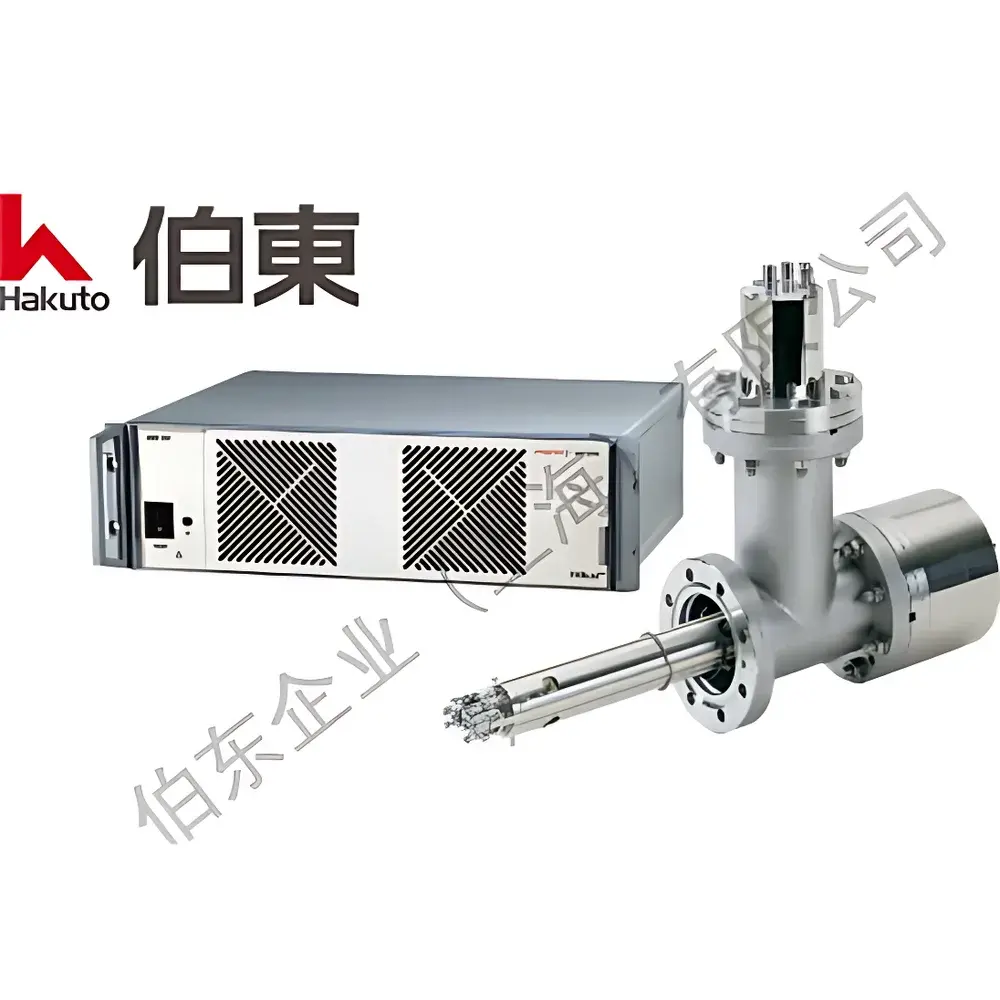
Pfeiffer Vacuum HiQuad™ Process Mass Spectrometer
| Brand | Pfeiffer Vacuum |
|---|---|
| Origin | Germany |
| Model | HiQuad™ |
| Measurement Principle | Quadrupole mass spectrometry with electron ionization (EI), optimized for real-time, high-speed quantitative gas analysis in industrial process environments |
| Mass Range | 1–128 u, 1–300 u, or 1–512 u (configurable per QMA analyzer variant) |
| Minimum Detectable Partial Pressure | 5×10⁻¹⁶ mbar (QMA 410), 2×10⁻¹⁵ mbar (QMA 430), 1×10⁻¹⁵ mbar (Ar, QMA 400) |
| Sensitivity (Faraday, 1 mA emission) | 1×10⁻³ A/mbar (QMA 410), 2×10⁻⁴ A/mbar (QMA 430), 5×10⁻⁴ A/mbar (QMA 400) |
| Max. Operating Pressure (Faraday) | 1×10⁻⁴ mbar |
| Max. Operating Pressure (SEM) | 1×10⁻⁵ mbar |
| Isotopic Ratio Precision (e.g., ⁴⁰Ar/⁴¹Ar) | < 0.3 ppb SEM resolution |
| Analyzer Temperature | 150 °C (operational), 400 °C (bake-out) |
| Scan Speed | up to 125 µs per atomic mass unit |
| Long-Term Stability | < 0.1 % drift over 8 hours |
| Ion Source | Off-axis biased electron impact source with magnetic field enhancement for low background and high signal-to-noise ratio |
| Detector Options | Faraday cup and secondary electron multiplier (SEM) |
| Interface | Integrated OPC UA server and embedded web browser |
| Software | Quadera® platform for real-time data acquisition, matrix-based concentration calculation, and multi-channel calibration |
Overview
The Pfeiffer Vacuum HiQuad™ is a high-performance quadrupole process mass spectrometer engineered for continuous, real-time gas composition monitoring in demanding industrial and research environments. Based on robust electron-impact ionization (EI) and precision quadrupole mass filtering, the HiQuad™ delivers exceptional sensitivity, wide dynamic range (up to 9 orders of magnitude), and sub-second spectral acquisition—enabling precise quantification of trace and major gas species in complex mixtures. Its design emphasizes long-term operational stability (< 0.1 % intensity drift over 8 h), critical for unattended process control, leak detection, catalyst studies, and semiconductor chamber diagnostics. The system operates under ultra-high vacuum conditions and supports bake-out temperatures up to 400 °C, ensuring consistent performance in applications requiring stringent cleanliness and residual gas analysis (RGA) fidelity.
Key Features
- Modular architecture with interchangeable QMA analyzers (QMA 400, QMA 410, QMA 430) tailored to specific mass range (1–128 u, 1–300 u, or 1–512 u) and sensitivity requirements.
- Off-axis biased ion source with integrated magnetic lens, minimizing neutral noise and enhancing signal-to-background ratio—critical for detecting low-abundance isotopes such as ⁴¹Ar adjacent to dominant ⁴⁰Ar peaks.
- Field-axis ion optics and high-stability RF/DC drive electronics ensure reproducible mass resolution and mass accuracy across extended measurement campaigns.
- Ultra-fast scanning capability: acquisition speed down to 125 µs per atomic mass unit, supporting time-resolved process dynamics including rapid pressure transients and pulsed plasma events.
- Dual-detector configuration (Faraday cup + secondary electron multiplier) enables seamless transition from high-concentration bulk gas analysis to sub-ppt partial pressure detection without hardware reconfiguration.
- Embedded Linux-based controller with native OPC UA server and HTML5-compliant web interface—facilitating direct integration into SCADA, DCS, and MES platforms without external PCs.
Sample Compatibility & Compliance
The HiQuad™ is compatible with inert, reactive, and corrosive gases—including H₂, O₂, N₂, Ar, He, CO, CO₂, NH₃, HCl, and silanes—when interfaced via appropriate inlet systems (e.g., capillary, molecular leak, or pressure-reducing valves). Its stainless steel or molybdenum quadrupole rods (diameters: 8 mm or 16 mm) are chemically resistant and thermally stable under bake-out conditions. The system conforms to CE marking requirements and meets electromagnetic compatibility (EMC) standards per EN 61326-1. For regulated industries, raw data streams and calibration logs generated by Quadera® support audit-ready documentation aligned with GLP and GMP principles; full 21 CFR Part 11 compliance is achievable through optional user access control and electronic signature modules.
Software & Data Management
Quadera® is a dedicated, Windows- and web-deployable software suite providing intuitive instrument control, real-time spectral visualization, and advanced quantitative analysis. It implements matrix-based calibration algorithms that correct for cross-sensitivity between overlapping mass fragments (e.g., CO₂⁺ at m/z 44 interfering with N₂O⁺), enabling accurate concentration derivation from partial pressure measurements. All acquisitions are timestamped and stored in HDF5 format, supporting metadata embedding (process tags, operator ID, environmental conditions). Raw and processed datasets can be exported in CSV, XML, or ASCII formats for third-party statistical modeling (e.g., PCA, PLS regression) or LIMS integration. Audit trails record all parameter changes, calibration events, and user logins—ensuring traceability for quality assurance and regulatory review.
Applications
- Real-time monitoring of chemical vapor deposition (CVD) and atomic layer deposition (ALD) reactor effluents for endpoint detection and stoichiometry verification.
- Leak localization and quantification in vacuum systems using helium or hydrogen tracer gases—leveraging sub-10⁻¹⁵ mbar detection limits.
- In-situ analysis of catalytic reaction intermediates during Fischer–Tropsch synthesis, ammonia cracking, or methanol reforming.
- Residual gas analysis in accelerator beamlines, fusion test stands, and space simulation chambers where long-term baseline stability is mandatory.
- Environmental emission monitoring of stack gases, including NOₓ, SO₂, and volatile organic compounds (VOCs), when coupled with pre-concentration units.
- Pharmaceutical lyophilization cycle validation via headspace O₂ and H₂O vapor tracking under controlled pressure ramps.
FAQ
What mass ranges are supported by the HiQuad™ platform?
The HiQuad™ offers three standard analyzer configurations: QMA 410 (1–128 u), QMA 430 (1–300 u), and QMA 400 (1–512 u), each optimized for resolution, sensitivity, and scan speed within its designated range.
Can the HiQuad™ operate continuously in harsh industrial environments?
Yes—the analyzer housing, electronics, and power supply are rated for continuous operation at ambient temperatures up to 40 °C and relative humidity ≤ 80 % non-condensing; optional cooling jackets and vibration-damping mounts extend suitability for factory-floor deployment.
Is remote diagnostics and firmware updates supported?
All HiQuad™ units include an embedded Ethernet port and TLS-secured web interface, enabling secure remote access for configuration review, log retrieval, and over-the-air firmware upgrades via authenticated HTTPS sessions.
How is calibration maintained over extended periods?
Quadera® supports multi-point gas standard calibrations with automated drift correction routines; optional reference gas inlets allow periodic auto-calibration against certified mixtures (e.g., Air Liquide CertiGas®) without interrupting process measurement.
Does the system meet ISO/IEC 17025 requirements for accredited laboratories?
While the HiQuad™ itself is not a certified reference instrument, its documented uncertainty budget, traceable calibration procedures, and full data provenance capabilities enable laboratories to demonstrate metrological traceability in accordance with ISO/IEC 17025:2017 clause 7.7.
Related Products






