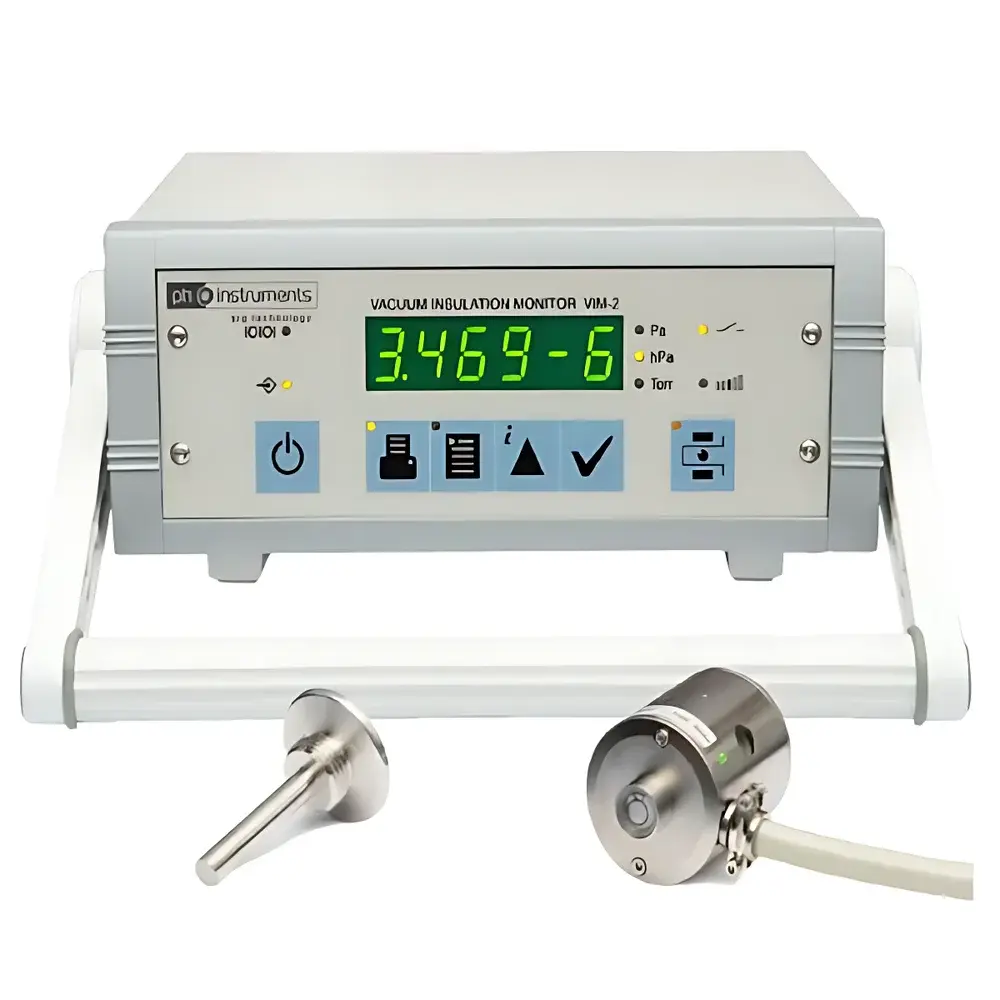
ph-instruments VIM-2 Portable Spinning Rotor Gauge
| Brand | ph-instruments |
|---|---|
| Origin | Germany |
| Model | VIM-2 Portable Spinning Rotor Gauge |
| Measurement Principle | Momentum exchange due to gas molecule adsorption/desorption |
| Range | 10 mbar to 5×10⁻⁷ mbar |
| Vacuum Interface | USB Type-C / Bluetooth / High-density 15-pin D-sub |
| Accuracy | ±10% (10 mbar – 0.1 mbar), ±1% (0.1 mbar – 1×10⁻⁶ mbar) |
| Long-term Drift | <1% per year |
| Sensor Material | Stainless steel 1.4404 / 1.4034 |
| Operating Temperature (Electronics) | 10–40 °C |
| Sensor Max Temp (Metal Seal) | 450 °C |
| Power Supply | 18–28 VDC, Li-ion battery (>2 h operation) |
| Data Storage | 1023 internal records |
| Output | 0–10 VDC (configurable) |
| Weight | Host 1650 g, Measuring Head 750 g, Adapter 510 g |
Overview
The ph-instruments VIM-2 Portable Spinning Rotor Gauge (SRG) is a field-deployable, high-stability vacuum measurement instrument engineered for absolute pressure determination in ultra-high vacuum (UHV) to rough vacuum regimes. Unlike indirect thermal or ionization-based gauges, the VIM-2 implements a primary physical measurement principle grounded in rotational dynamics: it measures the deceleration rate of a magnetically levitated steel sphere rotating at 615 Hz within a sealed sensor tube. This deceleration arises from momentum transfer between residual gas molecules and the rotor surface—adsorption at higher pressures and desorption-dominated energy loss at lower pressures (<10⁻⁷ mbar). The resulting torque is directly proportional to gas viscosity and, under controlled temperature conditions, correlates with absolute pressure via calibrated molecular drag models. Its all-metal, feedthrough-free construction eliminates outgassing pathways and electrical leakage risks inherent in Pirani or cold cathode gauges, making it suitable for critical applications where vacuum integrity must be preserved during diagnostics or long-term monitoring.
Key Features
- True portability enabled by integrated lithium-ion battery (>2 hours continuous operation) and Bluetooth 5.0 connectivity for remote control via dedicated Android/iOS application
- Ultra-wide dynamic range: 10 mbar to 5×10⁻⁷ mbar (7 Torr to 4×10⁻⁷ Torr), bridging rough, medium, high, and ultra-high vacuum domains in a single device
- Modular architecture: Sensor tube (weldable KF25/VCR/8 or custom flange) remains permanently installed; only the lightweight measuring head (750 g) is connected on-demand
- High-field magnetic suspension (90 mT) ensures stable rotor levitation and reduced sensitivity to mechanical misalignment during field installation
- Intrinsic accuracy of ±1% reading in the high-precision band (0.1–1×10⁻⁶ mbar); typical annual drift <1%—validated under GLP-aligned stability protocols
- Full metal construction (1.4404 & 1.4034 stainless steels) rated for bake-out up to 450 °C with metal seals, eliminating polymer degradation and aging effects common in ceramic or elastomer-based sensors
- Dual data logging: onboard storage for 1023 timestamped measurements + real-time streaming via USB Type-C or high-density 15-pin interface compliant with industrial SCADA systems
Sample Compatibility & Compliance
The VIM-2 is compatible with inert, reactive, and condensable gas environments typical in cryogenic insulation systems (e.g., LNG/LH₂ tank annuli), thin-film deposition chambers, particle accelerator beamlines, and vacuum-insulated panels (VIPs). Its absence of hot filaments or high-voltage electrodes prevents contamination of sensitive UHV surfaces and eliminates ignition hazards in hydrogen-rich or oxygen-enriched atmospheres. The device conforms to IEC 61000-6-2 (immunity) and IEC 61000-6-4 (emissions), and its firmware architecture supports audit-trail-enabled operation per FDA 21 CFR Part 11 requirements when integrated with validated laboratory information management systems (LIMS). Calibration traceability is maintained to national standards (PTB, NIST) through optional factory-certified calibration reports aligned with ISO/IEC 17025 procedures.
Software & Data Management
The VIM-2 operates with cross-platform desktop software (Windows 7/10/11) and a mobile application supporting real-time parameter configuration, live trend visualization, and export of CSV/Excel-compatible datasets. All measurements include embedded metadata: ambient temperature, rotor speed, integration time (user-selectable: 3/5/10/20/30 s), and automatic compensation for ambient thermal drift. Internal memory retains full measurement history with UTC timestamps and event flags (e.g., “sensor connected”, “battery low”). The 0–10 VDC analog output is programmable for pressure scaling and integrates seamlessly with PLC-based vacuum interlock systems. Firmware updates are delivered over-the-air via Bluetooth or USB, with cryptographic signature verification ensuring integrity and compliance with secure boot requirements.
Applications
- Non-invasive leak detection and vacuum integrity verification in cryogenic storage vessels without breaking vacuum
- Long-term health monitoring of vacuum-jacketed piping and superinsulated ductwork in energy infrastructure
- Calibration reference for secondary gauges (Pirani, capacitance manometers) in ISO Class 5–8 cleanroom vacuum systems
- R&D validation of outgassing rates in new materials (e.g., composites, getters, coatings) under accelerated aging conditions
- Preventive maintenance of diffusion pumps, turbomolecular pumps, and cryopanels via trend analysis of base pressure evolution
- Field verification of vacuum performance in satellite propulsion test stands and space simulation chambers
FAQ
Is the VIM-2 suitable for use in explosive atmospheres?
Yes—the sensor contains no ignition sources, uses only passive magnetic levitation, and complies with ATEX Directive 2014/34/EU Category 3G when installed with appropriate conduit and sealing methods.
Can the same measuring head be used with multiple permanently installed sensors?
Yes—the VIM-2 employs a universal readout head design compatible with all ph-instruments SRG sensor tubes, enabling cost-effective fleet deployment across large-scale infrastructure.
What correction factors are applied during measurement?
The firmware applies real-time temperature compensation and corrects for residual drag (material-dependent, dominant below 10⁻⁵ mbar) and molecular drag (pressure-proportional, ±6% uncorrected error). These are derived from factory characterization and updated via firmware patches.
How is zero-point stability ensured without periodic recalibration?
The VIM-2 does not require zeroing; its absolute measurement principle eliminates baseline drift. Annual verification against a reference standard is recommended per ISO 27874:2019 for vacuum metrology equipment.
Does the device support MODBUS RTU or other industrial protocols?
Native MODBUS RTU is available via the 15-pin interface upon request; custom protocol mapping (e.g., OPC UA) can be implemented through OEM firmware customization.