
Phasics SID4-HR High-Resolution Wavefront Sensor
| Origin | France |
|---|---|
| Manufacturer Type | Authorized Distributor |
| Origin Category | Imported |
| Model | SID4-HR |
| Pricing | Upon Request |
Overview
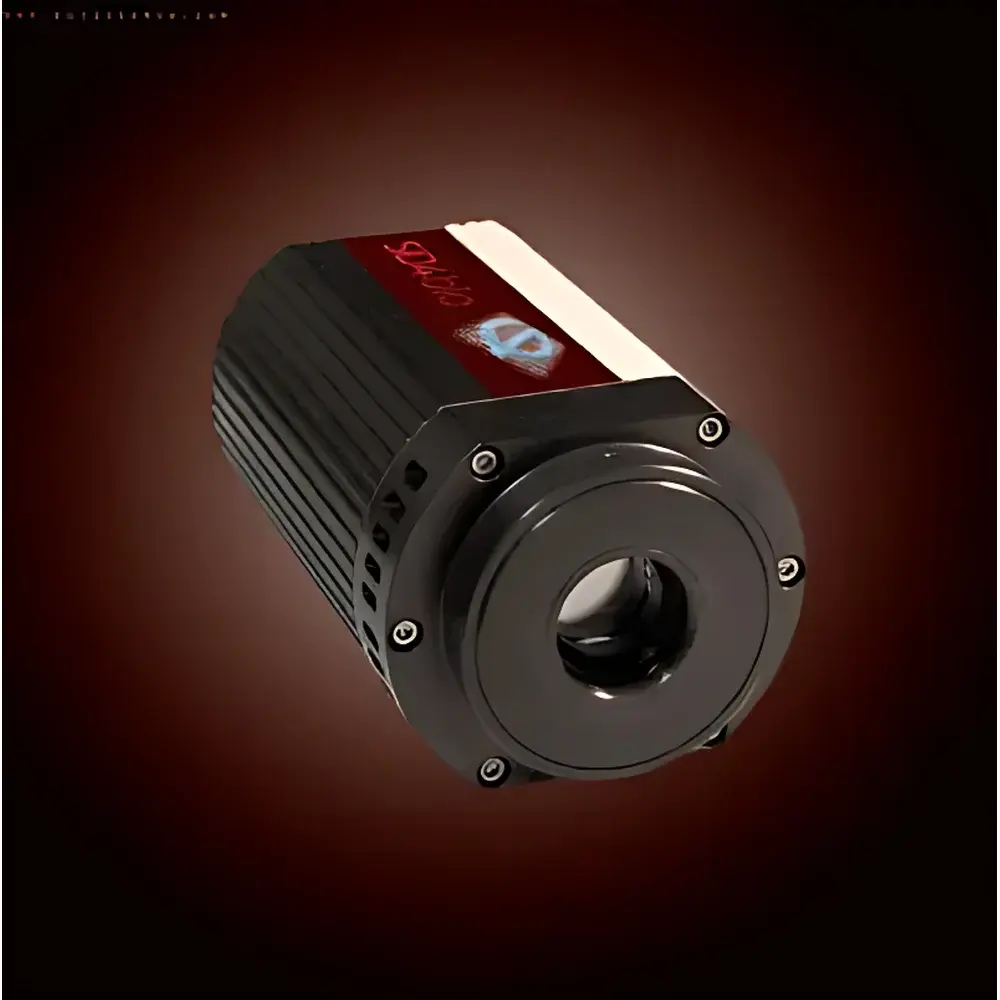
The Phasics SID4-HR is a high-resolution, quantitative wavefront sensor engineered for precision optical metrology in research, industrial R&D, and advanced manufacturing environments. It operates on the principle of **4-wave lateral shearing interferometry (4-LSI)** — a patented, non-common-path interferometric technique that directly reconstructs the optical phase map of an incident wavefront without requiring a reference beam or complex alignment. Unlike Hartmann-Shack sensors, which rely on centroid displacement of spot arrays and suffer from limited spatial resolution and dynamic range, the SID4-HR captures full-field, pixel-level phase data with intrinsic achromaticity and immunity to low-spatial-frequency noise. This enables robust, single-shot measurement of highly divergent beams (up to NA 0.75), aberrated wavefronts, and rapidly varying optical fields — all without auxiliary relay optics or beam expanders. The instrument is optimized for integration into laser characterization setups, adaptive optics loops, optical component testing stations, and in-line quality control systems for high-NA imaging optics.
Key Features
- High spatial resolution: up to 400 × 300 sampling points per frame (standard configuration: 160 × 120)
- Achromatic design: insensitive to wavelength variation across visible and near-infrared spectra (400–1100 nm), enabling broadband and multi-wavelength wavefront analysis
- Extended dynamic range: capable of measuring wavefront deviations exceeding ±100 µm PV without phase unwrapping artifacts
- High sensitivity: sub-nanometer optical path difference (OPD) detection limit under optimal illumination conditions
- Direct high-NA beam compatibility: measures strongly converging/diverging wavefronts (e.g., focused laser spots, microscope objectives) without relay lenses or collimation optics
- Compact, monolithic architecture: integrated CMOS sensor and micro-optical shear plate; no moving parts or active alignment mechanisms
- Real-time acquisition: supports frame rates up to 60 Hz at full resolution, suitable for closed-loop adaptive optics and dynamic aberration monitoring
Sample Compatibility & Compliance
The SID4-HR accommodates a wide range of optical inputs, including collimated beams, focused spots, Gaussian and multimode laser outputs, and wavefronts emerging from high-numerical-aperture (NA ≤ 0.75) optical systems such as lithographic projection lenses, ophthalmic instruments, and EUV condenser optics. Its calibration protocol follows traceable procedures aligned with ISO 10110-5 (surface form tolerances) and ISO 21248 (interferometric wavefront measurement). While not certified as a medical device, its measurement repeatability (< 0.5 nm RMS over 24 h, per internal validation report) meets GLP-aligned laboratory practice requirements. Data integrity complies with principles of FDA 21 CFR Part 11 when used with validated software configurations and audit-trail-enabled acquisition workflows.
Software & Data Management
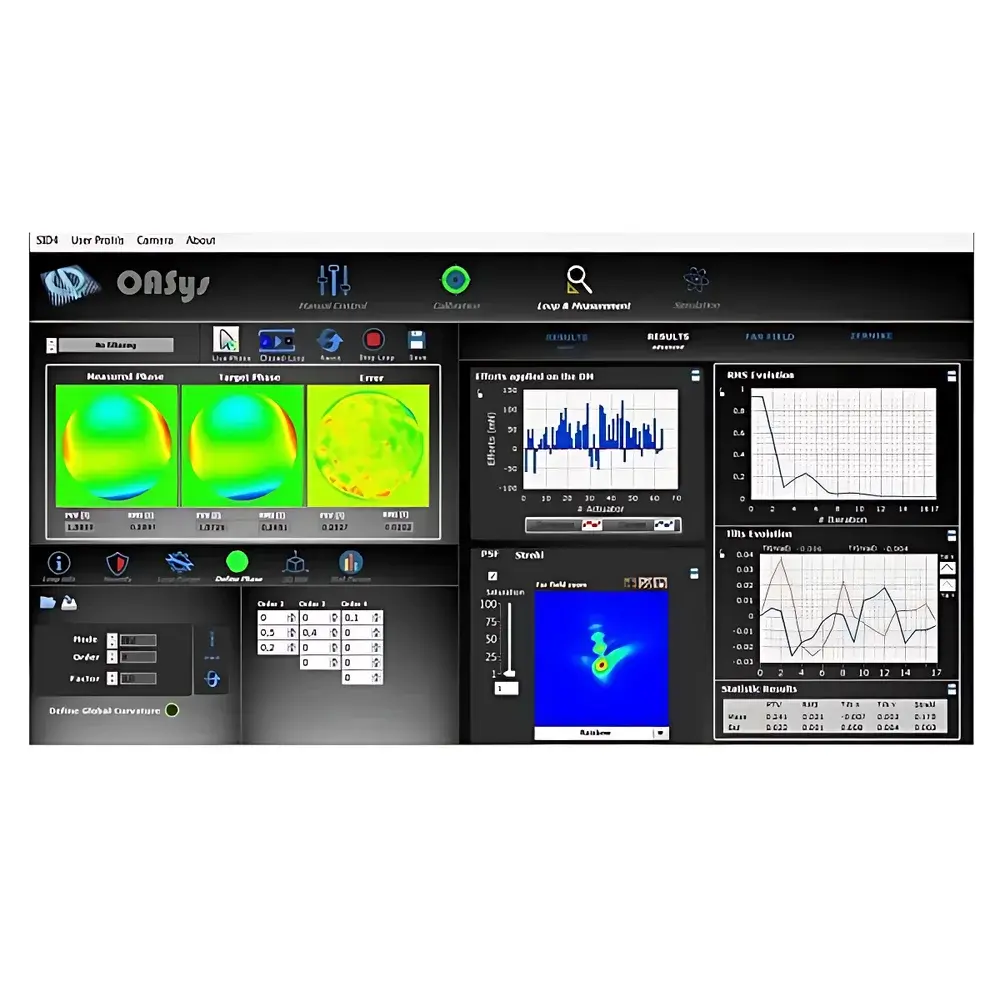
The sensor is operated via the proprietary Phasics WFS Software Suite, a Windows-based application providing real-time phase visualization, Zernike and Noll coefficient decomposition, MTF/PSF reconstruction, EFL and radius-of-curvature calculation, and aberration trend logging. Export formats include CSV, HDF5, TIFF (phase + intensity), and MATLAB-compatible .mat files. API support (C++, Python, LabVIEW) enables seamless integration with third-party control platforms (e.g., National Instruments DAQ, Thorlabs Kinesis, or custom Python-based AO controllers). All measurement sessions generate timestamped metadata logs, supporting traceability for ISO/IEC 17025-compliant calibration records and internal QA documentation.
Applications
- Laser beam quality assessment: M², BPP, Strehl ratio, and higher-order mode identification
- Optical component metrology: surface figure error mapping of mirrors, lenses, and aspheres; curvature radius verification; transmitted wavefront error (TWE) evaluation per ISO 10110-5
- Microscopy system characterization: objective PSF modeling, spherical aberration quantification in confocal and multiphoton systems
- Adaptive optics: wavefront sensing for deformable mirror control in astronomy, retinal imaging, and laser communication
- Industrial process monitoring: in-situ wavefront stability tracking during laser welding, ultrafast laser micromachining, or thin-film coating deposition
- Space optics validation: thermal and mechanical distortion analysis of lightweight segmented mirrors under vacuum and cryogenic conditions
FAQ
What is the maximum numerical aperture (NA) the SID4-HR can measure without relay optics?
The SID4-HR supports direct wavefront measurement of beams with NA up to 0.75, provided sufficient illumination uniformity and signal-to-noise ratio are maintained.
Is the sensor sensitive to polarization state?
No — the 4-wave lateral shearing interferometry principle is inherently polarization-insensitive; measurements remain stable across linear, circular, and unpolarized inputs.
Can it be used with pulsed lasers?
Yes, provided pulse energy and repetition rate fall within the CMOS sensor’s linear response range (typical minimum exposure: 10 µs; max average power density: 10 mW/mm²). Synchronization via TTL trigger input is supported.
Does the system require periodic recalibration?
A one-time factory calibration is performed per unit. Users may perform optional verification checks using a calibrated reference flat; no routine recalibration is needed under stable environmental conditions.
Is there a version compatible with vacuum or UHV environments?
The standard SID4-HR is designed for ambient operation. A custom vacuum-compatible variant (SID4-HR-VAC) with CF-flanged housing and radiation-hardened electronics is available upon request.





