
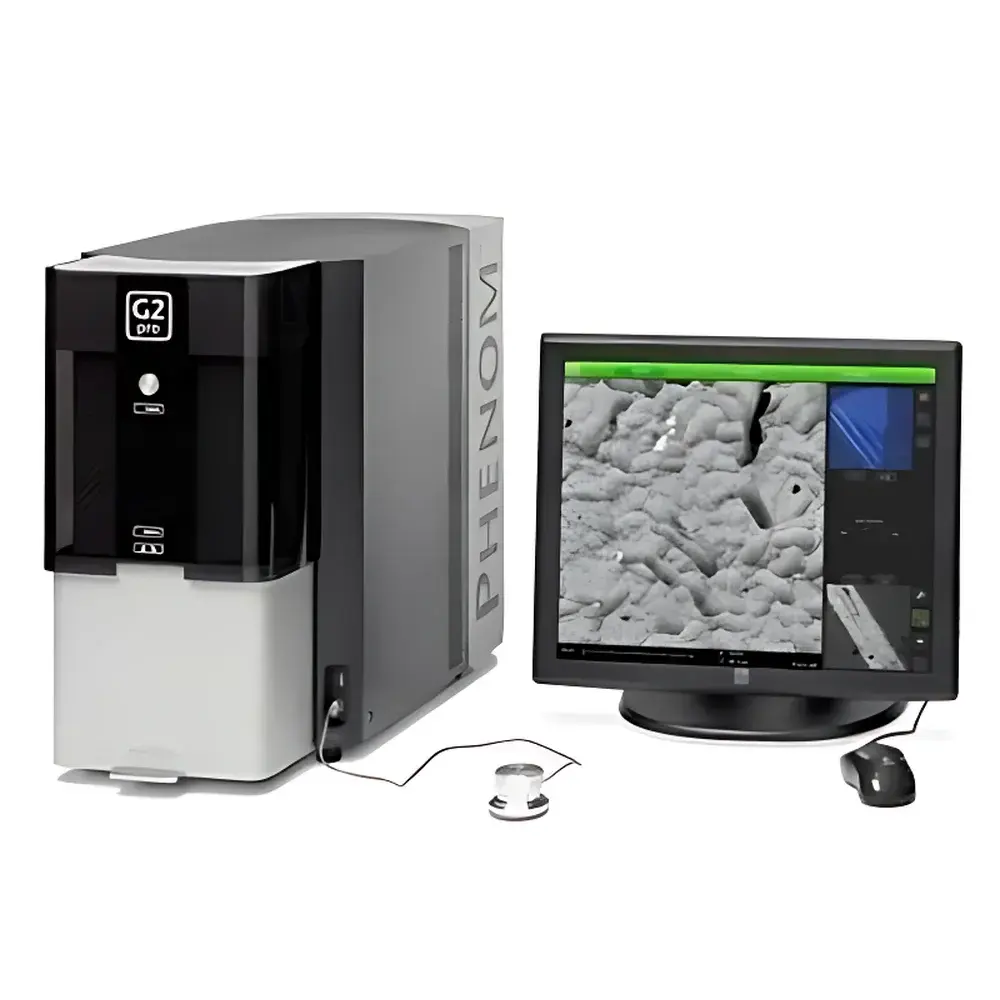
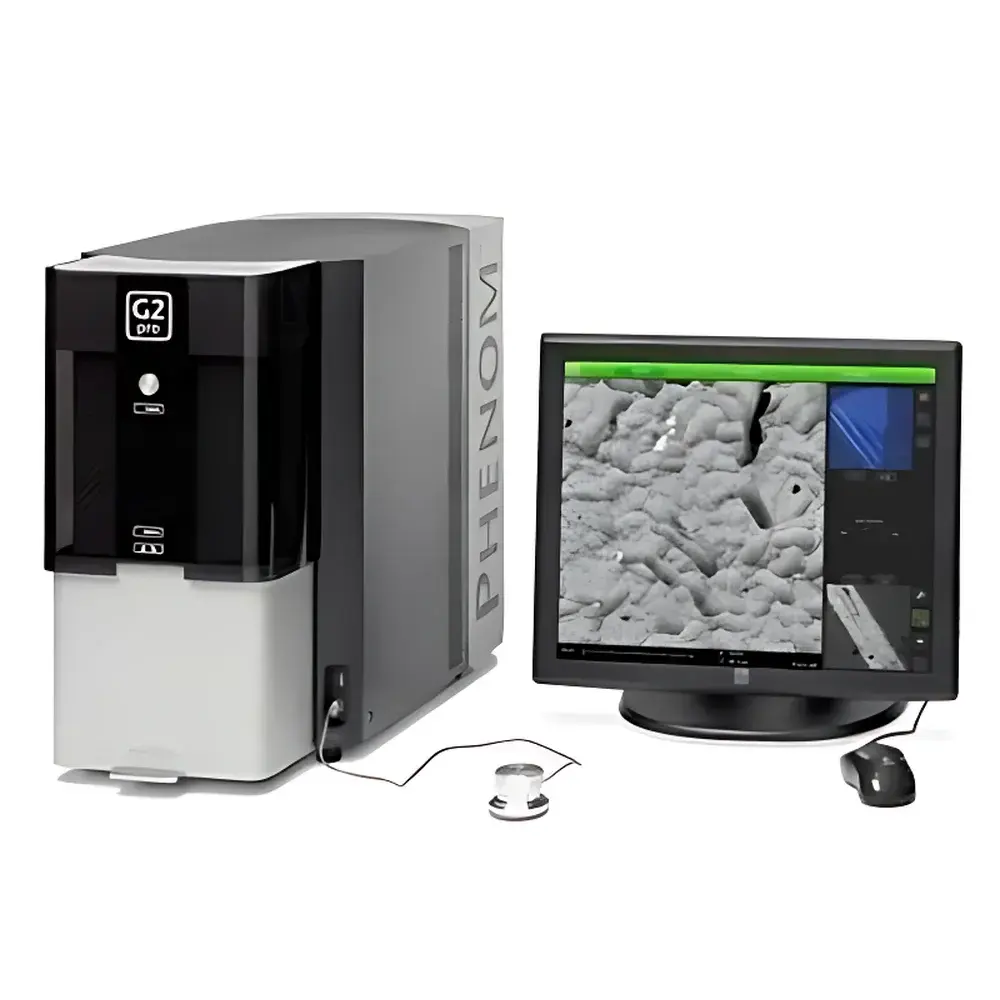
Phenom G2 Desktop Scanning Electron Microscope by Thermo Fisher Scientific (formerly FEI)
| Brand | SHNTI |
|---|---|
| Origin | Netherlands |
| Manufacturer Type | Authorized Distributor |
| Origin Category | Imported |
| Model | Phenom G2 |
| Price Range | USD 70,000–140,000 |
| Instrument Type | Benchtop SEM |
| Electron Source | Lanthanum Hexaboride (LaB₆) |
| Secondary Electron Image Resolution | ≤5.0 nm at 10 kV |
| Magnification Range | 10×–130,000× |
| Accelerating Voltage | 5–15 kV (adjustable in 1 kV steps) |
| Backscattered Electron Image Resolution | ≤7.0 nm at 10 kV |
| Maximum Sample Dimensions | 100 mm diameter × 50 mm height |
| Expandable Chamber Interface Ports | 1 (for optional EDS or cathodoluminescence modules) |
| Stage Type | Motorized XY-stage with tilt (±90°), rotation (360°), and Z-height adjustment |
Overview
The Phenom G2 Desktop Scanning Electron Microscope (SEM), developed by Thermo Fisher Scientific (formerly FEI) and distributed globally by SHNTI, is an engineered solution for rapid, high-fidelity surface imaging in routine laboratory environments. Unlike conventional floor-standing SEMs requiring dedicated rooms and extensive infrastructure, the Phenom G2 operates on standard benchtop space with integrated vacuum pumping, low-voltage electron optics, and a robust LaB₆ thermionic source. Its design leverages scanning electron microscopy principles—electron beam rastering across conductive or non-conductive specimens, detection of secondary electrons (SE) for topographic contrast and backscattered electrons (BSE) for atomic number contrast—to deliver nanoscale morphological and compositional insights without cryogenic cooling or ultra-high vacuum. The system is optimized for materials science labs, quality control facilities, geoscience departments, and failure analysis units where accessibility, throughput, and operational simplicity are prioritized alongside scientific rigor.
Key Features
- Benchtop architecture with footprint under 0.5 m²—no external vibration isolation table required; built-in active damping ensures stable imaging even on shared lab benches.
- LaB₆ electron source offering higher brightness and longer lifetime than tungsten filaments, enabling consistent signal-to-noise ratio across extended acquisition sessions.
- Low-acceleration imaging capability (5–10 kV) for enhanced surface sensitivity and reduced charging on insulating samples—eliminates routine sputter coating for polymers, ceramics, biological tissues, and composites.
- Integrated optical navigation camera and real-time electron-optical correlation—users click directly on the optical preview image to center and zoom the SEM field of view.
- Patented rapid vacuum system achieving operational pressure (<10⁻¹ Pa) in under 30 seconds via turbomolecular pump and dual-stage roughing system.
- Motorized 5-axis stage (X/Y/Z/tilt/rotation) with programmable position memory for multi-region automated imaging and sequential analysis workflows.
Sample Compatibility & Compliance
The Phenom G2 accommodates diverse specimen geometries up to 100 mm in diameter and 50 mm in height—including bulk metals, fractured cross-sections, powder dispersions on stubs, filter membranes, and uncoated biological sections. Its low-vacuum mode (10–30 Pa) enables direct imaging of hydrated or outgassing samples without prior metallization. The instrument complies with IEC 61000-6-3 (EMC emission standards) and IEC 61010-1 (safety requirements for electrical equipment). While not certified for ISO/IEC 17025 accreditation out-of-the-box, its audit-ready software logs all acquisition parameters, user actions, and system diagnostics—supporting GLP-compliant documentation when deployed in regulated QC/QA environments per ASTM E1558 and ISO 16700.
Software & Data Management
Acquisition and analysis are managed through Phenom Desktop Software—a Windows-based application supporting live imaging, automated particle analysis, elemental mapping (when paired with optional EDS), and report generation in PDF or CSV formats. All images embed EXIF-style metadata: timestamp, kV, WD, magnification, detector type, stage coordinates, and vacuum status. Audit trail functionality records operator login/logout events, parameter changes, and export actions—aligning with FDA 21 CFR Part 11 requirements when configured with electronic signatures and role-based access control. Raw data is stored in proprietary .phm format (convertible to TIFF/SEM) with lossless 16-bit depth and spatial calibration retained.
Applications
- Materials characterization: grain boundary analysis in alloys, fracture surface evaluation in composites, porosity quantification in battery electrodes.
- Life sciences: imaging of pollen morphology, diatom frustules, insect cuticle microstructures, and freeze-dried cell cultures.
- Electronics: solder joint inspection, PCB trace integrity assessment, MEMS device verification.
- Geosciences: mineral phase identification via BSE contrast, sediment particle shape analysis, volcanic ash morphology studies.
- Forensics & failure analysis: fiber comparison, gunshot residue morphology, corrosion product layer differentiation.
FAQ
Does the Phenom G2 require liquid nitrogen or external water cooling?
No—the system uses air-cooled electronics and a thermally stabilized LaB₆ source; no cryogens or chiller units are needed.
Can it be used in a standard office environment with ambient lighting and HVAC?
Yes—its electromagnetic shielding and mechanical damping eliminate sensitivity to building vibrations, power fluctuations, and ambient light interference.
Is EDS integration possible post-purchase?
Yes—the single expandable chamber interface supports OEM-compatible energy-dispersive X-ray spectrometers with plug-and-play alignment protocols.
What is the typical maintenance interval for the LaB₆ filament?
Under normal operation (≤8 h/day, 10 kV imaging), filament lifetime exceeds 1,500 hours; replacement is a field-serviceable procedure requiring <30 minutes.
How does the system ensure measurement traceability for QA reporting?
Each image includes embedded scale bars calibrated against NIST-traceable reference standards; software allows batch export of metadata for LIMS integration and internal audit trails.



