
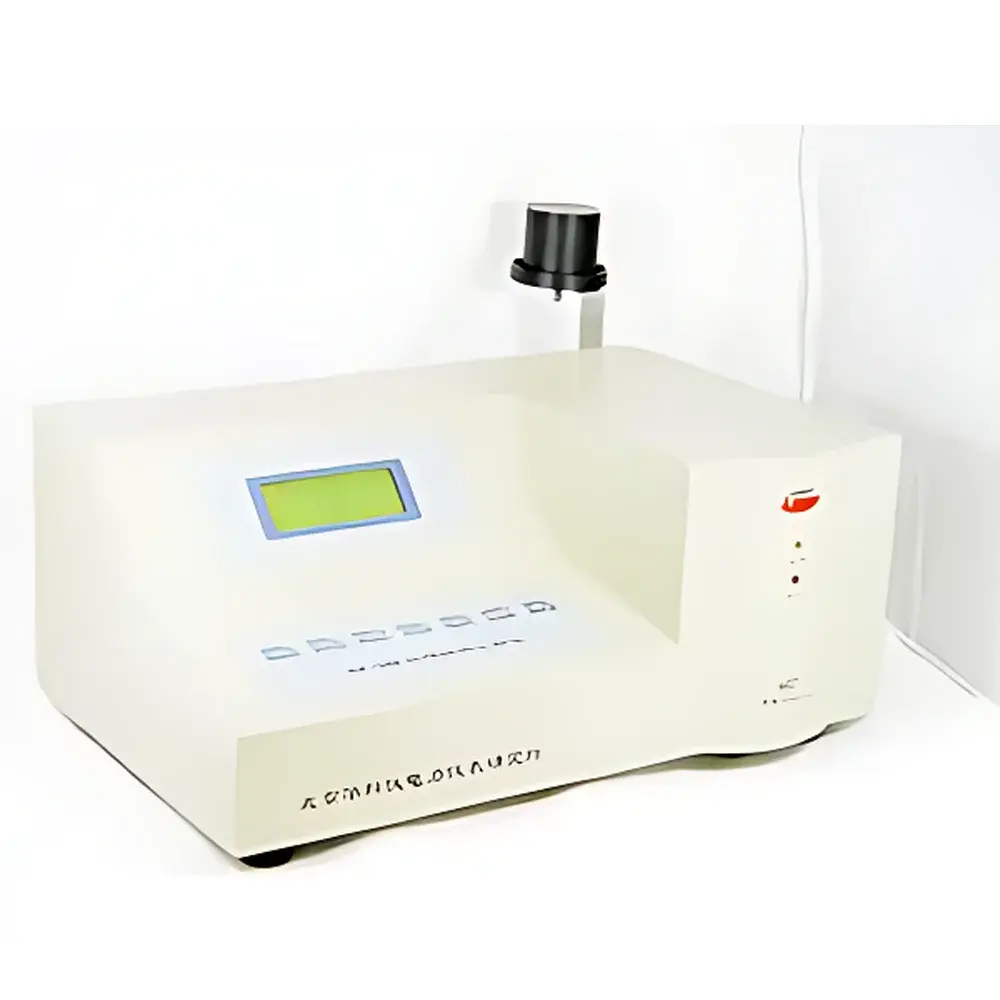
Phosphate Analyzer SENHK-208
| Origin | Beijing, China |
|---|---|
| Manufacturer Type | Authorized Distributor |
| Origin Category | Domestic (China) |
| Model | SENHK-208 |
| Pricing | Upon Request |
| Measurement Range | 0–20 mg/L or 0–50 mg/L |
| Accuracy | ≤ ±2% F.S. |
| Resolution | 0.01 mg/L |
| Repeatability | ≤ 1% |
| Stability | ≤ ±1% F.S. / 4 h |
| Operating Temperature | 5–45 °C |
| Relative Humidity | ≤ 90% RH (non-condensing) |
| Dimensions (L×W×H) | 420 × 190 × 280 mm |
| Power Supply | 198–242 VAC, 50 Hz ±1 Hz |
| Power Consumption | 30 VA |
| Weight | 5 kg |
Overview
The SENHK-208 Phosphate Analyzer is a benchtop photometric analyzer engineered for reliable, routine quantification of orthophosphate (PO₄³⁻) in water and wastewater samples. It operates on the principle of molybdenum blue colorimetry — a standardized spectrophotometric method wherein phosphate reacts with ammonium molybdate and antimony potassium tartrate under acidic conditions to form a phosphomolybdenum heteropoly acid, which is subsequently reduced to an intensely colored molybdenum blue complex. Absorbance is measured at a fixed wavelength (typically 700–880 nm), and concentration is determined via a calibrated calibration curve. Designed for laboratory, municipal, and industrial quality control environments, the SENHK-208 delivers consistent performance across its dual-range configuration (0–20 mg/L and 0–50 mg/L), meeting foundational requirements for phosphate monitoring in compliance with ISO 6878, ASTM D515-89 (Reapproved 2020), and EPA Method 365.3.
Key Features
- High-stability optical system featuring a U.S.-sourced monochromatic LED light source — optimized for narrow spectral bandwidth, low thermal drift, and extended operational lifetime without lamp replacement.
- Photodetector assembly incorporating a U.S.-manufactured silicon photodiode — delivering linear response, low dark current, and immunity to ambient light interference.
- Backlit 128×64 dot-matrix LCD with native Chinese character support — enabling intuitive menu navigation, real-time parameter display, and full-screen result visualization.
- Zero-reagent calibration protocol using deionized or distilled blank water — eliminating reagent lot variability and reducing consumable dependency while maintaining traceable baseline integrity.
- Multi-point calibration capability (up to 6 points) — supporting non-linear curve fitting (linear, quadratic, or user-defined) to improve accuracy across the full dynamic range, especially critical near detection limits and upper range boundaries.
- Role-based access control with password protection — restricting calibration, method editing, and data deletion functions to authorized personnel only, aligning with GLP documentation practices.
- Integrated data logger with six independent memory channels — storing date/time-stamped measurements, calibration records, and operator IDs for audit-ready traceability.
Sample Compatibility & Compliance
The SENHK-208 accepts standard 10–25 mL aqueous samples, including drinking water, surface water, treated effluent, boiler feedwater, and nutrient-rich process streams. Sample turbidity must be 10 mg/L. The instrument complies with IEC 61010-1:2010 safety standards for electrical equipment for measurement, control, and laboratory use. Its measurement methodology is compatible with regulatory frameworks requiring documented analytical validity, including ISO/IEC 17025:2017 clause 7.2 (method validation) and USP Analytical Instrument Qualification. While not inherently 21 CFR Part 11 compliant, audit trails and password-protected settings support alignment with GMP-aligned workflows when paired with controlled documentation procedures.
Software & Data Management
Data export is performed manually via front-panel key commands; no proprietary PC software or USB interface is included. All stored entries include timestamp, sample ID (user-entered), calibration status flag, and operator code (if assigned). The six-channel history buffer retains up to 200 entries per channel, with automatic overwrite upon capacity exhaustion. For integration into LIMS or centralized QA systems, users may transcribe results using validated SOPs — a practice commonly adopted in mid-tier environmental labs where full digital connectivity is not mandated by accreditation scope.
Applications
- Drinking water treatment plants: Monitoring residual orthophosphate post-dosing for corrosion control.
- Municipal wastewater facilities: Tracking phosphate removal efficiency across biological and tertiary treatment stages.
- Power generation: Ensuring ultra-low phosphate levels (< 0.05 mg/L) in high-purity boiler feedwater to prevent scale formation.
- Aquaculture and hydroponics: Maintaining optimal nutrient balance without eutrophication risk.
- Educational laboratories: Teaching fundamental principles of colorimetric analysis, calibration theory, and QA/QC protocols.
FAQ
Does the SENHK-208 require hazardous reagents for analysis?
No — the instrument uses a pre-formulated, stabilized reagent kit (not included) compatible with the molybdenum blue reaction. However, the zero-calibration function permits baseline verification without any reagent addition.
Can the instrument be used for total phosphorus measurement?
No — the SENHK-208 measures only orthophosphate (soluble reactive phosphorus). Total phosphorus determination requires prior persulfate or UV digestion, followed by analysis on the same platform if digestion equipment is available externally.
Is temperature compensation automated?
No — the analyzer does not incorporate built-in temperature sensing for absorbance correction. Users are advised to equilibrate samples to room temperature (20–25 °C) prior to analysis to minimize thermal effects on reaction kinetics and photometric response.
What maintenance intervals are recommended?
Optical path cleaning every 3 months using lint-free wipes and isopropyl alcohol; annual verification of calibration stability against NIST-traceable phosphate standards (e.g., SRM 3138); LED output intensity check via blank absorbance trending over time.



