
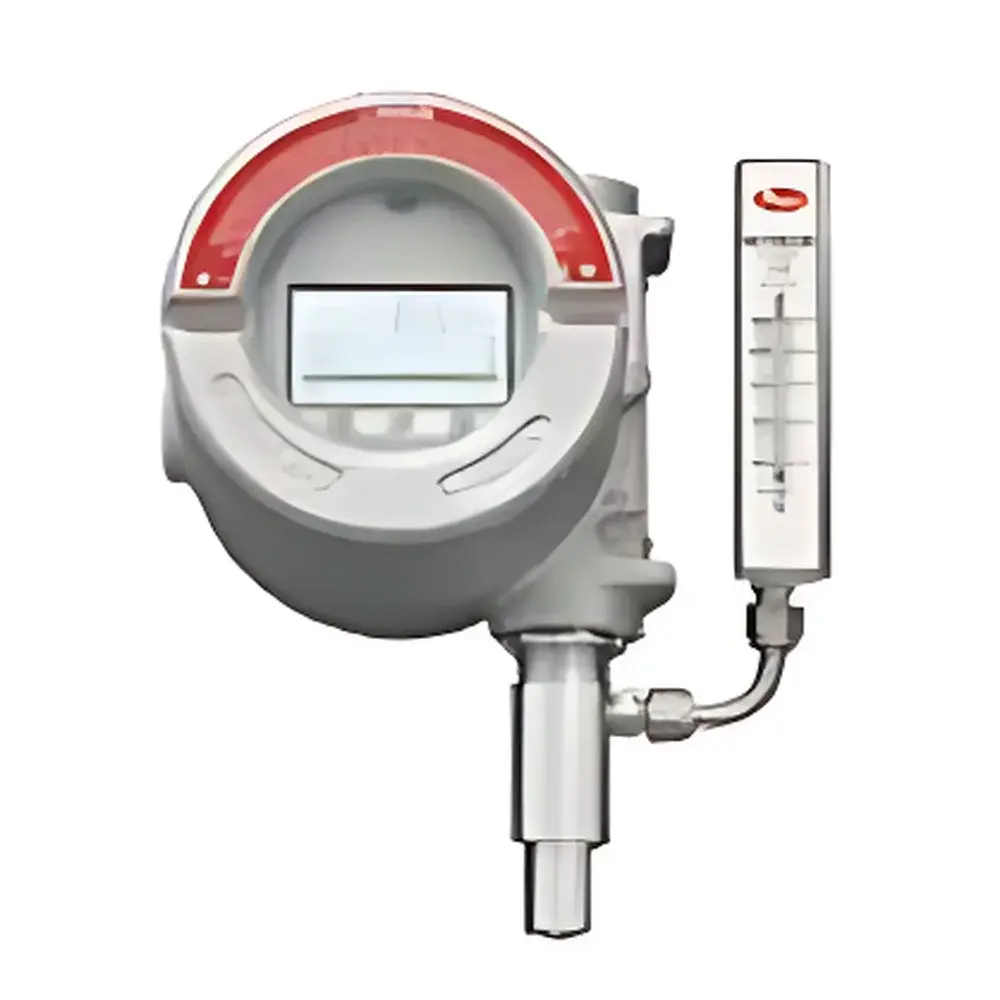
PhyMetrix DPT-900 Intrinsically Safe and Explosion-Proof Online Dew Point Analyzer
| Brand | PhyMetrix |
|---|---|
| Origin | USA |
| Model | DPT-900 |
| Product Type | Online Dew Point Analyzer |
| Measurement Principle | Electrolytic (P2O5 Sensor) |
| Operating Temperature | -20 °C to +60 °C |
| Accuracy | ±2 °C |
| Repeatability | ±0.5 °C |
| Dew Point Range | -110 °C to +20 °C |
| Response Time | ≤3 min (to 95% of step change, dry-to-wet) |
| Gas Flow Rate | >1 L/min |
| IP Rating | IP66/IP68 |
| Hazardous Area Certifications | FM/CSA Class I Div 1 Groups B, C, D |
| ATEX/IECEx | Ex d IIC T6 Gb |
| Enclosure Material | Aluminum (standard), optional 316L stainless steel |
| Dimensions | 226 × 147 × 147 mm (L×W×H) |
| Weight | 2.5 kg |
Overview
The PhyMetrix DPT-900 is an intrinsically safe and explosion-proof online dew point analyzer engineered for continuous, real-time moisture monitoring in hazardous and process-critical environments. It employs a high-stability, nanoscale microporous phosphorus pentoxide (P2O5) electrolytic sensor—the industry benchmark for trace moisture measurement in non-corrosive and mildly corrosive industrial gases. Unlike chilled-mirror or capacitive technologies, the P2O5 principle provides direct, absolute measurement of water vapor concentration via quantitative electrolysis, ensuring long-term stability and minimal drift across extreme dew point ranges (–110 °C to +20 °C). The instrument is designed for permanent installation in gas streams where safety compliance, measurement integrity, and operational uptime are non-negotiable—particularly in hydrocarbon processing, bulk gas production, pharmaceutical inerting, and aerospace purge systems.
Key Features
- FM/CSA and ATEX/IECEx certified explosion-proof enclosure (Class I Div 1, Ex d IIC T6 Gb) enabling deployment in Zone 1/Div 1 classified areas without additional barriers or purging systems
- Integrated sampling system: built-in 100 µm sintered stainless steel filter (cleanable in situ), precision flow restrictor (installable at inlet or outlet), and calibrated rotameter for visual flow verification (>1 L/min)
- Front-panel operation with sealed membrane keypad—no need to open the enclosure for calibration, zeroing, or configuration
- 3-inch polycarbonate observation window with anti-fog coating for unobstructed real-time status monitoring under ambient lighting
- Triple power input compatibility: universal 90–260 VAC / 47–440 Hz, isolated 12–24 VDC, or loop-powered 4–20 mA mode—enabling flexible integration into existing control infrastructure
- Modular options including 316L stainless steel housing (suffix -S), integrated pressure transducer (0–150 psia, ±1% FS, suffix -P), HART-enabled 4–20 mA output (suffix -A), and ATEX-certified intrinsic safety variant (suffix -I)
Sample Compatibility & Compliance
The DPT-900 is validated for use with dry air, nitrogen, argon, hydrogen, helium, oxygen (non-oil-lubricated compressors), natural gas (up to 10 bar partial pressure), and synthetic process gases. All wetted parts—including sample chamber, flow path, and sensor housing—are constructed from electropolished 316L stainless steel, ensuring chemical resistance and minimizing adsorption/desorption artifacts. The analyzer complies with ISO 8573-1:2010 Class 2 (for compressed air) and ASTM D6644 (Standard Test Method for Determination of Water Vapor in Gases by Electrolytic Hygrometry). Its design supports GLP/GMP audit readiness: all calibration events, parameter changes, and alarm triggers are timestamped and stored internally (with optional external logging via RS-422). The unit meets IEC 61508 SIL 2 functional safety requirements when deployed with appropriate safety instrumented systems (SIS).
Software & Data Management
While the DPT-900 operates as a standalone field instrument, its digital interface supports bidirectional communication via isolated RS-422 (Modbus RTU protocol) for integration into DCS, SCADA, or MES platforms. The HART-enabled 4–20 mA output carries primary dew point data plus secondary variables (process temperature, pressure if equipped, sensor health status). Configuration and diagnostics are performed using the PhyMetrix FieldMate utility (Windows-based, USB-to-RS422 adapter required), which logs calibration history, verifies sensor polarization voltage, and executes diagnostic self-tests—including electrolyte saturation check and electrode impedance profiling. Audit trails comply with FDA 21 CFR Part 11 when paired with validated enterprise data historians.
Applications
- Petrochemical refining: monitoring moisture in fuel gas, flare gas, and amine regeneration off-gas to prevent corrosion and hydrate formation
- Power generation: verifying dew point in generator hydrogen cooling circuits and SF6 insulation gas systems
- Pharmaceutical manufacturing: validating dry nitrogen blanketing during lyophilization, tablet coating, and API synthesis
- Aerospace: certifying moisture levels in aircraft pneumatic systems and avionics purge air per SAE AS4059F
- Industrial gas production: ensuring compliance with ISO 8573-1 Class 1–3 specifications for high-purity N2, Ar, and He
- Natural gas transmission: inline monitoring pre-dehydration and post-drying to verify molecular sieve performance
FAQ
What certification standards does the DPT-900 meet for hazardous area installation?
It holds FM/CSA Class I, Division 1, Groups B, C, D; Class II/III, Division 1, Groups E, F, G, and ATEX/IECEx Ex d IIC T6 Gb certifications—covering gas groups IIC (hydrogen, acetylene) and dust groups E/F/G.
Can the DPT-900 compensate for pressure variations in real time?
Yes—when equipped with the optional pressure sensor (suffix -P), it applies automatic pressure correction to dew point readings per ISO 6245, eliminating manual correction factors.
Is the P2O5 sensor susceptible to poisoning by hydrocarbons or siloxanes?
The sensor is tolerant of trace hydrocarbons (<1 ppmv) but requires upstream filtration for siloxanes, amines, or halogenated compounds. PhyMetrix recommends co-location with activated carbon or molecular sieve traps in contaminated streams.
How often does the electrolytic sensor require recalibration?
Under stable operating conditions, annual calibration is sufficient; however, a zero-check using certified dry gas (e.g., <–70 °C DP N2) is recommended quarterly. Sensor lifetime exceeds 24 months in clean, low-humidity service.
Does the DPT-900 support remote firmware updates?
No—firmware updates require local connection via RS-422 and the FieldMate software; no over-the-air or web-based update capability is implemented to maintain cybersecurity integrity per IEC 62443-3-3.






