
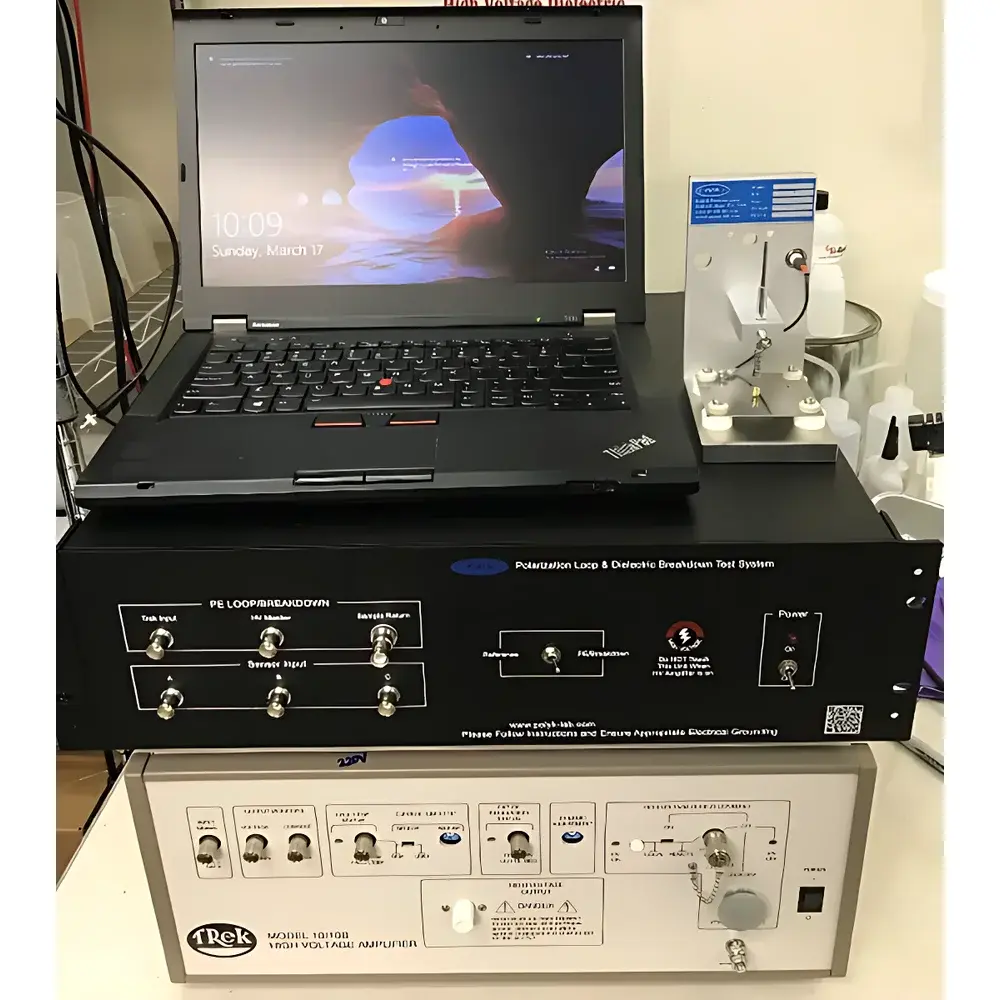
PolyK CPE1901 Ferroelectric and High-Voltage Dielectric Breakdown Test System
| Brand | PolyK Technologies |
|---|---|
| Origin | USA |
| Model | CPE1901 |
| Voltage Amplifier Output | >10 kV to 30 kV |
| Charge Range | 1 nC to >1 mC |
| Frequency Range | 0.01 Hz – 1 kHz (standard), up to 300 kHz (with optional HF module) |
| Built-in Amplifier | ±100 V or ±200 V |
| Hysteresis & Breakdown Modes | AC, DC, Field Endurance Life |
| Software Platform | LabVIEW-based with waveform control (sine, triangle, unipolar/bipolar, arbitrary) |
| Optional Modules | Piezoelectric Strain Measurement (10 nm resolution Fotonic Sensor or magnetoelectric sensor), High-Voltage Variable-Temperature Testing (–184 °C to +250 °C) |
| Compliance | Designed for ASTM D149, IEC 60243, IEEE Std 930, and ISO 25777 test protocols |
Overview
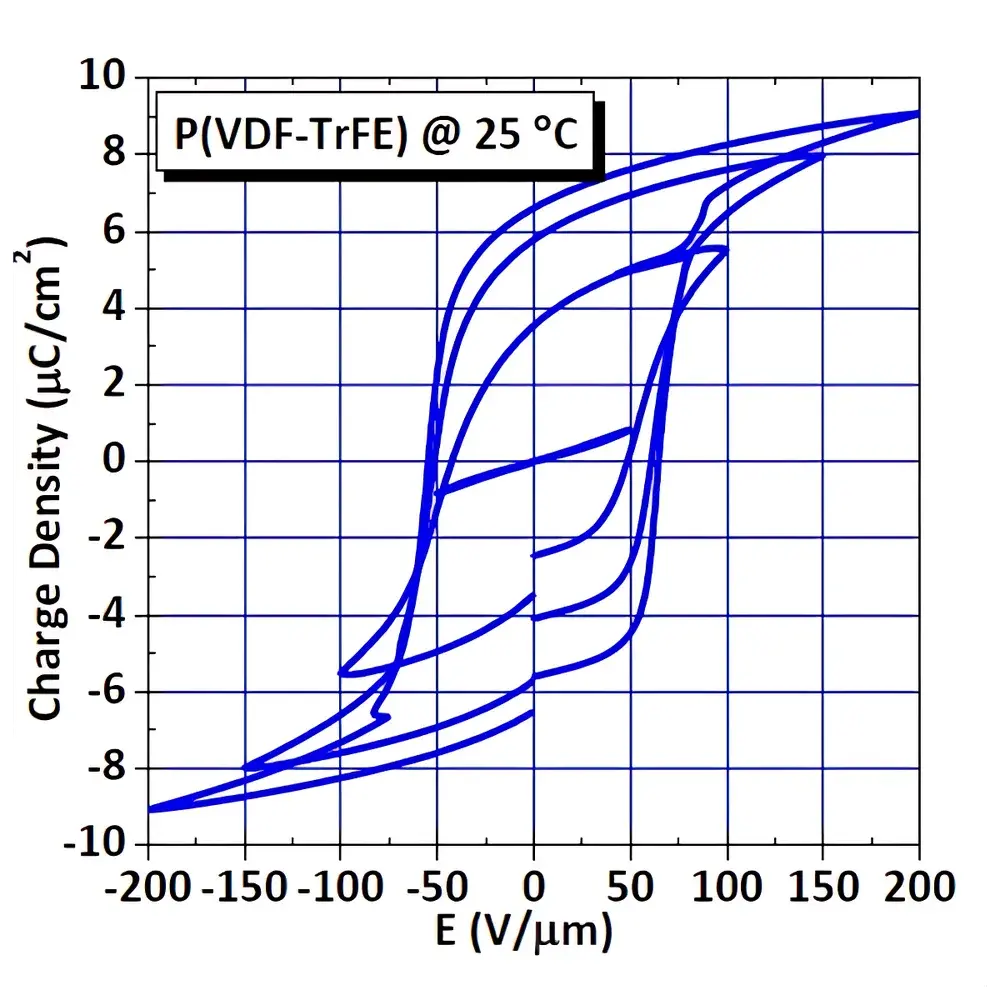
The PolyK CPE1901 Ferroelectric and High-Voltage Dielectric Breakdown Test System is an engineered platform for quantitative characterization of polarization-electric field (P–E) hysteresis behavior and dielectric integrity under high-field stress conditions. Based on an enhanced dynamic Sawyer–Tower circuit architecture, the system enables precise charge displacement measurement synchronized with controlled electric field application across a broad frequency spectrum—from quasi-static (0.01 Hz) to high-frequency excitation (up to 300 kHz). It supports both ferroelectric and linear dielectric materials, including ceramics (e.g., PZT, BTO), polymers (e.g., PVDF-TrFE), relaxor ferroelectrics, and emerging energy-storage dielectrics. The core measurement principle relies on real-time integration of current through a precision reference capacitor, enabling direct calculation of polarization density (P), remanent polarization (Pr), coercive field (Ec), and energy storage metrics—without requiring assumptions about electrode geometry or sample thickness uniformity.
Key Features
- Integrated protection circuitry that automatically isolates the measurement path upon dielectric breakdown, safeguarding amplifiers, data acquisition hardware, and user-defined test sequences.
- High-voltage amplification capability (10–30 kV output) via compatible Trek amplifiers, supporting sustained operation at frequencies up to 1 kHz (standard) and extended bandwidth up to 300 kHz with optional high-frequency modules.
- Multi-mode dielectric breakdown testing: configurable in AC, DC, or field endurance life mode—all selectable via software-controlled signal routing without physical reconfiguration.
- Fully automated ferroelectric characterization workflows, including dynamic hysteresis (DHM), positive-up-negative-down (PUND), static hysteresis (SHM), fatigue (FM), retention (RM), and imprint (IM) measurements.
- Real-time energy density computation: software calculates charge/discharge energy densities (Wch, Wdis) and round-trip efficiency (η) directly from raw P–E loop integrals, traceable to SI units.
- Robust mechanical fixture design accommodating soft, compliant polymer films and brittle ceramic wafers alike—maintaining uniform electrode contact while minimizing edge effects and mechanical damage during high-field cycling.
- LabVIEW-based control environment with programmable waveform synthesis (sine, triangle, unipolar/bipolar pulses, arbitrary user-defined waveforms) and precise timing synchronization between voltage stimulus and charge integration.
Sample Compatibility & Compliance
The CPE1901 accommodates disk, rectangular, and interdigitated electrode geometries with standard diameters from 5 mm to 25 mm and thicknesses ranging from 10 µm to 2 mm. It is validated for use with metal–insulator–metal (MIM) capacitor structures, thin-film heterostructures, bulk sintered ceramics, and solution-processed polymer films. All test methodologies align with internationally recognized standards: dielectric strength evaluation per ASTM D149 and IEC 60243-1; ferroelectric property reporting per IEEE Std 1789 and ISO 25777; and statistical reliability analysis per IEEE Std 930. The system architecture supports GLP-compliant audit trails when configured with timestamped metadata logging and user-access controls.
Software & Data Management
The native LabVIEW application provides full instrument orchestration—including amplifier biasing, DAQ sampling rate selection, trigger latency compensation, and real-time loop visualization. Raw datasets are stored in HDF5 format with embedded metadata (test parameters, environmental conditions, calibration constants). Batch processing tools enable comparative analysis across multiple samples or thermal/electrical stress conditions. Export options include CSV, MATLAB (.mat), and standardized XML schemas for LIMS integration. Optional FDA 21 CFR Part 11 compliance packages include electronic signatures, role-based access, and immutable audit logs for regulated environments.
Applications
- Development and qualification of high-energy-density capacitor dielectrics for pulsed power systems.
- Reliability assessment of ferroelectric memory devices under accelerated field stress (TDDB, FOM evaluation).
- Structure–property correlation studies in multiferroic composites and layered perovskites.
- Thermally activated conduction mechanism analysis via temperature-dependent leakage current and pyroelectric response (with optional modules).
- Standardized certification testing for aerospace-grade insulation materials per MIL-STD-202 and ESA/SCC Basic Specification No. 22900.
- Academic research into domain switching kinetics, nucleation-limited polarization reversal, and fatigue degradation pathways.
FAQ
What voltage ranges does the CPE1901 support for polarization measurement?
The system includes internal ±100 V or ±200 V amplifiers for low-field screening; external high-voltage amplifiers (10–30 kV) are integrated via isolated analog interfaces for full-breakdown characterization.
Can the system perform simultaneous piezoelectric strain and polarization measurement?
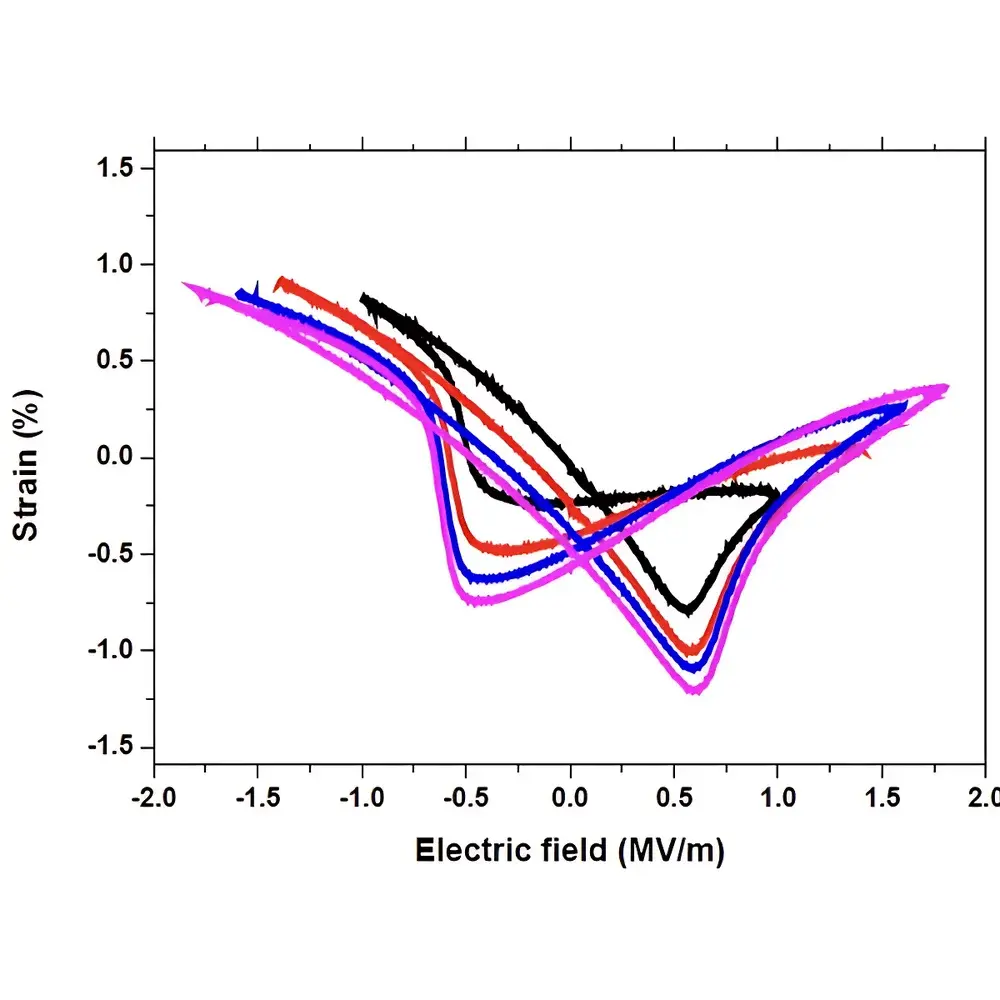
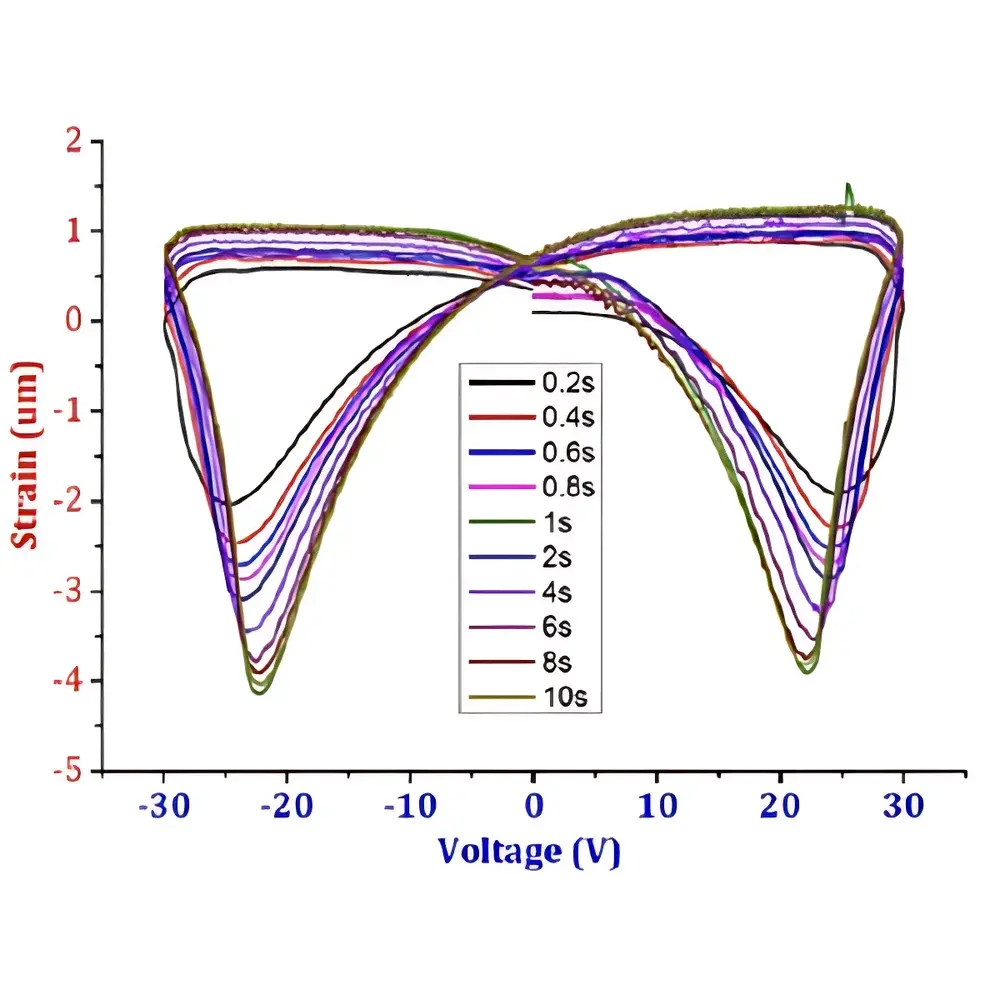
Yes—when equipped with the optional Fotonic Sensor (10 nm resolution) or magnetoelectric transducer, synchronized strain–field–polarization triad data can be acquired under identical thermal and electrical boundary conditions.
Is variable-temperature testing limited to cryogenic operation?
No—the high-voltage variable-temperature option spans –184 °C (liquid nitrogen) to +250 °C, with active temperature stabilization and field-cooling capability to maintain thermal equilibrium during polarization cycling.
How is data traceability ensured for regulatory submissions?
With the optional 21 CFR Part 11 package, all test runs generate digitally signed records containing operator ID, calibration certificate IDs, environmental logs, and cryptographic hashes of raw datasets.
Does the system support custom waveform generation for advanced fatigue protocols?
Yes—arbitrary waveform synthesis allows implementation of asymmetric bipolar pulses, staircase fields, or stochastic voltage profiles, all time-synchronized to charge integration with sub-microsecond jitter.



