
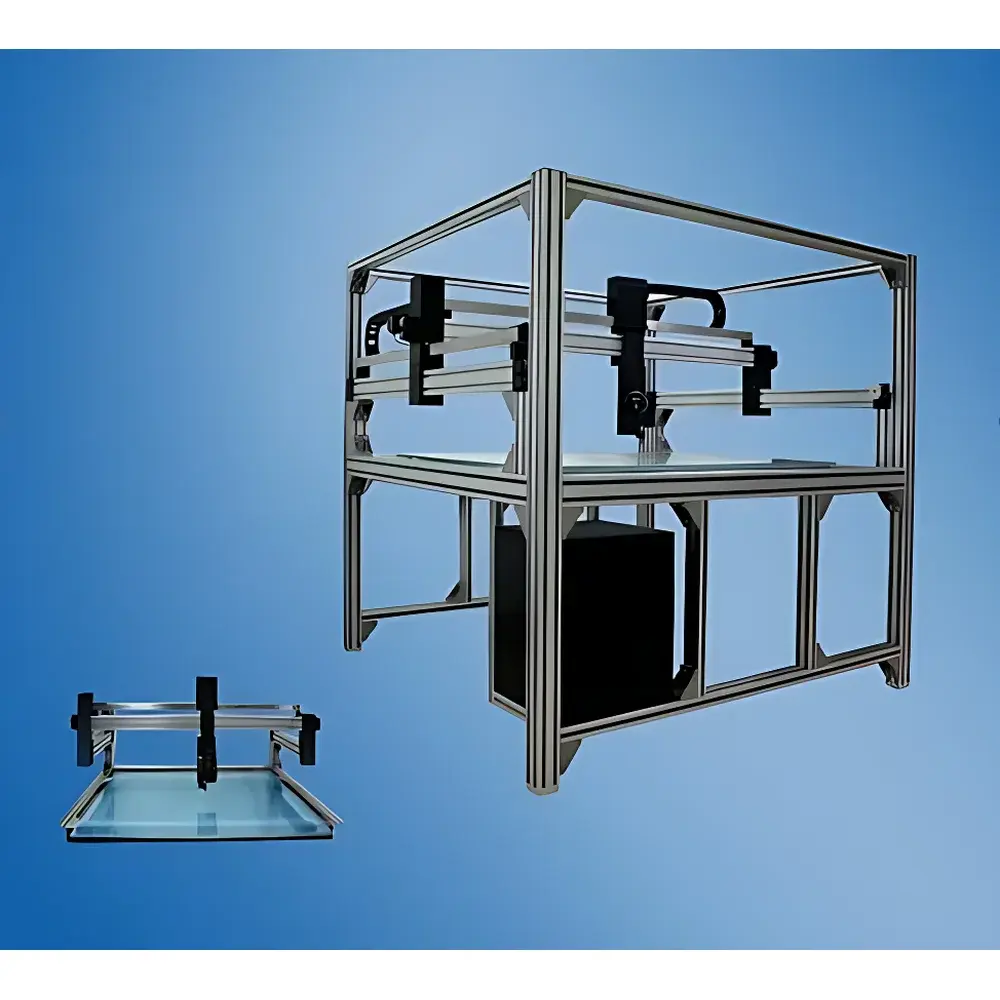
PowerView JC2000X4EA Fully Automated Large-Platform Video-Based Contact Angle Goniometer
| Origin | Beijing, China |
|---|---|
| Manufacturer Type | Authorized Distributor |
| Product Origin | Domestic (PRC) |
| Model | JC2000X4EA |
| Price Range | USD 2,800–7,000 |
| Instrument Class | Video Optical Contact Angle Meter |
| Form Factor | Benchtop Laboratory System |
| Contact Angle Measurement Range | 0–180° |
| Contact Angle Accuracy | ±0.1° (θ/2 Method) |
| Fixed Sample Stage Dimensions | 100 mm × 100 mm |
| Optical Magnification | 0.7–5× (55–320 pixels/mm) |
| Surface/Interfacial Tension Range | 0–1000 mN/m |
Overview
The PowerView JC2000X4EA is a fully automated, benchtop video-based contact angle goniometer engineered for high-precision quantification of solid–liquid interfacial wettability under controlled laboratory conditions. It operates on the optical principle of silhouette imaging: a high-resolution industrial CCD camera captures side-view or top-down profiles of sessile drops, pendant drops, captive bubbles, or inserted plates; geometric analysis—combined with rigorous mathematical curve fitting—determines the tangent angle at the solid–liquid–vapor three-phase boundary. This instrument supports both static and dynamic contact angle measurements—including advancing, receding, tilting, and rolling angles—enabling comprehensive characterization of surface heterogeneity, hysteresis, and time-dependent wetting behavior. Designed for reproducible interfacial thermodynamics analysis, it serves as a foundational tool in R&D and QC workflows where surface energy, critical micelle concentration (CMC), and interfacial tension are key performance indicators.
Key Features
- Fully motorized XYZ sample stage with 300 mm X-travel and 100 mm Y-travel (0.1 mm positioning resolution), accommodating large-format substrates up to 100 mm × 100 mm without manual repositioning.
- Integrated precision syringe pump system with programmable dispensing control, enabling repeatable drop deposition, multi-point sequential imaging, and automated focal adjustment via Z-axis actuation (25 mm travel, 0.01 mm step resolution).
- Industrial continuous-zoom optical lens (0.7–5× magnification) paired with a low-light-sensitive CCD sensor (1280 × 1024 resolution, 25 fps, 0.0005 lux minimum illumination), ensuring high-fidelity image capture across diverse surface textures and optical properties.
- Dual-mode LED cold backlight system with adjustable intensity and imported acrylic diffuser plates, minimizing glare and thermal drift while enhancing contrast for transparent or reflective samples.
- Comprehensive software suite supporting six independent contact angle calculation algorithms—including θ/2, circle/ellipse fitting, tangent fitting, and automatic edge detection—validated against ISO 19403-2 and ASTM D7334 standards for interfacial characterization.
- Automated surface free energy analysis using nine established theoretical models (e.g., Owens–Wendt, Wu, Fowkes, van Oss–Chaudhury–Good), applicable to both low-energy polymers and high-energy metals/ceramics.
Sample Compatibility & Compliance
The JC2000X4EA accommodates a broad spectrum of physical forms: rigid solids (films, wafers, coatings), fibrous materials (yarns, nonwovens), porous media (filter papers, membranes), and consolidated powders (via pelletization). Its large-stage architecture and flexible lighting geometry support irregular geometries and anisotropic surfaces without sample truncation. The system complies with fundamental metrological requirements outlined in ISO 21605 (contact angle measurement terminology) and aligns with GLP-relevant data integrity practices—supporting timestamped audit trails, user-access logging, and exportable metadata embedded directly into image files. While not FDA 21 CFR Part 11–certified out-of-the-box, its database structure (SQL-compatible export, Excel-ready reports, AVI video logging) facilitates integration into validated QA/QC environments requiring traceable documentation.
Software & Data Management
The proprietary PowerView software provides end-to-end workflow automation: from script-driven experimental sequencing (e.g., 50-cycle advancing/receding angle acquisition with 2 s interval) to batch processing of hundreds of images with consistent thresholding and curvature modeling. All contact angle values are stored with full provenance—including raw image, fitted contour, confidence metrics, and operator ID. Data exports include CSV, Excel, and annotated PNG/TIFF formats; video recordings (AVI) retain frame-accurate timestamps for kinetic analysis. Built-in database functions enable version-controlled backups, compression archiving, and cross-experiment comparative statistics—critical for method validation studies and inter-laboratory correlation assessments.
Applications
This goniometer is routinely deployed in academic and industrial laboratories for: surface treatment efficacy evaluation (plasma, corona, silanization); hydrophobic/hydrophilic coating development (anti-fog, anti-reflective, self-cleaning); inkjet printability assessment; pharmaceutical tablet film-coating uniformity; biomaterial cell-adhesion substrate screening; oil–water separation membrane characterization; and nanomaterial dispersion stability analysis. Its compatibility with CMC determination and interfacial tension profiling extends utility into surfactant formulation, emulsion stabilization, and enhanced oil recovery research.
FAQ
What sample types can be measured without modification?
Solid flat substrates (glass, silicon, metal foils), polymer films, textiles (woven/nonwoven), and pressed powder pellets (≥10 mm diameter, ≥2 mm thickness) are directly compatible.
Does the system support dynamic contact angle measurement?
Yes—advancing and receding angles are acquired via automated sequential dosing and real-time edge tracking; tilt-stage add-ons (sold separately) enable rolling and sliding angle quantification.
Is calibration traceable to national standards?
The system includes certified reference standards (e.g., NIST-traceable glass slides with defined contact angles) and supports user-defined calibration routines per ISO/IEC 17025 guidelines.
Can surface free energy be calculated for heterogeneous surfaces?
The software applies spatially resolved contact angle mapping (when combined with optional motorized stage scanning) and employs heterogeneity-corrected models such as the Girifalco–Good equation for composite interfaces.
What maintenance is required during routine operation?
No consumables beyond standard syringe needles and cleaning solvents; optical path requires quarterly inspection for dust accumulation; annual verification of stage positioning accuracy and camera focus stability is recommended.



