
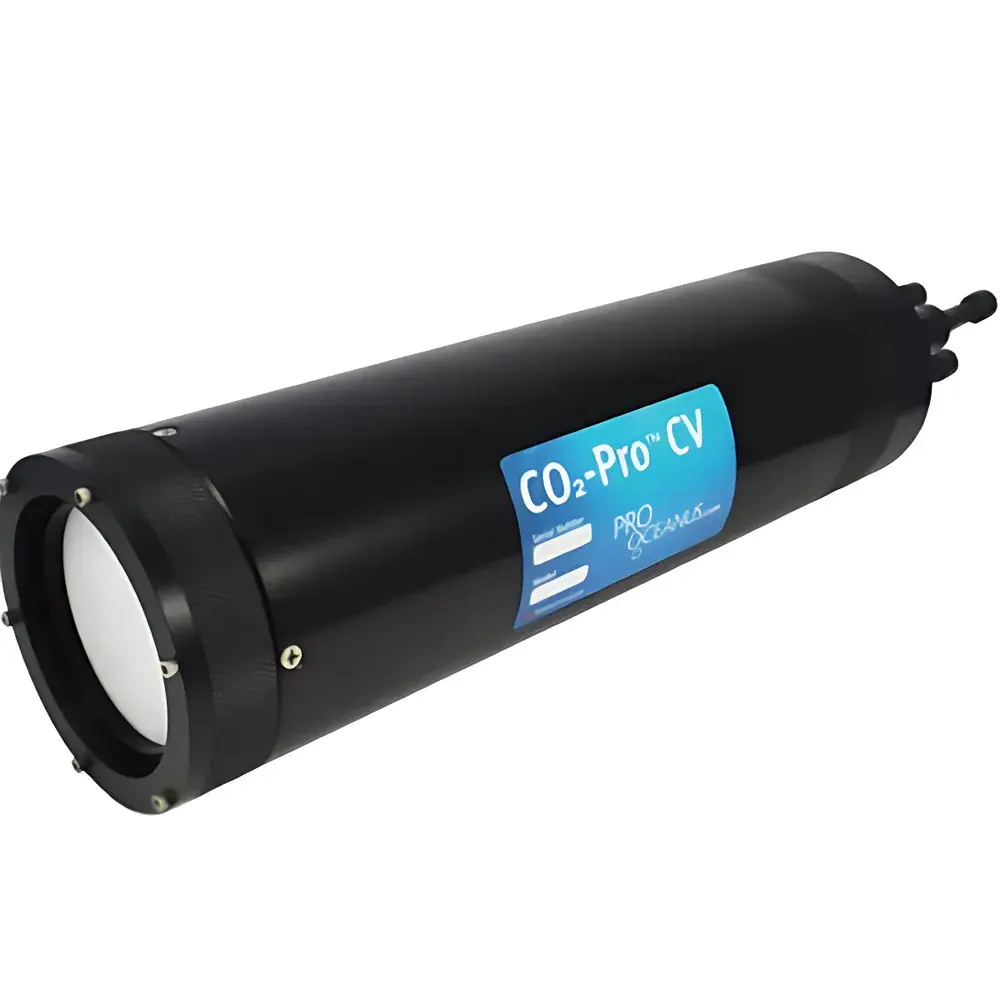
Pro-Oceanus CO2-Pro CV Submersible Carbon Dioxide Analyzer
| Brand | Pro-Oceanus |
|---|---|
| Origin | Canada |
| Manufacturer Type | Authorized Distributor |
| Origin Category | Imported |
| Model | CO2-Pro CV |
| Pricing | Upon Request |
Overview
The Pro-Oceanus CO2-Pro CV is a submersible, autonomous carbon dioxide (CO₂) partial pressure (pCO₂) analyzer engineered for high-precision, long-term in situ measurements in marine, estuarine, freshwater, and laboratory environments. It operates on the principle of membrane-based gas equilibration coupled with non-dispersive infrared (NDIR) spectroscopy — a physically robust, reagent-free methodology that eliminates chemical consumption, drift from reagent degradation, or interference from dissolved ions. Seawater or freshwater diffuses across a hydrophobic, gas-permeable polypropylene matrix membrane into an internal equilibration chamber; the equilibrated headspace gas is then drawn over an NDIR detector optimized for CO₂ absorption at 4.26 µm. This design ensures minimal biofouling susceptibility, as the membrane surface remains chemically inert and does not support microbial adhesion or enzymatic activity. The instrument’s compact cylindrical form factor (38 cm × 10 cm), combined with its low power draw (3 W nominal, 9 W during warm-up), enables deployment on moorings, seafloor observatories, profiling floats, towed bodies, and shipboard underway systems — with continuous operation supported for up to 12 months without intervention.
Key Features
- Reagent-free, membrane-mediated pCO₂ measurement using dual-beam NDIR detection for enhanced stability and signal-to-noise ratio
- Automatic Zero Point Calibration (AZPC): integrated CO₂ scrubber cartridge redirects sample flow through soda lime during scheduled calibration cycles, eliminating need for external zero gas cylinders
- Real-time thermobaric compensation: simultaneous onboard measurement of temperature (±0.05 °C), pressure (±0.05% FS), and humidity (±2% RH) applied to raw NDIR output via embedded polynomial algorithms
- Internal 2 GB microSD card supporting autonomous data logging at user-configurable intervals (1 s to 3600 s), with timestamped ASCII records including raw voltage, calibrated pCO₂ (µatm), T, P, and diagnostic flags
- Two housing options: acetal polymer (rated to 600 m depth) or Grade 5 titanium alloy (rated to 6000 m depth), both corrosion-resistant and compatible with long-term immersion in saline or brackish media
- Low-power architecture optimized for battery- or energy-harvesting platforms; compatible with standard 10–18 VDC input; optional peristaltic pump (4 W active) enhances response time (t₆₃ < 50 s) and mitigates boundary layer effects in low-flow conditions
- Self-contained operation: no host computer required for startup or data retrieval; intuitive menu-driven interface accessible via RS-232 terminal or optional analog outputs (0–5 V / 4–20 mA)
Sample Compatibility & Compliance
The CO2-Pro CV is validated for use across a broad physicochemical range: water temperatures from –2 °C to +40 °C (with model-specific sensor calibration profiles for polar, temperate, and tropical regimes); salinities from 0 to 40 PSU; and turbidities up to 1000 NTU. Its membrane-based sampling mechanism renders it insensitive to particulate load, dissolved organic carbon (DOC), hydrogen sulfide (H₂S), or redox-active species that commonly interfere with electrochemical or colorimetric sensors. The instrument complies with ISO 17025-aligned calibration traceability protocols and supports audit-ready data integrity through time-stamped logs, firmware version tracking, and cyclic redundancy check (CRC)-protected storage. While not certified for GMP/GLP environments per se, its AZPC function, full environmental compensation, and deterministic response kinetics make it suitable for regulatory-grade ocean acidification monitoring programs aligned with GOA-ON, SOCCOM, and ICOS requirements.
Software & Data Management
Data are output in human-readable ASCII format via RS-232 serial interface (default 9600 baud, N-8-1), enabling direct ingestion into common oceanographic data acquisition systems (e.g., Sea-Bird Electronics SBE Data Processing, MATLAB, Python pandas). Optional analog outputs facilitate integration with SCADA or PLC-based infrastructure. Pro-Oceanus provides the CO2-Pro Configuration Utility (Windows/Linux/macOS) for firmware updates, parameter configuration (sampling interval, AZPC schedule, alarm thresholds), and binary log file parsing. All logged data include UTC timestamps synchronized to internal real-time clock (RTC) with ±2 s/year drift. No proprietary drivers or cloud dependencies are required; raw files are stored unencrypted on removable microSD for offline archival and third-party validation.
Applications
- Ocean acidification trend analysis via multi-year pCO₂ time series on fixed moorings and cabled observatories
- Surface ocean CO₂ flux estimation using underway systems aboard research and commercial vessels (compliant with SOOP-CO₂ standards)
- Benthic-pelagic coupling studies in coastal upwelling zones and hypoxic basins
- Freshwater carbon cycling research in lakes, rivers, and wetlands — particularly where biofouling limits conventional sensor longevity
- Calibration and validation of satellite-derived sea surface pCO₂ products (e.g., NOAA PMEL XCO₂ L3/L4 datasets)
- Controlled laboratory experiments requiring high-temporal-resolution pCO₂ monitoring under varying pH, temperature, and alkalinity conditions
FAQ
What is the measurement principle used by the CO2-Pro CV?
It employs membrane-mediated gas equilibration followed by non-dispersive infrared (NDIR) detection — a physical, reagent-free method compliant with ASTM D5865 and ISO 8573-1 Annex B for gas concentration metrology.
Does the instrument require periodic calibration with certified gas standards?
No. Automatic Zero Point Calibration (AZPC) uses an internal CO₂ absorbent cartridge; span calibration is recommended annually using a known pCO₂ standard (e.g., equilibrated gas or certified seawater reference material).
Can the CO2-Pro CV operate autonomously for one year without servicing?
Yes — when powered continuously and deployed within its thermal and pressure ratings, with AZPC enabled every 7–30 days (user-configurable), and with sufficient microSD capacity (2 GB supports >18 months at 1-min sampling).
Is pressure compensation applied in real time during measurement?
Yes. A calibrated piezoresistive pressure transducer feeds continuous depth-corrected values to the embedded compensation algorithm, ensuring accurate pCO₂ conversion across variable hydrostatic loads.
What communication interfaces are available?
Standard RS-232 ASCII output; optional analog outputs (0–5 V DC or 4–20 mA) and TTL-level trigger signals for external synchronization.
Related Products







