ProOpto UV/VUV Beam Profiler
| Brand | ProOpto |
|---|---|
| Origin | Germany |
| Model | UV/VUV |
| Wavelength Range | 100–1100 nm (quantum conversion coating active <320 nm |
| Field of View | 20 mm × 14 mm (custom FOVs available) |
| Sensor | 4 MP CMOS, 12-bit, USB 3.0 interface |
| Frame Rate | up to 15 fps |
| Exposure Time | 20 µs – 1 s |
| Attenuation | prism-based attenuator (1000:1), optional ND filters |
| Compliance | ISO 11146, ISO 13694, ISO 11670, ISO 15367 |
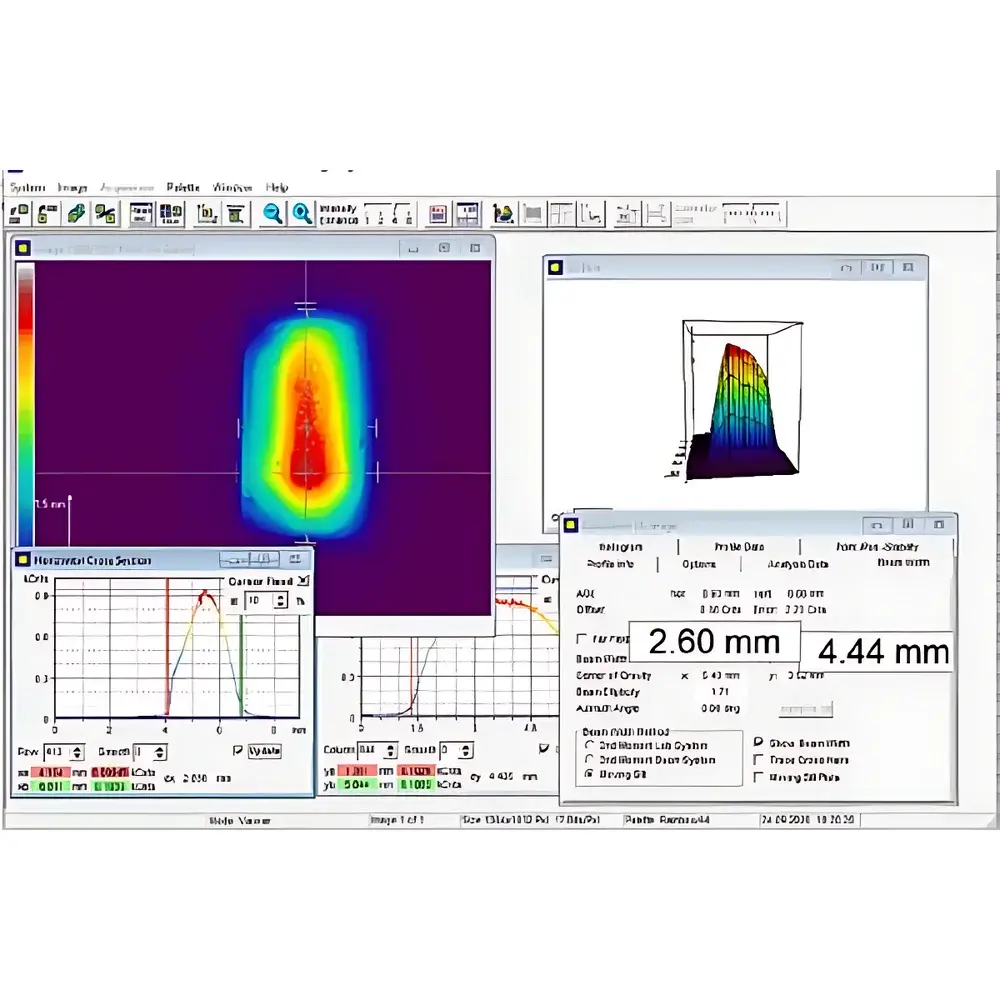
| Software | ISO-compliant beam analysis suite supporting ≥20 camera types |
Overview
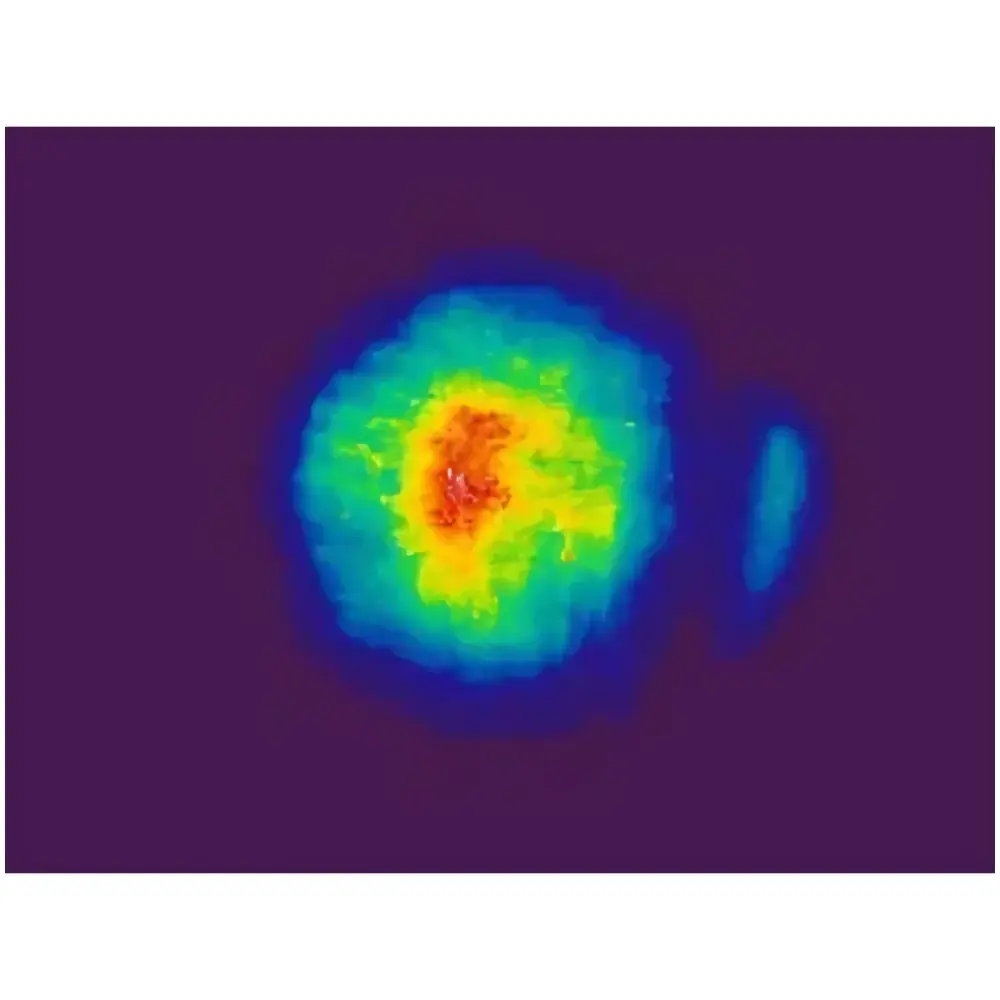
The ProOpto UV/VUV Beam Profiler is an engineered optical metrology instrument designed for quantitative spatial characterization of laser beams across the vacuum ultraviolet (VUV), deep ultraviolet (DUV), visible, and near-infrared (NIR) spectral ranges. It operates on the principle of direct imaging photodetection, utilizing a quantum-conversion-coated CMOS sensor optimized for high quantum efficiency below 320 nm—enabling accurate, non-scanning measurement of pulsed and continuous-wave (CW) sources including excimer lasers (e.g., ArF at 193 nm, KrF at 248 nm), frequency-tripled and quadrupled solid-state lasers (e.g., 355 nm, 266 nm, 213 nm), UV LEDs, and broadband VUV lamps. Unlike scanning slit or knife-edge profilers, this system delivers full two-dimensional intensity distribution in real time, with calibrated spatial resolution and radiometric linearity traceable to ISO 11146-1:2021 and ISO 13694:2019. The instrument’s architecture integrates gas-purged optical path options for operation below 190 nm, ensuring stable photon detection in oxygen-sensitive spectral regions.
Key Features
- Quantum-conversion-coated CMOS detector enabling high-sensitivity, low-noise imaging from 100 nm to 1100 nm—with validated linearity and stability under pulsed UV irradiation
- Real-time beam profiling at up to 15 frames per second, with programmable exposure times from 20 µs to 1 s for optimal signal-to-noise ratio across diverse pulse energies and repetition rates
- Integrated prism-based attenuator (1000:1 attenuation ratio) and optional neutral density filter sets for safe, distortion-free measurement of high-peak-power excimer and Q-switched UV sources
- Modular field-of-view design: standard 20 mm × 14 mm active area; custom FOVs available to accommodate divergent far-field measurements or tightly focused near-field applications
- Fully compliant optical calibration traceable to ISO standards—including M² calculation per ISO 11146-2:2021, beam diameter and divergence per ISO 11146-1, and beam pointing stability per ISO 11670:2006
Sample Compatibility & Compliance
The ProOpto UV/VUV Beam Profiler supports direct imaging of both coherent and incoherent sources without intermediate optics that degrade fidelity. It is routinely deployed for alignment and qualification of industrial excimer lithography systems, UV curing platforms, and scientific laser laboratories. The instrument meets essential regulatory and quality infrastructure requirements for metrology-grade optical testing: all beam parameter algorithms adhere strictly to ISO 11146 (laser beam widths, divergence, M²), ISO 13694 (beam profile definitions), ISO 11670 (pointing stability assessment), and ISO 15367 (wavefront reconstruction via iterative phase retrieval). For environments requiring audit readiness, the software platform supports GLP/GMP-aligned data logging—including timestamped raw images, metadata embedding (wavelength, exposure, attenuation state), and exportable CSV/ASCII reports compatible with LIMS integration.
Software & Data Management
The bundled Beam Analysis Software provides a deterministic, standards-based computational engine—not a generic image processor. It implements ISO-defined second-moment (D4σ) and knife-edge-derived beam width algorithms in parallel, with user-selectable edge-detection thresholds and background subtraction models. All calculations are performed on native 12-bit sensor data without interpolation or lossy compression. The software supports ≥20 camera types—including legacy and third-party sensors—via standardized SDK interfaces, enabling lab-wide deployment consistency. Audit trails record operator ID, session start/end timestamps, configuration changes, and version-controlled algorithm parameters. Export formats include TIFF (with embedded EXIF metadata), HDF5 (for MATLAB/Python post-processing), and PDF reports compliant with internal QA documentation workflows. Optional FDA 21 CFR Part 11 modules provide electronic signature support and immutable audit logs for regulated manufacturing environments.
Applications
- Qualification and maintenance of ArF (193 nm) and KrF (248 nm) excimer lasers used in semiconductor photolithography tools
- Far-field divergence mapping of UV fiber-coupled diodes and LED arrays for disinfection and photochemical reactor design
- M² factor validation of frequency-converted Nd:YAG systems (213 nm, 266 nm, 355 nm) prior to delivery to ultrafast spectroscopy or micromachining workstations
- Wavefront asymmetry detection in misaligned harmonic generation cavities—revealing thermal lensing or astigmatism via ISO 15367-compliant Zernike decomposition
- Time-resolved beam centroid tracking during plasma-induced focal shift experiments in VUV laser-matter interaction studies
FAQ
Is nitrogen or argon purging mandatory for operation below 190 nm?
Yes. Oxygen absorption strongly attenuates photons below ~190 nm; therefore, a continuous purge with high-purity N₂ or Ar is required to maintain optical transmission through the sensor window and quantum conversion layer.
Can the system measure CW UV sources without damage risk?
Yes—the quantum conversion coating and integrated attenuation optics are rated for continuous exposure at irradiance levels typical of CW UV lasers up to 100 mW/cm² (dependent on wavelength and spot size); extended exposure limits are documented in the safety manual.
Does the software support automated pass/fail reporting against user-defined ISO tolerance bands?
Yes. Threshold-based acceptance criteria can be defined per parameter (e.g., M² ≤ 1.3 ± 0.05, centroid drift < 2 µrad over 1 hour), with batch-report generation and configurable alert notifications.
Are calibration certificates provided with each unit?
Each instrument ships with a factory calibration certificate referencing NIST-traceable irradiance and spatial standards, valid for 12 months; on-site recalibration services are available globally through ProOpto’s authorized service centers.
Is remote operation supported via Ethernet or only USB 3.0?
USB 3.0 is the primary interface; however, optional USB-to-Ethernet bridge hardware and API-level TCP/IP command support enable integration into centralized lab control networks.