
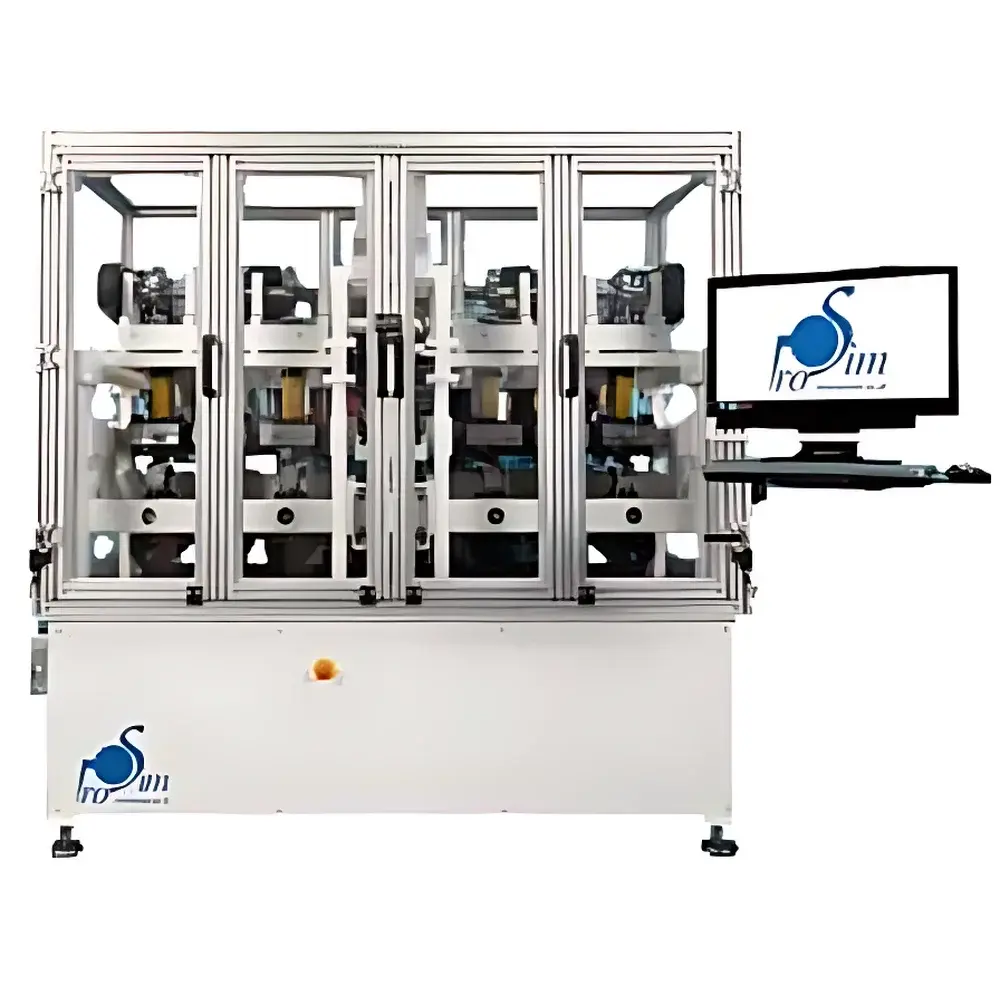
PROSIM Hip and Spine Implant Fatigue Simulator
| Brand | PROSIM |
|---|---|
| Origin | United Kingdom |
| Model | HIP-SPINE-FATIGUE-SIMULATOR |
| Max Test Load | 5 kN |
| Frequency Range | 2.0 Hz |
| Machine Weight | 800 kg |
| Degrees of Freedom | 6-axis motion per station (flexion/extension ±60°, abduction/adduction ±20°, internal/external rotation ±30°) |
| Microseparation Capability | up to 5 mm (acetabular cup) |
| Temperature Control | 37 °C ± 2 °C (serum bath) |
| Station Capacity | 6 simultaneous implant test stations + 2 load-soak stations |
| Sensor Configuration | Six-axis load cell per station |
| Motion Control | Closed-loop servo-electromechanical actuation with waveform tracking fidelity < ±0.5% error |
| Compliance | ISO 14242-1:2012, ISO 18192-1:2011 |
Overview
The PROSIM Hip and Spine Implant Fatigue Simulator is a high-fidelity, multi-station electromechanical testing system engineered for orthopaedic device evaluation under physiologically representative conditions. It operates on the principle of controlled cyclic biomechanical loading—applying time-varying forces, moments, and kinematic trajectories to simulate in vivo joint articulation and intervertebral disc mechanics. Designed in collaboration with CRITT MDTR (France), an independent wear-testing laboratory accredited to ISO/IEC 17025, the simulator replicates clinically relevant gait cycles—including walking, jogging, and rest phases—while maintaining physiological temperature (37 °C ± 2 °C) and biochemical environment (e.g., bovine serum immersion). Its architecture integrates six independently programmable test stations, each equipped with full 6-degree-of-freedom motion control, enabling concurrent assessment of hip prostheses and spinal implants according to ISO 14242-1:2012 (hip wear) and ISO 18192-1:2011 (spinal wear). Unlike hydraulic or pneumatic fatigue systems, this simulator employs servo-electromechanical actuators—offering superior waveform fidelity, lower maintenance overhead, and intrinsic compatibility with GLP-compliant data acquisition.
Key Features
- Six parallel test stations with fully independent 6-axis motion control (flexion/extension ±60°, abduction/adduction ±20°, internal/external rotation ±30°)
- Two dedicated load-soak stations for static immersion conditioning prior to dynamic testing
- Electromechanical actuation with real-time closed-loop feedback; capable of tracking complex physiological waveforms with < ±0.5% amplitude deviation
- Integrated six-axis load cells at each station (force range: ±5 kN axial, ±100 N·m moment) for simultaneous force/moment measurement
- Microseparation control of acetabular cup with resolution ≤ 5 µm and displacement range up to ±5 mm
- Programmable frequency range from 0.1 Hz to 2.0 Hz, supporting both low-cycle fatigue (LCF) and high-cycle fatigue (HCF) protocols
- Individual XY alignment stages per station to ensure precise rotational center registration relative to anatomical landmarks
- Dedicated thermal management per station: PID-controlled heating elements maintain 37 °C ± 2 °C in serum-filled baths throughout extended test durations (≥ 10 million cycles)
- Windows-based HMI with intuitive workflow navigation, parameter validation checks, and pre-loaded ISO-compliant test templates
Sample Compatibility & Compliance
The simulator accommodates standard-sized total hip arthroplasty components (including metal-on-polyethylene, ceramic-on-ceramic, and metal-on-metal configurations) as well as lumbar intervertebral disc replacements (e.g., nucleus pulposus substitutes and total disc arthroplasty devices). All motion profiles adhere strictly to ISO-defined anatomical loading paths—ensuring that resultant contact pressures, sliding distances, and micromotion patterns remain within clinical relevance boundaries. The system meets mechanical and metrological requirements of ISO 14242-1:2012 Annex A (hip wear simulation) and ISO 18192-1:2011 Clause 6 (spinal implant wear). Data acquisition complies with FDA 21 CFR Part 11 requirements when configured with audit-trail-enabled software; raw sensor logs are timestamped, unalterable, and stored in HDF5 format for traceability. Optional IQ/OQ documentation packages support GMP-aligned validation for regulatory submissions (e.g., FDA 510(k), CE MDR Class III).
Software & Data Management
Control and analysis are managed via PROSIM’s proprietary SimuTest Suite—a Windows-native application built on .NET Framework with deterministic real-time scheduling. Each test sequence is defined using hierarchical XML-based protocol files, allowing granular specification of load ramps, dwell times, motion envelopes, and thermal setpoints. During operation, the software continuously logs position (encoder-derived), force (load cell), torque (rotary transducer), and temperature (PT100) at ≥1 kHz sampling rate. Post-test, data are exported in CSV or MATLAB-compatible formats; integrated wear volume estimation tools apply ASTM F2003-derived gravimetric correction algorithms. All user actions—including method edits, calibration events, and emergency stops—are recorded in an immutable audit trail compliant with GLP Annex 11 and ISO 13485:2016 clause 7.5.2.
Applications
- Preclinical wear screening of next-generation bearing couples (e.g., highly crosslinked UHMWPE, oxidized zirconium, hydroxyapatite-coated surfaces)
- Comparative assessment of modular taper junction fretting corrosion under dynamic micro-motion
- Long-term durability evaluation of polymeric spinal nucleus replacements under combined compression-shear loading
- Validation of finite element models against empirical wear scar morphology and mass loss trends
- Supporting ISO 14242-3:2021 (hip simulator verification) and ISO 18192-2:2022 (spinal simulator verification) qualification studies
- Regulatory submission dossiers requiring ISO-conformant wear data for FDA, Notified Bodies, or PMDA review
FAQ
What standards does the PROSIM Hip and Spine Fatigue Simulator comply with?
It is fully aligned with ISO 14242-1:2012 (hip wear) and ISO 18192-1:2011 (spinal wear), including anatomical motion paths, loading vectors, and environmental conditions.
Can the system be validated for GLP or GMP environments?
Yes—optional IQ/OQ documentation, electronic signature support, and 21 CFR Part 11–compliant audit trails are available upon request.
Is custom motion profile programming supported?
Yes. Users may define proprietary gait cycles, stair-climbing sequences, or patient-specific kinematics via the SimuTest Suite’s waveform editor.
How is temperature uniformity maintained across all stations?
Each station features independent PID-controlled heating elements embedded in the serum bath housing, with dual-point PT100 monitoring ensuring ±2 °C stability over 30-day continuous operation.
What maintenance intervals are recommended for electromechanical actuators?
Servo motors and gearboxes require inspection every 5 million cycles or annually—whichever occurs first—with lubrication and encoder recalibration performed by certified PROSIM field engineers.



