
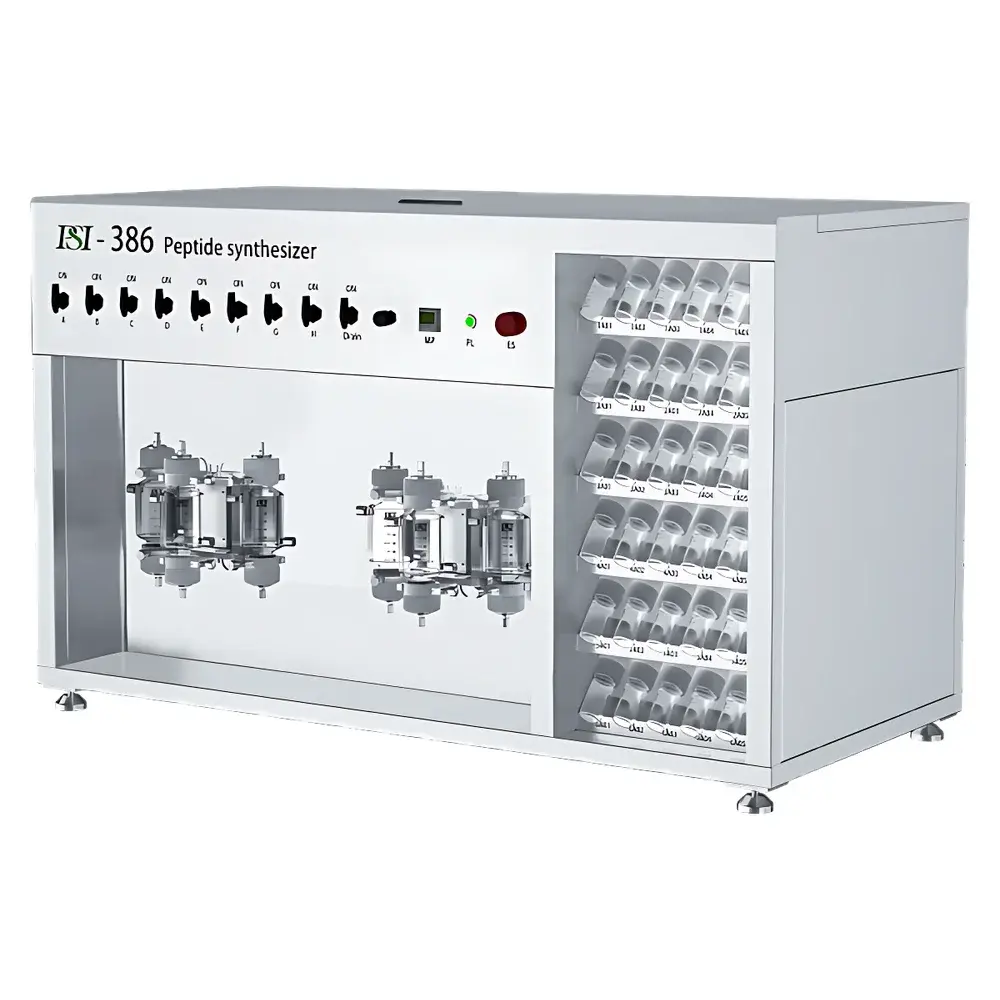
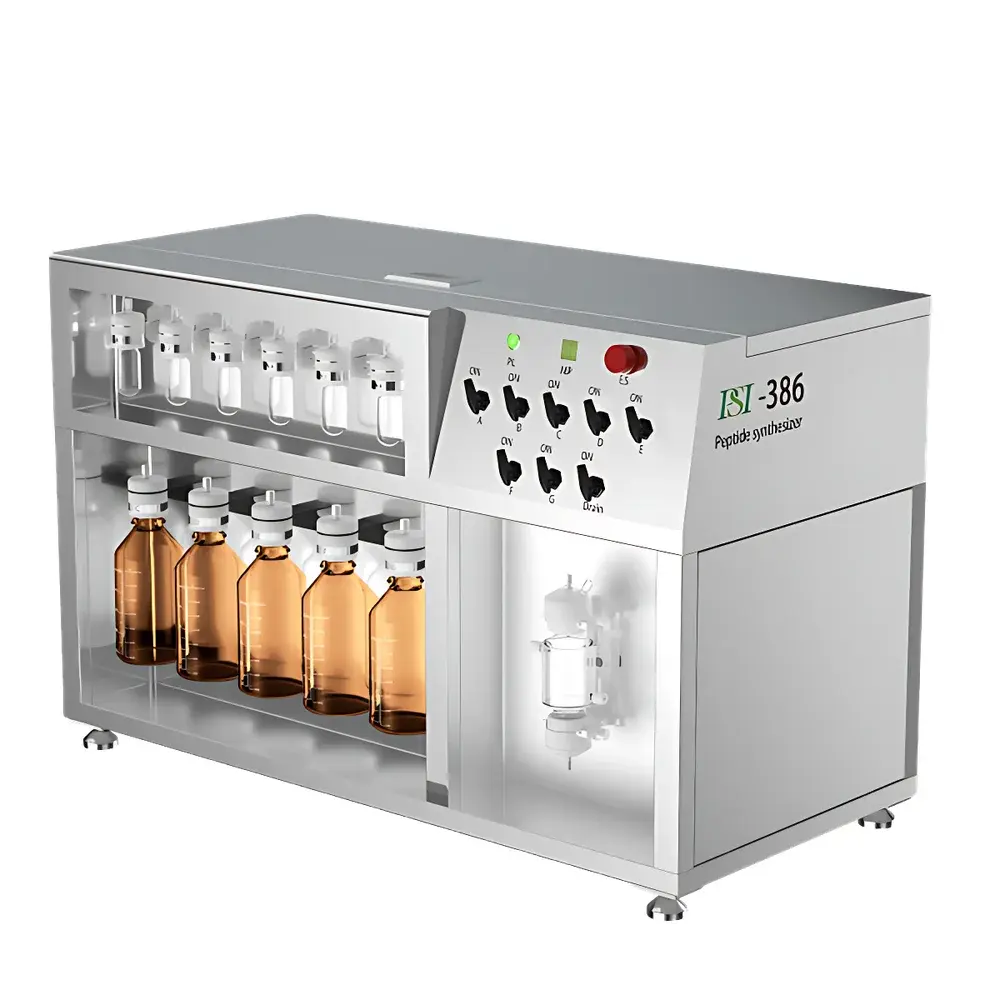
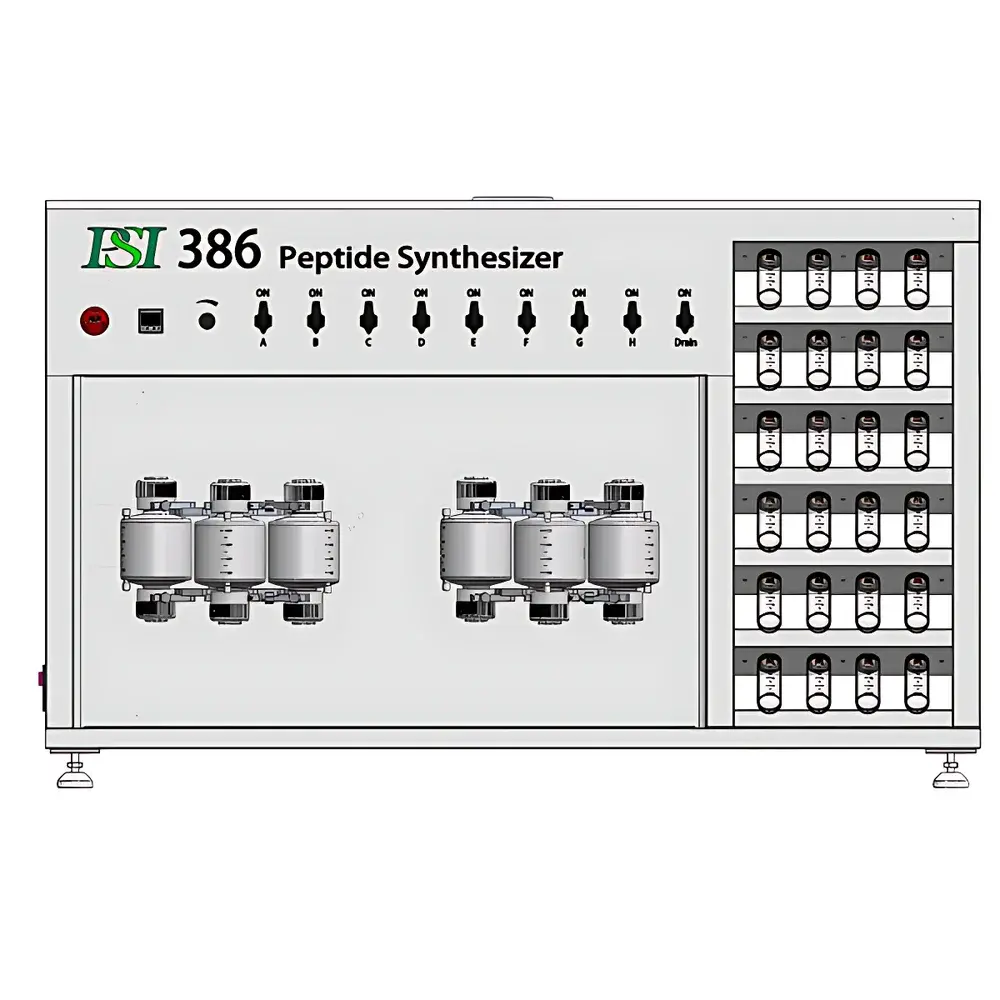
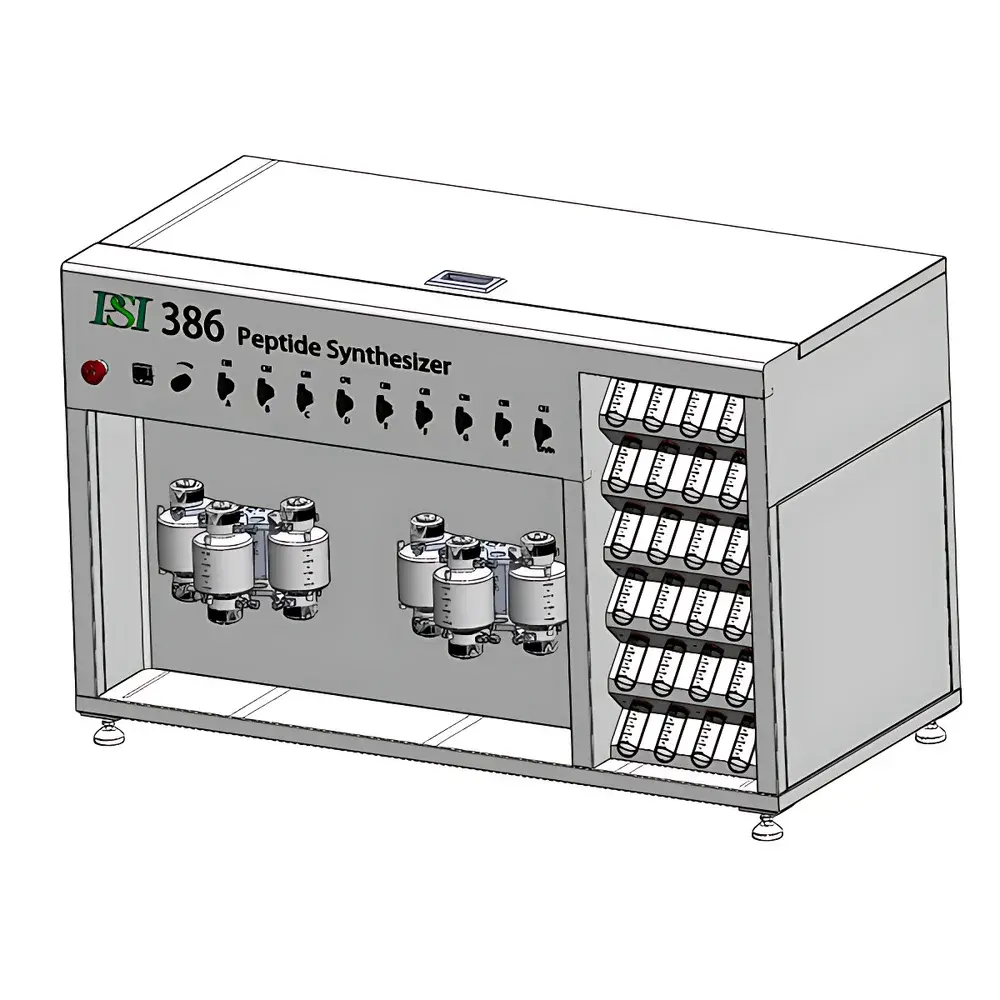
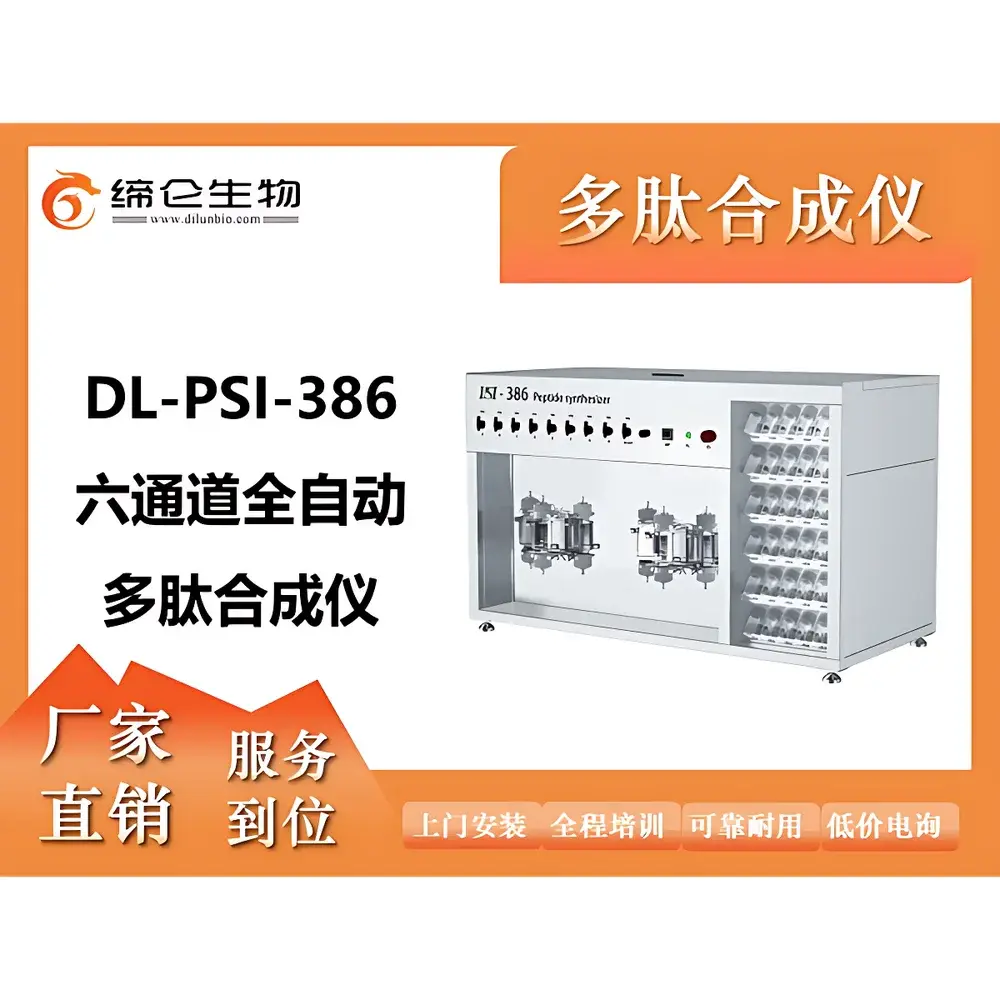
PSI DL-PSI386 Six-Channel Automated Peptide Synthesizer (Research-Grade)
| Brand | PSI |
|---|---|
| Origin | USA |
| Model | DL-PSI386 |
| Amino Acid Delivery | Automated |
| Reagent Delivery | Automated |
| Synthesis Scale | 0.25–3 mmol per channel |
| Reactor Count | 30 |
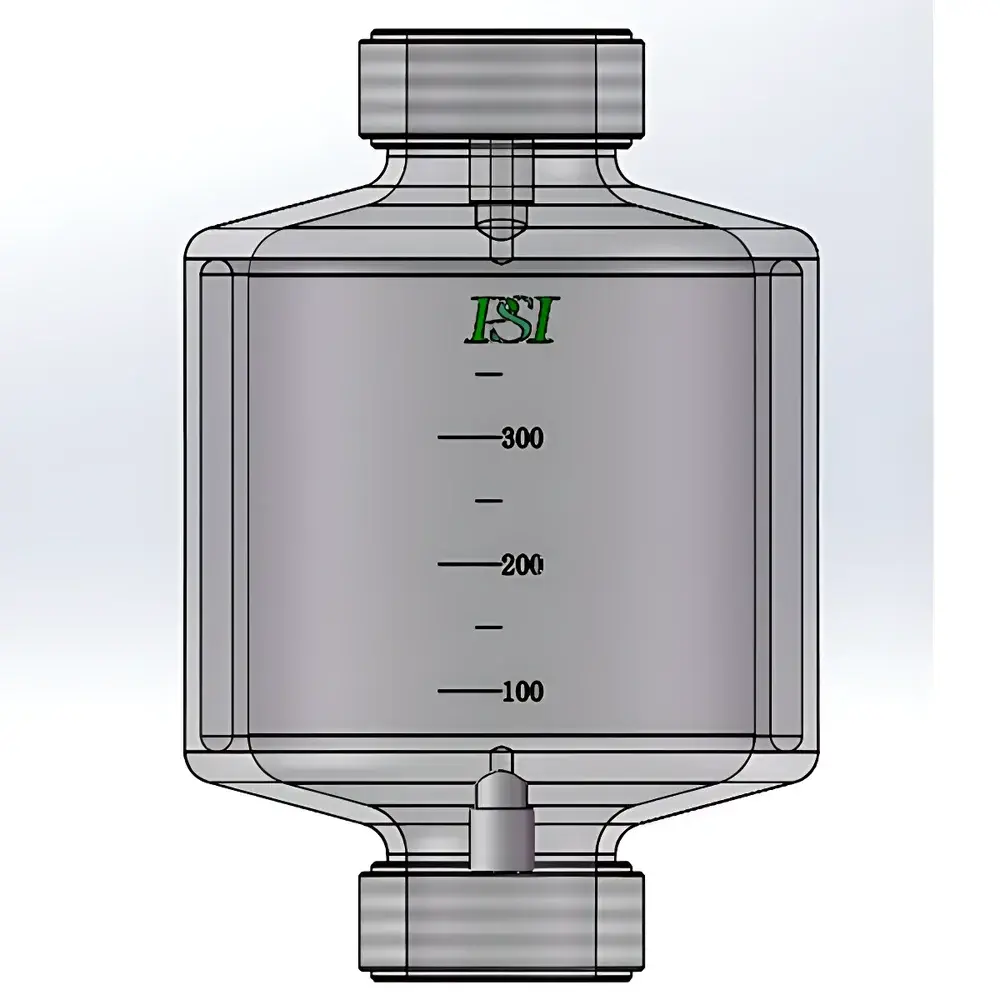
| Reactor Volumes | 50 mL, 100 mL, 200 mL (jacketed) |
| Syringe Pump Accuracy | ±0.01 mL |
| Coupling Efficiency / Crude Purity | ≥99.5% |
| Solvent Flow Rate | 2–4 mL/s |
| Mixing Mechanism | Stirring-free reactor inversion (180° mechanical oscillation) |
| Inversion Speed | 0–30 rpm, continuously adjustable |
| Solvent Reservoirs | 8 units |
| Power Supply | 110/220 V, 50/60 Hz |
| Enclosure Material | 304 stainless steel |
| Unit Weight | 100–150 kg |
| Dimensions (W×D×H) | 113 × 58 × 72 cm |
Overview
The PSI DL-PSI386 is a high-flexibility, six-channel automated peptide synthesizer engineered for advanced research laboratories requiring parallel synthesis of structurally diverse peptides under fully programmable, GLP-aligned conditions. Unlike conventional synthesizers relying on impeller-based agitation—which risks resin fragmentation, reduced coupling efficiency, and inconsistent solvation—the DL-PSI386 implements PSI’s proprietary stirrer-free mixing architecture: each reaction vessel undergoes precise 180° mechanical inversion, inducing vigorous yet non-destructive tumbling of solid-phase resin beads within the reagent solution. This principle, first validated by Dr. John Ye in 1995, eliminates shear-induced resin damage while maximizing mass transfer and coupling kinetics—enabling reproducible crude purity ≥99.5% across sequences up to 100+ residues. The system supports independent method programming per channel, allowing simultaneous synthesis of peptides with divergent lengths, protecting group strategies, coupling reagents, or side-chain modifications—critical for epitope mapping, SAR studies, constrained peptide design, and isotopic labeling workflows.
Key Features
- Six independently controllable synthesis channels with asynchronous scheduling—each channel configurable for distinct protocols, resin loading, coupling cycles, and deprotection timing.
- 30-position amino acid reservoir carousel accommodating standard Fmoc-protected α-amino acids, D-/β-amino acids, phosphoamino acids, fluorescent dyes (e.g., FITC, TAMRA), biotin derivatives, and custom-modified monomers.
- Eight solvent reservoirs (glass or 316L stainless steel, 0.5–30 L capacity) supporting multi-solvent wash protocols (DMF, DCM, NMP, piperidine, acetic anhydride, TFA cocktails) with automated solvent selection and purge sequencing.
- Jacketed reaction vessels (50 mL, 100 mL, 200 mL) with integrated temperature monitoring—compatible with controlled exotherm management during HATU/DIC couplings or elevated-temperature deprotections.
- High-precision dual-syringe pump delivery system (±0.01 mL accuracy) ensuring stoichiometric reagent dosing and minimized excess—reducing cost per synthesis and simplifying downstream purification.
- Electronically actuated servo-motor-driven inversion mechanism (0–30 rpm, stepless adjustment) with real-time position feedback and torque monitoring for process traceability.
- Full stainless-steel (304) chassis with IP54-rated enclosure, CE-compliant EMC shielding, and redundant safety interlocks for solvent vapor containment and emergency shutdown.
Sample Compatibility & Compliance
The DL-PSI386 accommodates all common solid-phase resins—including Wang, Rink amide, 2-Cl-Trt, and Sieber amide—and supports both Fmoc and Boc chemistries. Its open fluidics architecture permits integration of non-standard reagents (e.g., PyBOP/HOAt, DIC/OxymaPure, or enzymatic coupling solutions) without hardware modification. The system complies with ISO 13485 design controls for medical device-related peptide development and meets key elements of FDA 21 CFR Part 11 requirements via optional electronic audit trail logging (user login, method versioning, run logs, parameter changes). All firmware and method files support checksum verification and export in CSV/XML formats for regulatory submission packages. Instrument qualification documentation (IQ/OQ/PQ templates) is provided for GMP-aligned environments.
Software & Data Management
Controlled via PSI SynthOS™ v4.2—a Windows-based, role-based interface supporting method creation, batch queueing, real-time sensor visualization (pressure, temperature, flow), and event-triggered notifications. Each synthesis run generates a timestamped, digitally signed log file containing full reagent consumption records, inversion cycle counts, pump actuation events, and error flags. Data export supports direct ingestion into LIMS platforms (e.g., LabVantage, Thermo SampleManager) via ODBC or REST API. Optional 21 CFR Part 11 add-on enables electronic signatures, user access tiers (admin/operator/auditor), and immutable audit trails compliant with GLP/GMP inspection criteria.
Applications
- High-throughput generation of peptide libraries for target validation and hit-to-lead optimization.
- Synthesis of post-translationally modified peptides (phosphorylated, glycosylated, acetylated) for structural biology and assay development.
- Production of antigenic peptides for monoclonal antibody generation and immunoassay calibration standards.
- Parallel synthesis of cyclic, stapled, and D-amino acid-containing peptides for protease resistance profiling.
- Method development and scale-up bridging from 0.25 mmol (research) to 3 mmol (preclinical material) within identical platform architecture.
- Support for cGMP-compliant synthesis of clinical trial materials when operated under qualified SOPs and change-controlled software versions.
FAQ
What is the maximum peptide length achievable with consistent >99% crude purity?
For standard Fmoc-SPPS using optimized protocols (double couplings, capping, extended deprotection), sequences up to 85–100 residues have been validated at ≥99.5% crude purity on 0.25–1.0 mmol scales.
Can the system be integrated with in-line HPLC or mass spectrometry for real-time monitoring?
Yes—via optional ¼” PTFE tubing ports and TTL-triggered I/O interface, enabling synchronization with fraction collectors or LC-MS systems for automated cleavage analysis or iterative coupling verification.
Is remote operation supported for unattended overnight runs?
The synthesizer includes embedded Ethernet/Wi-Fi connectivity; secure remote access is enabled via TLS-encrypted VNC or PSI’s dedicated SynthLink™ client—supporting live status viewing, emergency pause/resume, and log download without local workstation presence.
How is resin integrity preserved during long syntheses involving >50 coupling steps?
The absence of mechanical agitators eliminates resin attrition; combined with gentle yet thorough 180° inversion and programmable rest intervals between couplings, resin swelling and mechanical stability are maintained throughout extended protocols.
Does the system support custom scripting for non-standard chemistry (e.g., native chemical ligation or click-coupling)?
SynthOS™ permits user-defined macro scripting (Python-compatible syntax) to orchestrate non-sequential valve actuations, timed reagent injections, and conditional logic—enabling implementation of convergent synthesis, segment condensation, or orthogonal deprotection schemes.





