
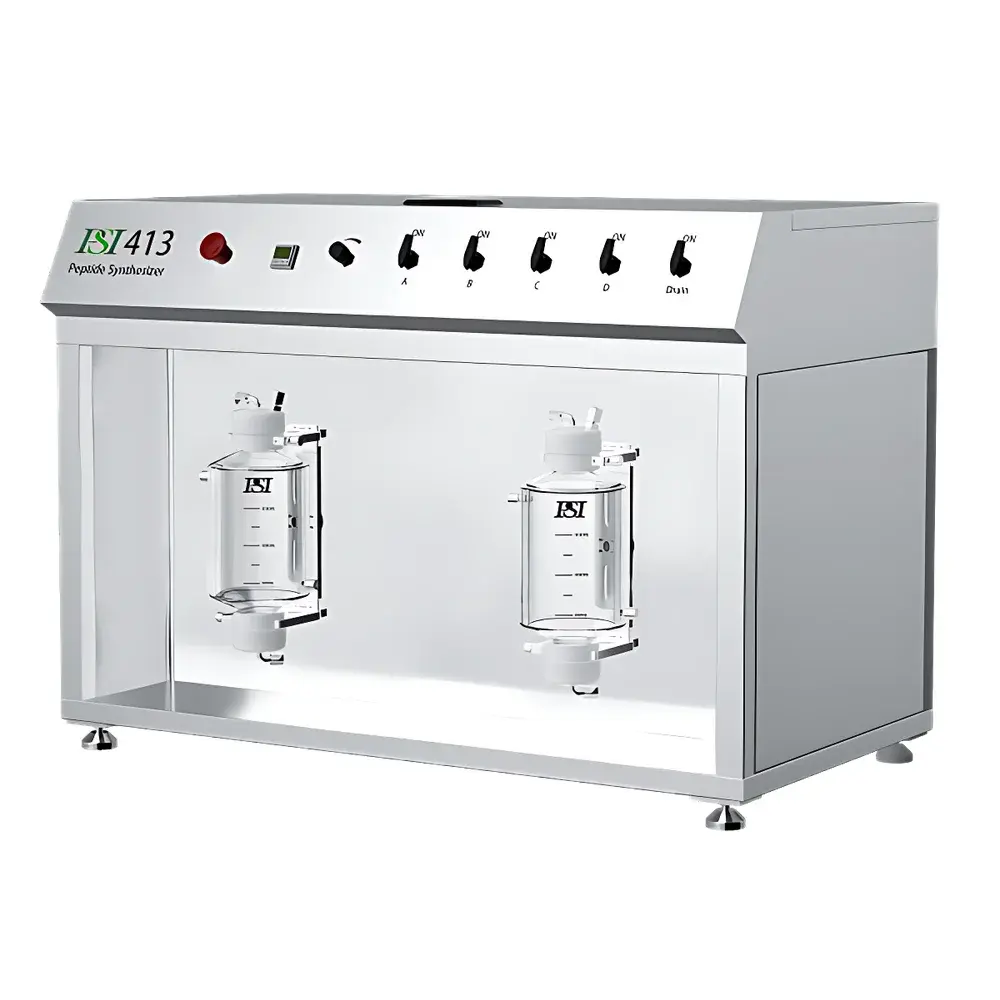
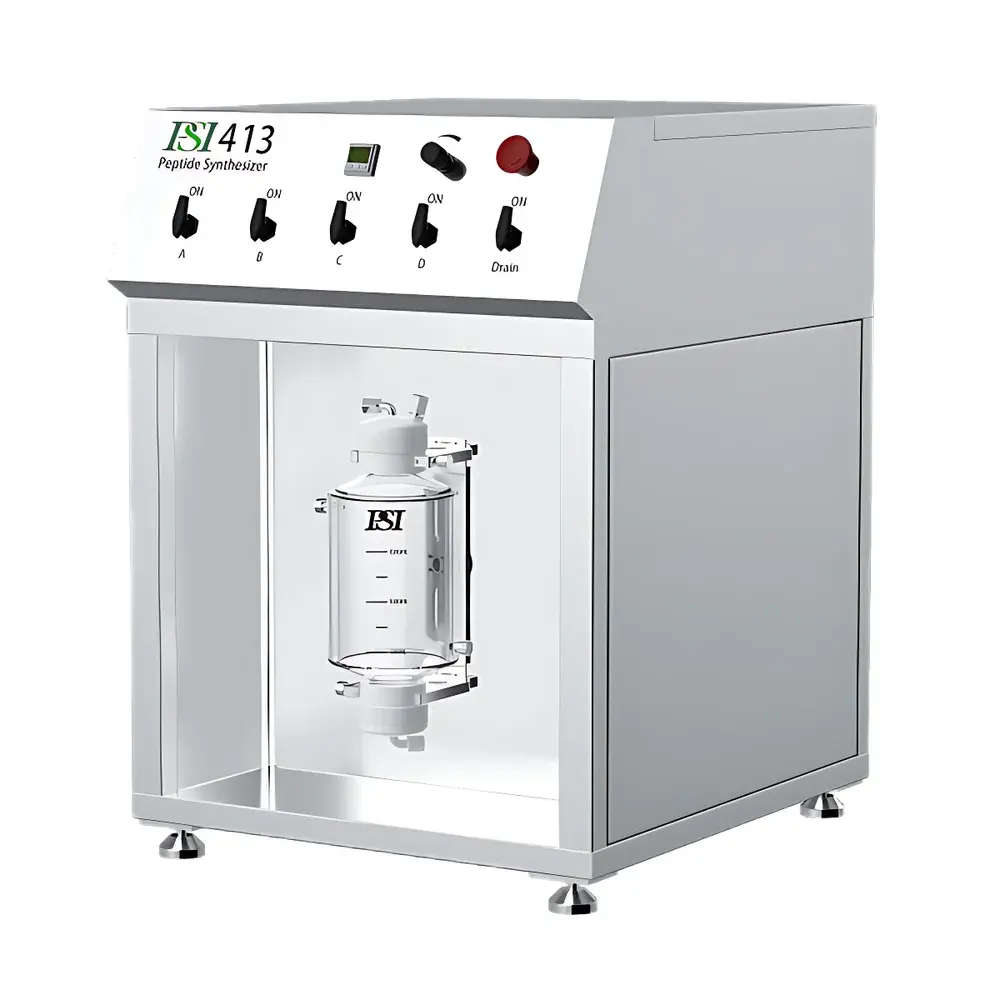
PSI DL-PSI413 Semi-Automatic Pilot-Scale Peptide Synthesizer (Single or Dual Channel)
| Brand | PSI |
|---|---|
| Origin | USA |
| Model | PSI413 |
| Synthesis Scale | 2.5–20 mmol per channel |
| Reactor Configuration | 1 or 2 reactors |
| Reactor Volumes | 0.5 L, 1 L, 2 L (jacketed) |
| Amino Acid & Reagent Addition | Manual |
| Syringe Pump Accuracy | ±0.1 mL |
| Solvent Flow Rate | 200 mL/min |
| Mixing Mechanism | Reactor Inversion (stirrer-free) |
| Coupling Efficiency | ≥99.5% |
| Temperature Control | Water Bath |
| Agitation Speed | 0–25 rpm (infinitely adjustable) |
| Solvent Reservoirs | 4 |
| Power Supply | 220 V, 50/60 Hz, 1 kW |
| Inert Atmosphere | N₂ or Ar throughout synthesis |
| Maximum Peptide Length | >100 residues |
| Construction Material | 304 Stainless Steel |
| Compliance | Designed for GLP-compliant peptide process development and scale-up |
Overview
The PSI DL-PSI413 Semi-Automatic Pilot-Scale Peptide Synthesizer is an engineered platform for robust, reproducible solid-phase peptide synthesis (SPPS) at the critical pilot-scale transition—bridging laboratory discovery to GMP-relevant process validation. Unlike fully automated systems relying on mechanical stirring, the DL-PSI413 implements a proprietary stirrer-free mixing architecture: the reactor undergoes controlled 180° inversion, inducing vigorous tumbling of resin beads within the reaction medium. This motion maximizes interfacial contact between solid-phase resin and liquid reagents without shear-induced resin fragmentation—a known cause of reduced coupling efficiency and channel clogging in stirred reactors. Developed from foundational work by Dr. John Ye (1995), this inversion-based mixing enables consistent coupling yields ≥99.5% across scales up to 20 mmol per channel, supporting synthesis of peptides exceeding 100 amino acid residues with high sequence fidelity.
Key Features
- Dual-channel configuration enables parallel synthesis of two distinct peptide sequences under identical thermal and kinetic conditions—essential for comparative process optimization or co-synthesis of analogues.
- Jacketed reactors (0.5 L, 1 L, 2 L) support precise temperature control via external water bath, maintaining reaction stability during exothermic deprotection and coupling steps.
- Electronically actuated servo motor drives smooth, programmable inversion cycles (0–25 rpm, infinitely adjustable), ensuring uniform resin suspension without mechanical abrasion.
- Four independent solvent reservoirs accommodate standard SPPS reagents: DMF, DCM, piperidine, and activated amino acid solutions—minimizing cross-contamination risk.
- Full inert gas management: continuous N₂ or Ar purging maintains oxygen-free environment throughout deprotection, coupling, washing, and drying phases—critical for cysteine-rich or oxidation-sensitive sequences.
- 304 stainless steel construction ensures corrosion resistance against aggressive solvents (e.g., TFA, HFIP) and compatibility with cleaning-in-place (CIP) protocols required for multi-product facilities.
Sample Compatibility & Compliance
The DL-PSI413 accommodates standard polystyrene- and PEG-based resins (e.g., Wang, Rink amide MBHA) in particle sizes ranging from 100–200 µm, with optimal performance observed at 5–50 g resin loads per reactor. Its manual reagent addition interface supports stoichiometric precision in real time—enabling user-defined molar equivalents of amino acids, activators (HBTU/HATU), bases (DIEA), and linkers—ideal for method development where empirical optimization precedes automation. The system meets fundamental engineering requirements for GLP-aligned process documentation: all operational parameters (inversion speed, dwell times, temperature setpoints) are manually logged and traceable. While not inherently 21 CFR Part 11 compliant, its design facilitates integration with validated electronic lab notebooks (ELNs) and LIMS for audit-ready data capture during tech transfer.
Software & Data Management
As a semi-automatic platform, the DL-PSI413 does not incorporate embedded software or touchscreen controls. Instead, it relies on operator-driven protocol execution, with timing, sequencing, and volume delivery governed by standardized SOPs. This architecture eliminates firmware-related validation burdens and supports seamless alignment with existing quality management systems (QMS). Users may integrate external timers, digital flow meters, or balance interfaces for enhanced data logging. All hardware interfaces—including nitrogen pressure regulators, water bath controllers, and pump actuators—are calibrated per ISO/IEC 17025 guidelines. Maintenance logs, calibration certificates, and reagent lot traceability are maintained externally per client’s document control procedures.
Applications
- Pilot-scale synthesis of clinical trial materials (CTMs) for Phase I/II studies, particularly for oncology and metabolic disease targets requiring milligram-to-gram quantities.
- Process validation studies comparing coupling reagents, solvents, or resin types under scalable conditions prior to full automation deployment.
- Production of immunogenic peptides (e.g., neoantigens, epitope libraries) where batch-to-batch consistency and low endotoxin carryover are essential.
- Development of cyclic, branched, or post-translationally modified peptides requiring extended coupling times or orthogonal protection schemes.
- Technology transfer support between academic labs and CDMO partners—leveraging its transparent, operator-controlled workflow to deconvolute process variables.
FAQ
What distinguishes the reactor inversion mixing mechanism from conventional stirred reactors?
Inversion eliminates mechanical shear forces that fracture resin beads—preserving swelling capacity, improving reagent diffusion, and sustaining high coupling efficiency (>99.5%) over extended synthesis cycles.
Can the DL-PSI413 be upgraded to full automation?
No—the system is purpose-built as a semi-automatic platform. For automated operation, PSI offers the DL-PSI419 series with asynchronous valve manifolds and integrated reagent dispensing.
Is the system suitable for GMP manufacturing?
It is intended for pilot-scale process development and non-GMP production. For commercial manufacturing, PSI recommends its dual-arm production synthesizers validated under ICH Q5, Q7, and FDA guidance.
What maintenance is required for long-term reliability?
Routine inspection of O-rings, jacket integrity, gas line fittings, and motor drive belts every 200 synthesis cycles; annual calibration of temperature sensors and flow meters per ISO 9001 protocols.
Does the system support DIC or Fmoc-strategy synthesis exclusively?
It is fully compatible with both Fmoc and Boc chemistries, provided appropriate solvent compatibility and cleavage conditions are implemented by the operator.



