
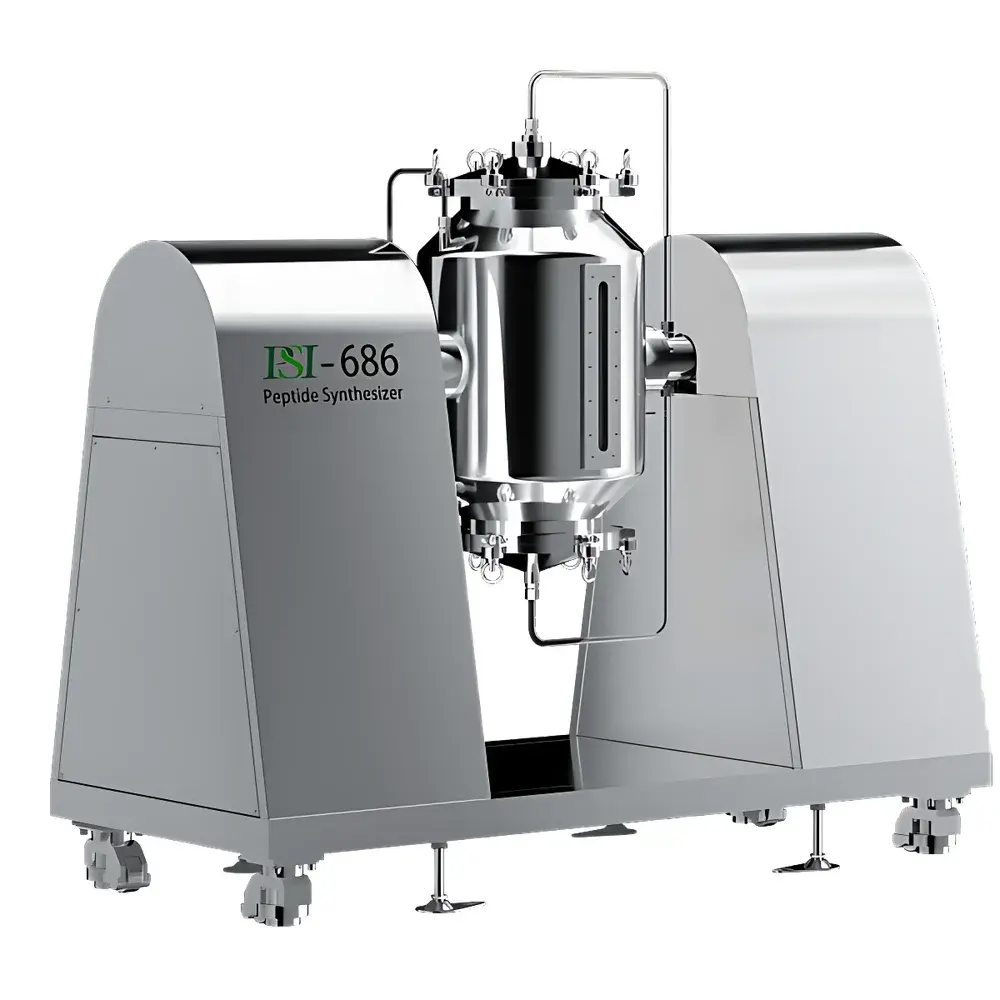
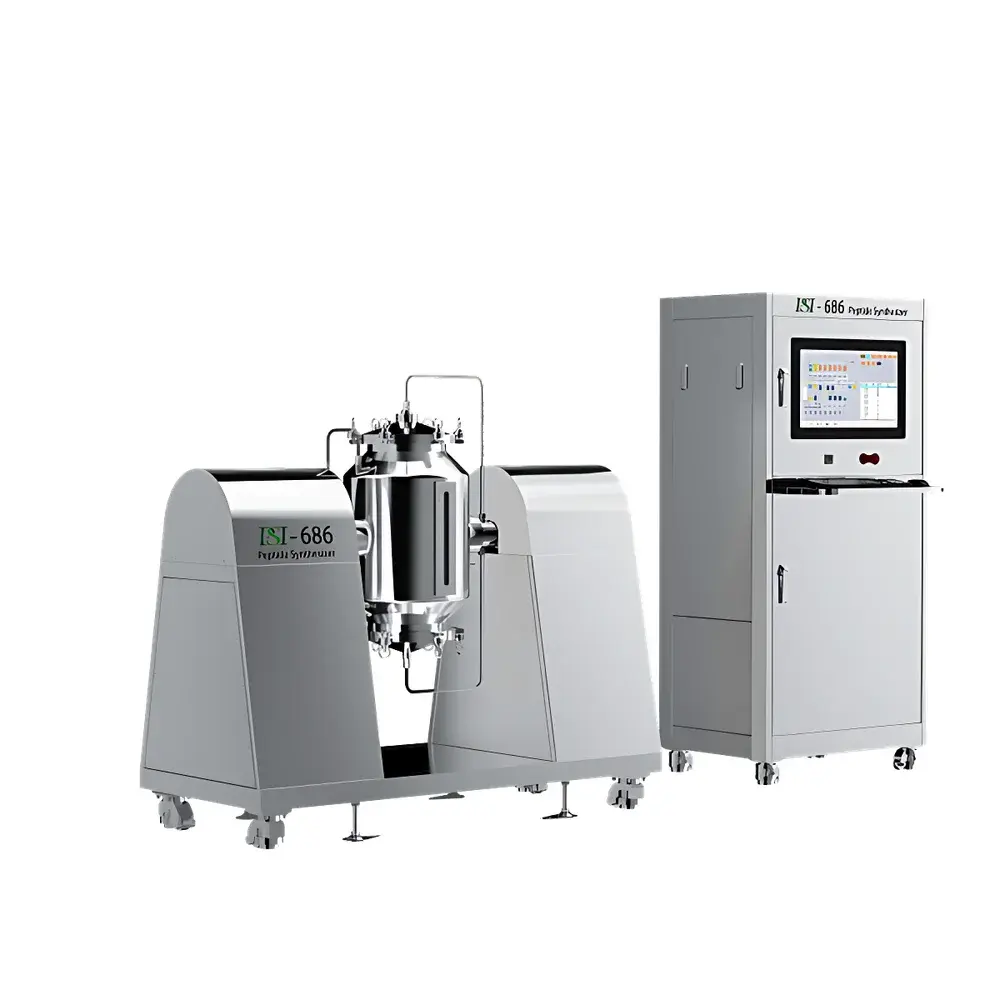
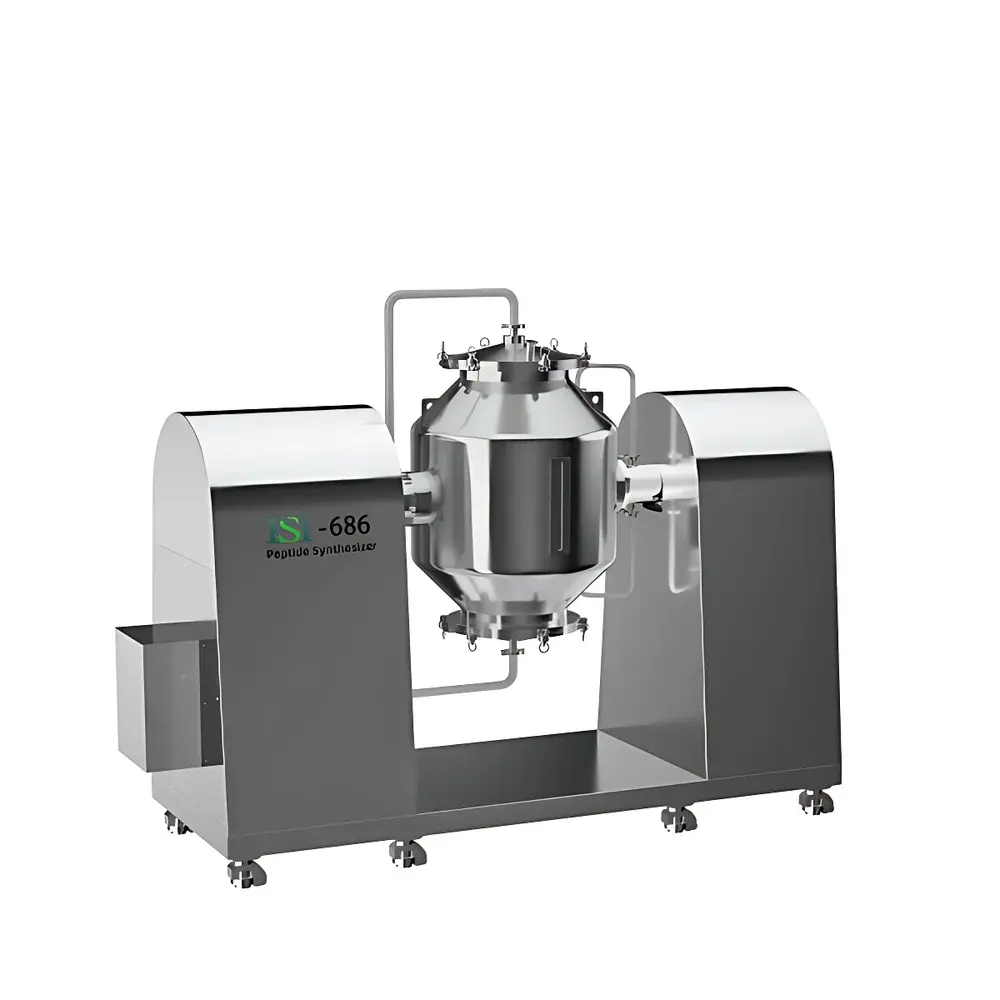
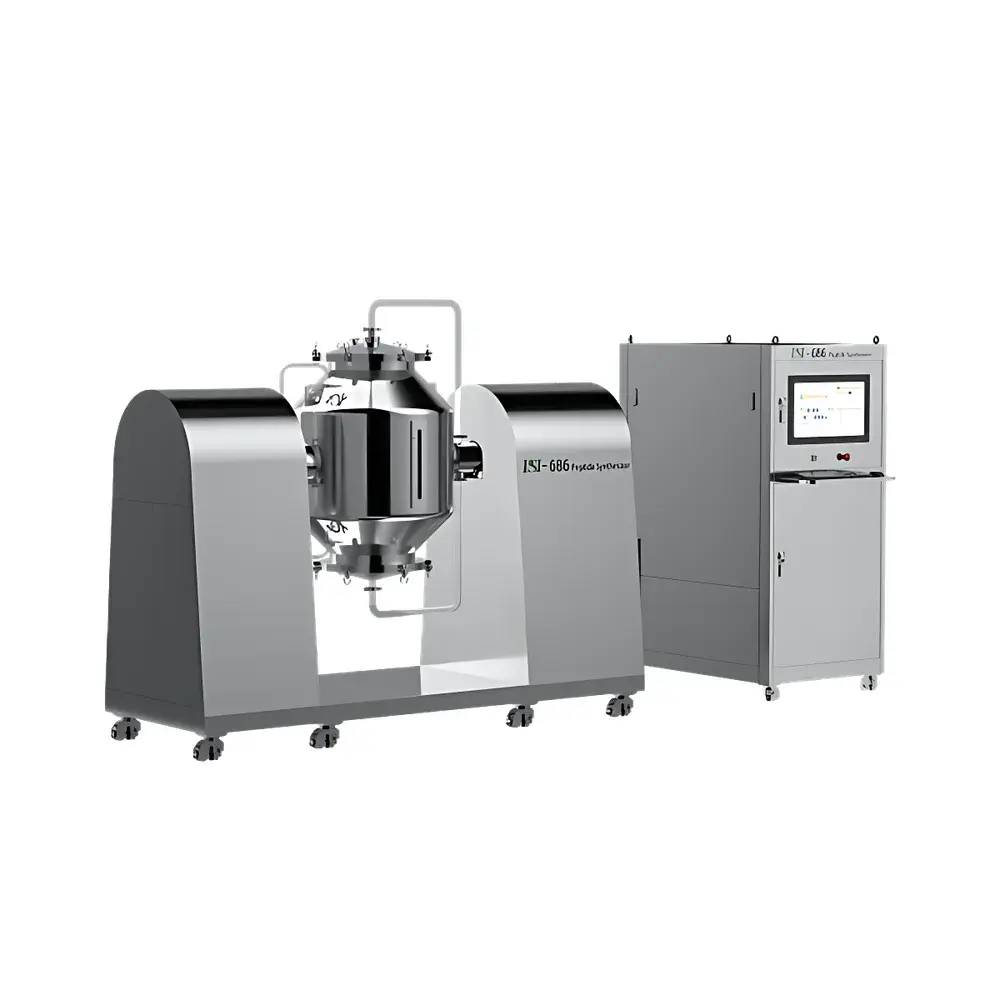
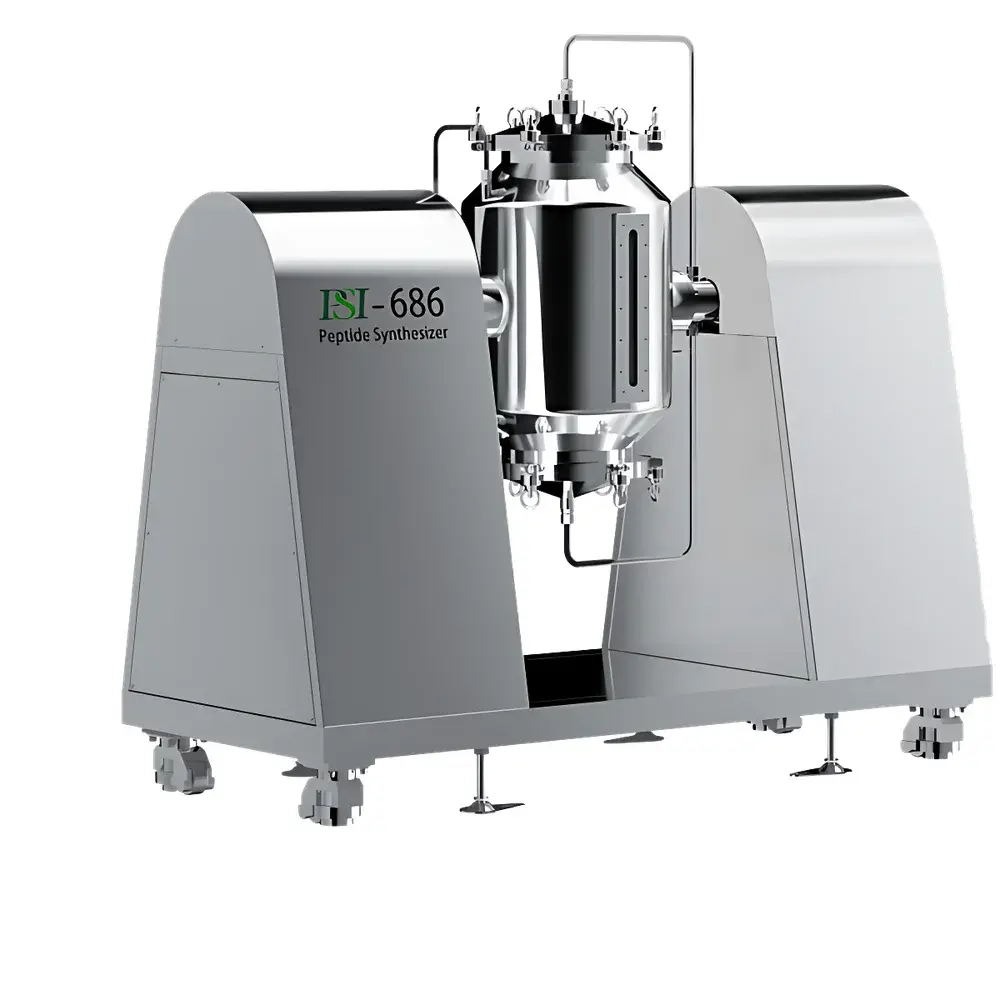
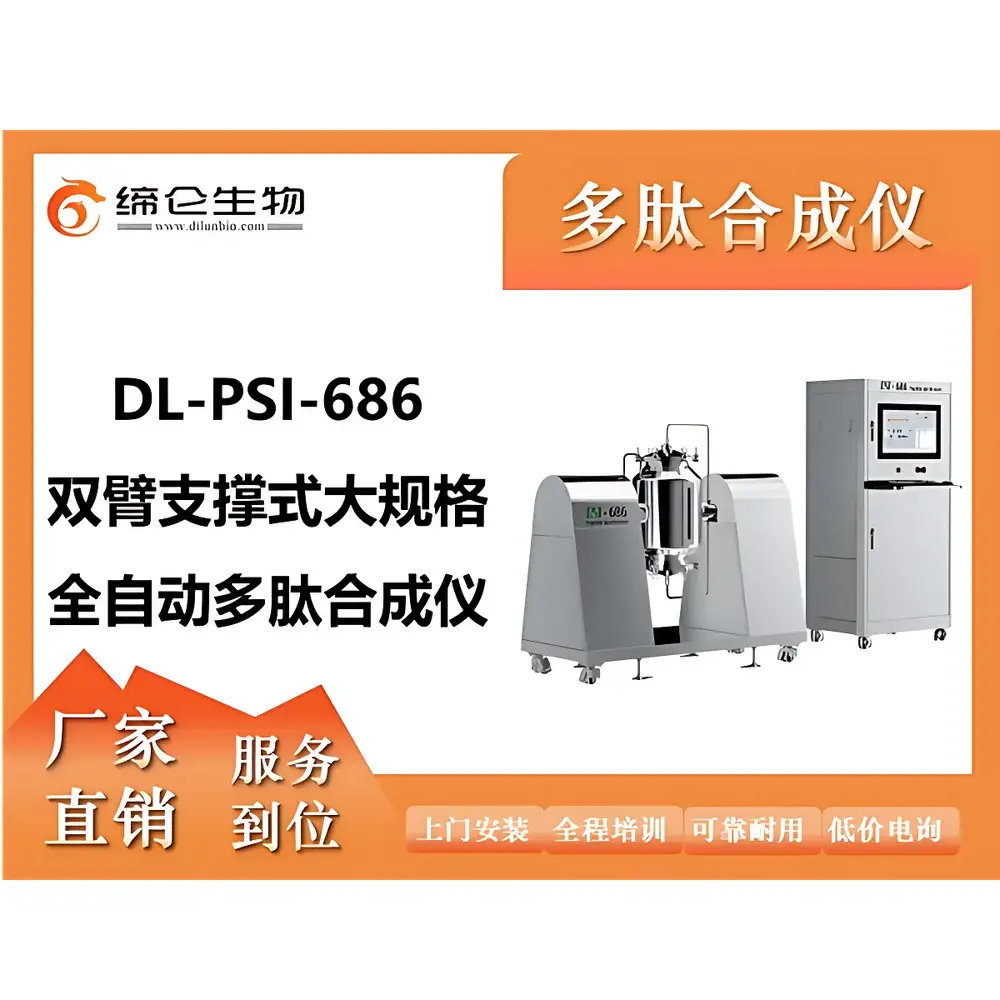
PSI DL-PSI686 Dual-Arm Supported Large-Scale Fully Automated Solid-Phase Peptide Synthesizer
| Brand | PSI |
|---|---|
| Origin | USA |
| Model | DL-PSI686 |
| Amino Acid Delivery | Automated |
| Reagent Delivery | Automated |
| Synthesis Scale | 0.15–1 mmol and 1–3 mmol |
| Reactor Quantity | 1 |
| Reactor Volume Options | 30 L / 50 L / 100 L / 200 L |
| Syringe Pump Precision | ±1 mL |
| Synthesis Purity | ≥99.5% |
| Solvent Flow Rate | 10–20 L/min |
| Construction Material | 304 Stainless Steel |
| Reactor Drive Power | 1.8–3.5 kW |
| Reactor Dimensions (L×W×H) | 158–185 cm × 70–95 cm × 125–165 cm |
| Cabinet Dimensions (L×W×H) | 145–165 cm × 90–120 cm × 185–215 cm |
| Mixing Mechanism | 180° bidirectional reactor inversion (impeller-free) |
| Solvent Inlet Channels | 3 or 5 (tubing-based) |
| Waste Discharge Ports | 3 (categorized, tubing-based) |
| Recycle Loops | 2 (tubing-based) |
| Stirring Speed Range | 0–15 rpm (infinitely variable) |
Overview
The PSI DL-PSI686 is a dual-arm supported, large-scale, fully automated solid-phase peptide synthesizer engineered for GMP-compliant manufacturing of therapeutic-grade peptides at pilot and commercial production volumes. Unlike conventional stirred-tank reactors relying on mechanical impellers—prone to resin shear, localized hot spots, and material leaching—the DL-PSI686 employs a patented 180° bidirectional reactor inversion mechanism. This impeller-free mixing principle leverages gravitational force and controlled kinetic energy transfer to induce vigorous, uniform collision between solid-phase resin beads and liquid-phase reagents across the entire reaction volume. As reactor mass increases, the mechanical energy imparted during inversion scales proportionally, ensuring reproducible homogeneity even in 200 L batches. Designed and validated per ISO 13485 and aligned with FDA 21 CFR Part 11 data integrity requirements, the system supports end-to-end traceability from amino acid coupling cycles to solvent consumption logs, making it suitable for regulatory submissions under ICH Q5, Q7, and USP .
Key Features
- Dual-arm structural support ensures mechanical stability during high-mass reactor inversion, minimizing vibration transmission and extending bearing service life beyond 10,000 operational cycles.
- Modular reactor configuration with interchangeable 30 L, 50 L, 100 L, and 200 L vessels—all fabricated from electropolished 304 stainless steel meeting ASME BPE surface finish standards (Ra ≤ 0.4 µm).
- Explosion-proof servo motor drive system with real-time torque monitoring and automatic stall detection, compliant with ATEX Zone 1 and NEC Class I, Division 1 specifications.
- Integrated solvent management architecture featuring three independent waste discharge lines (for DMF, piperidine, and acetic acid streams), two closed-loop solvent recovery paths, and five chemically resistant solvent inlet channels with pressure-regulated flow control.
- Automated amino acid delivery via precision syringe pumps calibrated to ±1 mL accuracy; reagent addition synchronized with coupling cycle timing and monitored by integrated conductivity and UV-Vis verification modules.
- Full-cycle environmental monitoring: temperature (±0.3°C), pressure (±0.5 kPa), and solvent flow rate (10–20 L/min, calibrated per ISO 4064) logged with timestamped audit trails.
Sample Compatibility & Compliance
The DL-PSI686 accommodates standard Wang, Rink amide, and 2-chlorotrityl chloride resins ranging from 100–500 µm particle size, as well as specialty functionalized supports for cyclization or post-synthetic modification. It supports Fmoc/tBu, Boc/Bzl, and hybrid protection schemes with orthogonal deprotection kinetics. All wetted surfaces comply with USP Class VI biocompatibility testing. The system meets ASTM E2500-13 (User Requirements Specification) and supports validation protocols per IQ/OQ/PQ frameworks. Documentation packages include Factory Acceptance Test (FAT) reports, Material Certificates (EN 10204 3.1), and full GxP-ready electronic records—including electronic signatures compliant with 21 CFR Part 11 Subpart C.
Software & Data Management
Controlled by PSI SynthOS™ v4.2, a deterministic real-time operating system running on an industrial-grade embedded controller, the DL-PSI686 provides role-based access control (RBAC), configurable workflow templates, and automated deviation logging. All synthesis parameters—including coupling time, deprotection duration, wash cycles, and reagent batch IDs—are stored in an encrypted SQLite database with optional synchronization to SQL Server or Oracle via TLS 1.2–secured ODBC connections. Audit trails are immutable, time-stamped, and exportable in PDF/A-1b format for regulatory review. Batch reports include raw sensor data, chromatographic purity estimates (via optional inline UV-Vis integration), and reconciliation of theoretical vs. actual reagent consumption per step.
Applications
- Commercial-scale synthesis of generic and innovator peptide APIs (e.g., liraglutide analogs, octreotide derivatives, and GLP-1 receptor agonists).
- Production of immunogenic epitopes for vaccine development under cGMP conditions.
- Manufacturing of peptide–drug conjugates (PDCs) requiring strict stoichiometric control and low residual solvent limits.
- Support of Phase III clinical trial material supply with full traceability down to individual amino acid lot numbers.
- Process development studies comparing coupling efficiency across resin types, solvents, and activation chemistries under identical mechanical mixing conditions.
FAQ
What regulatory standards does the DL-PSI686 support for pharmaceutical manufacturing?
It is designed and documented to meet FDA 21 CFR Part 11, EU Annex 11, ISO 13485, and ICH Q7 requirements, with full validation support documentation available upon request.
Can the system operate unattended for extended synthesis runs?
Yes—equipped with integrated alarm suppression, redundant power supply monitoring, and automated emergency solvent purge protocols, it supports 72+ hour continuous operation with remote health monitoring via SNMP or MQTT.
Is reactor inversion speed adjustable per synthesis step?
No—the inversion frequency is fixed at 0.25 Hz (15 rpm equivalent kinetic energy) to ensure consistent resin impact velocity; however, inversion dwell time and direction sequence are programmable per cycle.
How is resin integrity preserved during large-volume inversion mixing?
Resin attrition is minimized through optimized inversion arc geometry and deceleration profiles that limit peak acceleration to <2.5 g, validated using dynamic image analysis per USP .
Does PSI provide lifecycle support for legacy method transfers?
Yes—PSI offers method conversion services from ACT Tetras, CEM Liberty, or Gyros Protein Technologies platforms, including kinetic parameter mapping and resin-swelling equivalence modeling.



