
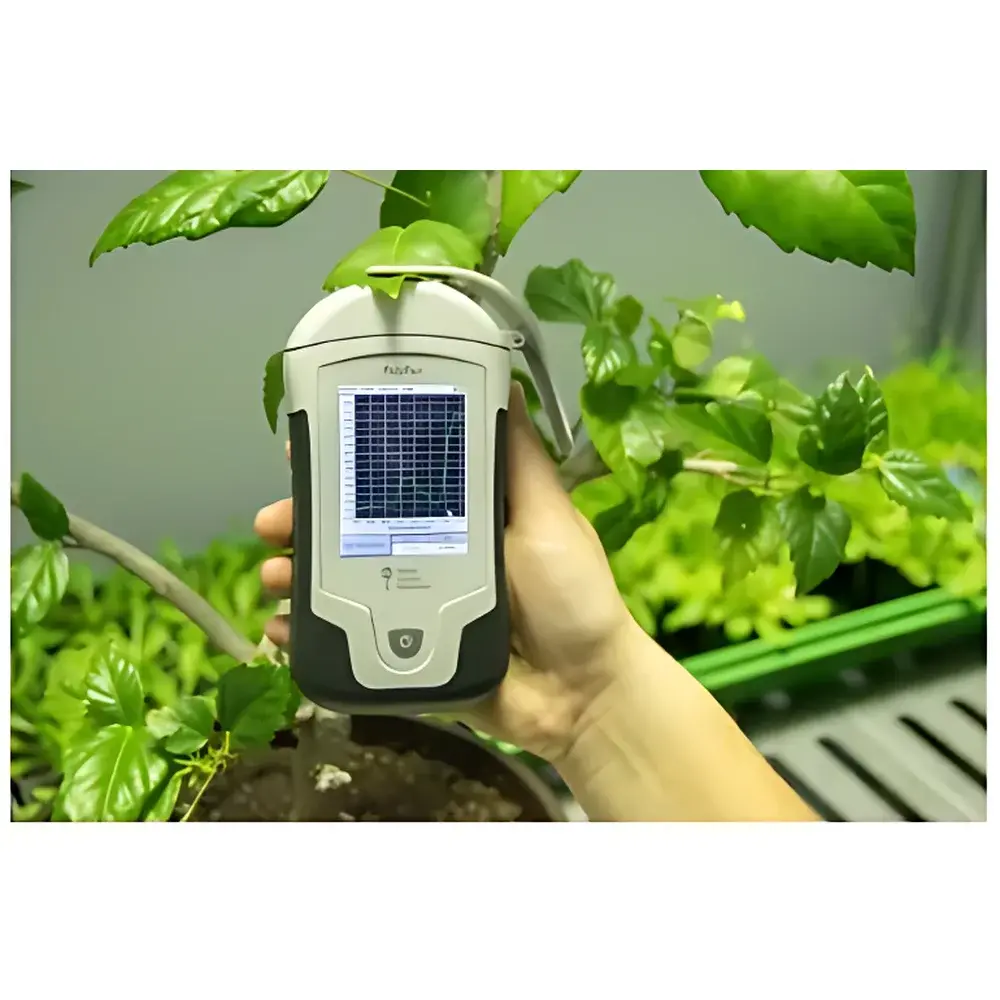
PSI FluorCam Portable Photosynthesis & Chlorophyll Fluorescence Imaging System
| Brand | PSI |
|---|---|
| Origin | Czech Republic |
| Model | FluorCam Portable |
| CO₂ Range | 0–3000 ppm |
| CO₂ Resolution | 1 ppm |
| H₂O Range | 0–75 mbar |
| H₂O Resolution | 0.1 mbar |
| PAR Range | 0–3000 µmol·m⁻²·s⁻¹ |
| Leaf Chamber Temp | −5 to 50 °C (±0.2 °C) |
| Air Pump Flow | 100–500 mL/min |
| CO₂ Control | up to 2000 ppm |
| PAR Control | RGB LED up to 2400 µmol·m⁻²·s⁻¹, White LED up to 2500 µmol·m⁻²·s⁻¹ |
| Battery Life | up to 16 h (12 V / 7.5 Ah Li-ion) |
| Imaging Sensor | TOMI-2 CCD, 1360×1024 pixels, 16-bit A/D, 20 fps max |
| Imaging Area | 35×46 mm |
| Excitation Wavelengths | 620 nm (measuring light), 455/620/white (saturating & actinic light), 735 nm (far-red) |
| Spectral Response | 400–1000 nm |
| Quantum Efficiency | 70% at 540 nm |
| Read Noise | <12 e⁻ RMS |
| Full Well Capacity | >70,000 e⁻ (unbinned) |
| Data Interface | Gigabit Ethernet, Mini-B USB, RS232 |
| Display | 480×272 pixel WQVGA touchscreen |
| Storage | SD card (up to 32 GB) |
Overview
The PSI FluorCam Portable Photosynthesis & Chlorophyll Fluorescence Imaging System is a field-deployable, dual-modality instrumentation platform engineered for integrated assessment of plant photosynthetic performance. It combines closed-system gas exchange measurement—based on non-dispersive infrared (NDIR) CO₂ analysis and differential open-path humidity sensing—with high-resolution, quantitative chlorophyll fluorescence imaging grounded in pulse-amplitude modulated (PAM) fluorometry principles. This co-registered measurement architecture enables simultaneous acquisition of physiological parameters (net assimilation rate A, transpiration E, stomatal conductance Gs, intercellular CO₂ concentration Ci) and spatially resolved fluorescence kinetics (Fv/Fm, ΦPSII, NPQ, ETR, qP, Rfd, OJIP-derived JIP-test parameters), thereby capturing both biochemical capacity and photochemical efficiency across heterogeneous leaf surfaces. Designed for rigorous field ecology and controlled-environment physiology, the system adheres to established photobiological measurement conventions defined in ISO 17123-9 and ASTM E2933, supporting reproducible, GLP-compliant experimental workflows.
Key Features
- Integrated dual-sensor architecture: NDIR-based CO₂ analyzer with automatic zeroing, temperature/pressure compensation, and differential open-path H₂O sensor (0–75 mbar, ±0.1 mbar resolution)
- Programmable LED illumination system: Four independently controllable 5×5 LED arrays providing tunable measuring light (620 nm, 10–100 µs pulse width), saturating light (white, blue 455 nm, or red 620 nm; up to 4900 µmol·m⁻²·s⁻¹), actinic light (0–1400 µmol·m⁻²·s⁻¹), and far-red (735 nm) for Fo′ determination
- TOMI-2 scientific CCD imaging module: 1360×1024 pixel resolution, 16-bit dynamic range (65,536 gray levels), 20 fps video capture capability, quantum efficiency peak at 540 nm (70%), spectral sensitivity 400–1000 nm
- Comprehensive fluorescence parameter suite: Real-time calculation and 2D mapping of >50 parameters including Fv/Fm, ΦPSII, NPQ, qP, qN, Rfd, ETR, OJIP transient derivatives (VJ, VK, ABS/RC, TR0/RC, ET0/RC), and kinetic curve fitting
- Modular expandability: Optional GFP fluorescence imaging, JIP-test OJIP rapid induction module, vegetation spectral index package (NDVI, PRI, SIPI, etc.), and polyphenol–chlorophyll ratio module (Chl, Flav, Anth, NBl indices)
- Field-hardened ergonomics: Total system mass ≤ 4.1 kg (main unit) + 0.8 kg (handheld chamber); operational range 5–45 °C; 16-hour battery autonomy; IP54-rated enclosure for outdoor deployment
Sample Compatibility & Compliance
The FluorCam Portable accommodates intact leaves, seedlings, rosettes, and small canopy sections via interchangeable temperature-controlled leaf chambers and spring-loaded leaf clips with integrated dark-adaptation capability. Its non-invasive optical design ensures minimal sample perturbation during repeated measurements over diurnal or stress-response time courses. All gas exchange protocols comply with standardized methodologies referenced in USDA ARS Technical Bulletin No. 1932 and the European COST Action FA1306 guidelines for photosynthesis phenotyping. Fluorescence imaging protocols follow the consensus definitions established by the International Society of Photosynthesis Research (ISPR) and are traceable to NIST-calibrated irradiance standards. Data acquisition and storage meet audit requirements for GLP-regulated environmental physiology studies, with timestamped metadata, firmware version logging, and user-defined protocol identifiers embedded in raw output files.
Software & Data Management
FluorCam Control & Analysis software provides a unified interface for instrument configuration, real-time visualization, and post-acquisition quantification. The application supports live preview, customizable measurement protocols (via drag-and-drop workflow builder or script-based editing), ROI definition (rectangular, circular, polygonal, sector-based), and batch processing of multi-sample datasets. Each acquired image sequence is stored with full metadata—including ambient PAR, leaf temperature, CO₂ setpoint, actinic intensity, and timing parameters—in vendor-neutral HDF5 format. Export options include time-resolved fluorescence movies (AVI/MPEG-4), parameter heatmaps (TIFF/PNG), statistical summaries per ROI (CSV/XLSX), histograms, and kinetic curve overlays. Software modules implement FDA 21 CFR Part 11–compliant electronic signatures, audit trails, and role-based access control when deployed on networked laboratory systems.
Applications
This system serves as a primary tool in plant abiotic and biotic stress phenotyping, enabling quantitative comparison of photosynthetic resilience across genotypes under drought, heat, cold, salinity, heavy metal exposure, or pathogen challenge (e.g., powdery mildew, Fusarium circinatum). It supports high-throughput screening of elite crop varieties for carbon fixation efficiency, nitrogen use efficiency (via NBl index), and photoprotective capacity (NPQ dynamics). In climate change research, it facilitates field-based monitoring of photosynthetic acclimation across elevation gradients or long-term warming experiments. Additional applications include functional validation of transgenic lines (GFP reporter co-imaging), optimization of greenhouse lighting strategies, and calibration of satellite-derived vegetation indices through ground-truth spectral–physiological correlation.
FAQ
What distinguishes the FluorCam Portable from conventional portable photosynthesis systems?
It uniquely integrates PAM fluorometry-based spatial imaging with high-precision gas exchange in a single handheld platform—enabling concurrent measurement of biochemical fluxes and photochemical efficiency across heterogeneous tissue regions.
Can the system operate autonomously during extended field campaigns?
Yes: programmable无人值守 protocols support timed, sequential measurements over hours or days; data are timestamped and stored locally on SD card or streamed via Gigabit Ethernet to remote servers.
Is the fluorescence imaging calibrated for absolute quantum yield quantification?
Yes: factory calibration against NIST-traceable radiometric standards ensures quantitative ΦPSII and ETR values; user recalibration is supported using reference reflectance tiles and certified light meters.
How does the system handle variable ambient light conditions during field use?
The integrated cosine-corrected PAR sensor and real-time feedback loop enable dynamic adjustment of actinic light intensity to maintain consistent photosynthetic photon flux density (PPFD) regardless of sky conditions.
Are software updates and firmware upgrades provided post-purchase?
Yes: PSI delivers free lifetime firmware and software updates via secure customer portal, including new protocol templates, analytical algorithms, and compliance enhancements aligned with evolving ISO/ASTM standards.
Related Products





