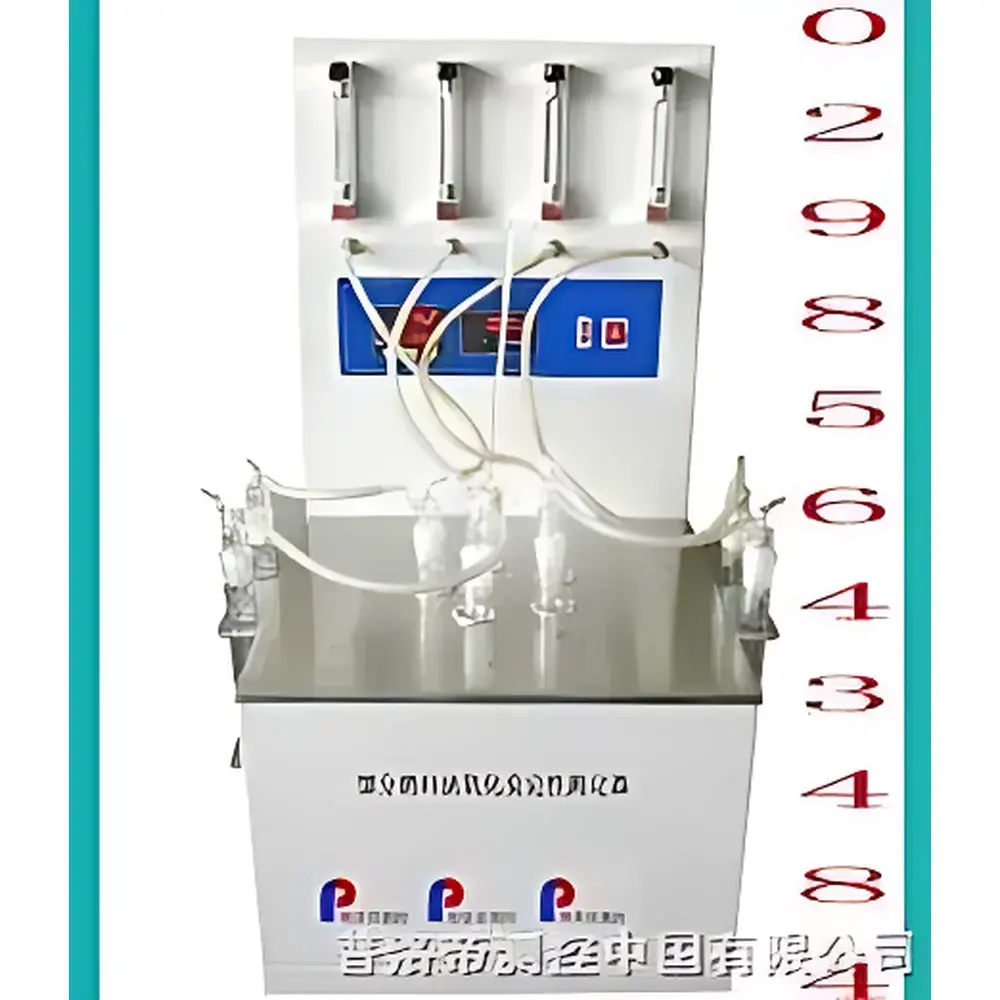
PULUODY PLD-0175B Distillate Fuel Oxidation Stability Tester
| Brand | PULUODY |
|---|---|
| Origin | Shaanxi, China |
| Manufacturer Type | Direct Manufacturer |
| Country of Origin | China |
| Model | PLD-0175B |
| Power Supply | AC 220 V ±10%, 50 Hz |
| Heating Power | 1500 W |
| Temperature Control Accuracy | ±0.1 °C |
| Bath Capacity | 4 Test Positions |
| Oxygen Flow Control | Calibrated Precision Flowmeter |
| Cooling Method | Integrated Drain Valve + Forced-Air Fan |
| Operating Environment | Dark Chamber Enclosure |
| Compliance Standard | SH/T 0175 |
Overview
The PULUODY PLD-0175B Distillate Fuel Oxidation Stability Tester is a precision-engineered laboratory instrument designed for the quantitative assessment of oxidative degradation resistance in middle-distillate petroleum fuels—primarily diesel, heating oil, and jet fuel fractions. It operates on the principle of accelerated oxidation under controlled thermal and gaseous conditions, in strict accordance with the Chinese national standard SH/T 0175, which is technically aligned with ASTM D2274 (Standard Test Method for Oxidation Stability of Distillate Fuel Oil by Accelerated Method) and equivalent to ISO 12205. The instrument subjects fuel samples to elevated temperature (typically 95 °C), continuous oxygen flow (10 mL/min ±0.5 mL/min), and extended exposure time (16 hours) within a thermostatically regulated water bath. Oxidation products—including insoluble gum and sediment—are subsequently quantified gravimetrically after filtration, enabling direct evaluation of fuel storage stability and susceptibility to deposit formation during long-term handling or tank storage.
Key Features
- Four independent test positions enable parallel analysis of multiple samples, improving throughput while maintaining inter-test consistency.
- Digital temperature controller with dual-display interface shows both setpoint and real-time bath temperature, facilitating rapid calibration verification and ±0.1 °C thermal stability across the full operating range (ambient to 100 °C).
- Integrated dark chamber enclosure ensures complete light exclusion during oxidation—critical for preventing photo-oxidative side reactions and meeting SH/T 0175’s mandatory dark-condition requirement.
- Precision-calibrated mass flowmeter delivers stable, traceable oxygen delivery at 10 mL/min, eliminating reliance on pressure regulators or uncalibrated rotameters.
- Automated thermal management system includes auxiliary heater cutoff logic and post-test forced-air cooling via built-in fan, coupled with bottom-mounted drain valve for rapid bath fluid evacuation without disturbing oxidized sample tubes.
- Robust stainless-steel bath vessel and corrosion-resistant internal components ensure long-term reliability in humid, oxygen-rich environments.
Sample Compatibility & Compliance
The PLD-0175B is validated for use with distillate-range hydrocarbon fuels having initial boiling points above 150 °C and final boiling points below 370 °C. Compatible matrices include ultra-low-sulfur diesel (ULSD), biodiesel blends up to B20, aviation turbine fuel (Jet A/A-1), and industrial heating oils. All operational parameters—including temperature ramp rate, oxygen flow tolerance, and dark-chamber integrity—conform to SH/T 0175 Section 5 requirements. While not certified to ASTM or ISO standards out-of-the-box, the system’s mechanical and control architecture permits third-party validation for ASTM D2274 compliance when operated under documented SOPs and calibrated against NIST-traceable references. Routine performance qualification (PQ) checks—including temperature uniformity mapping across all four wells and flowmeter linearity verification—are recommended prior to GLP or quality-controlled release testing.
Software & Data Management
The PLD-0175B operates as a standalone benchtop instrument with no embedded microprocessor or data logging capability. Temperature setpoint, elapsed time, and manual timer activation are managed via front-panel controls. For laboratories requiring electronic recordkeeping, integration with external data acquisition systems (e.g., LabVIEW, DeltaV, or LIMS) is supported via optional analog voltage output (0–5 V) for bath temperature monitoring. All test parameters—including start time, termination criteria, and operator ID—must be manually recorded in bound logbooks or electronic lab notebooks (ELN) to satisfy basic audit trail requirements under ISO/IEC 17025 or internal QC protocols. While the unit does not support FDA 21 CFR Part 11-compliant electronic signatures, its deterministic operation and physical traceability align with paper-based GLP documentation practices common in refinery QC labs.
Applications
- Refinery quality assurance: Final product release testing for oxidation stability prior to pipeline injection or terminal storage.
- Fuel additive evaluation: Screening antioxidant efficacy (e.g., hindered phenols, amine-based stabilizers) under standardized oxidative stress.
- Blending compatibility studies: Assessing synergistic or antagonistic interactions between conventional diesel and bio-derived components (FAME, HVO).
- Storage stability forecasting: Correlating measured gum content with real-world tank aging behavior using empirical regression models.
- Regulatory submission support: Generating data packages for national fuel specifications where SH/T 0175 compliance is mandated.
FAQ
What standards does the PLD-0175B directly comply with?
It is engineered and verified to meet all procedural and apparatus requirements specified in SH/T 0175. Its design principles and performance envelope are compatible with ASTM D2274 and ISO 12205, though formal certification requires site-specific validation.
Can the instrument accommodate non-standard sample volumes or alternative oxidants?
No. It is configured exclusively for 40 mL fuel samples in standardized copper coil-wrapped oxidation tubes per SH/T 0175. Only medical-grade or high-purity oxygen (≥99.5%) is permitted; air or nitrogen substitution invalidates test validity.
Is routine calibration required, and what tools are needed?
Yes. Annual verification of temperature uniformity (using four calibrated PT100 probes) and flowmeter accuracy (with bubble flowmeter or mass flow calibrator) is essential. Calibration certificates must reference ISO/IEC 17025-accredited standards.
How is bath water replenishment handled during multi-shift operation?
The system lacks automatic level sensing. Operators must visually inspect and manually top up deionized water before each test batch to maintain immersion depth over the oxidation tube shoulders.
Does the dark chamber provide electromagnetic shielding or RF isolation?
No. The enclosure is optically opaque only; it offers no EMI suppression. Placement near variable-frequency drives or radio transmitters may affect digital temperature display stability and should be avoided.