
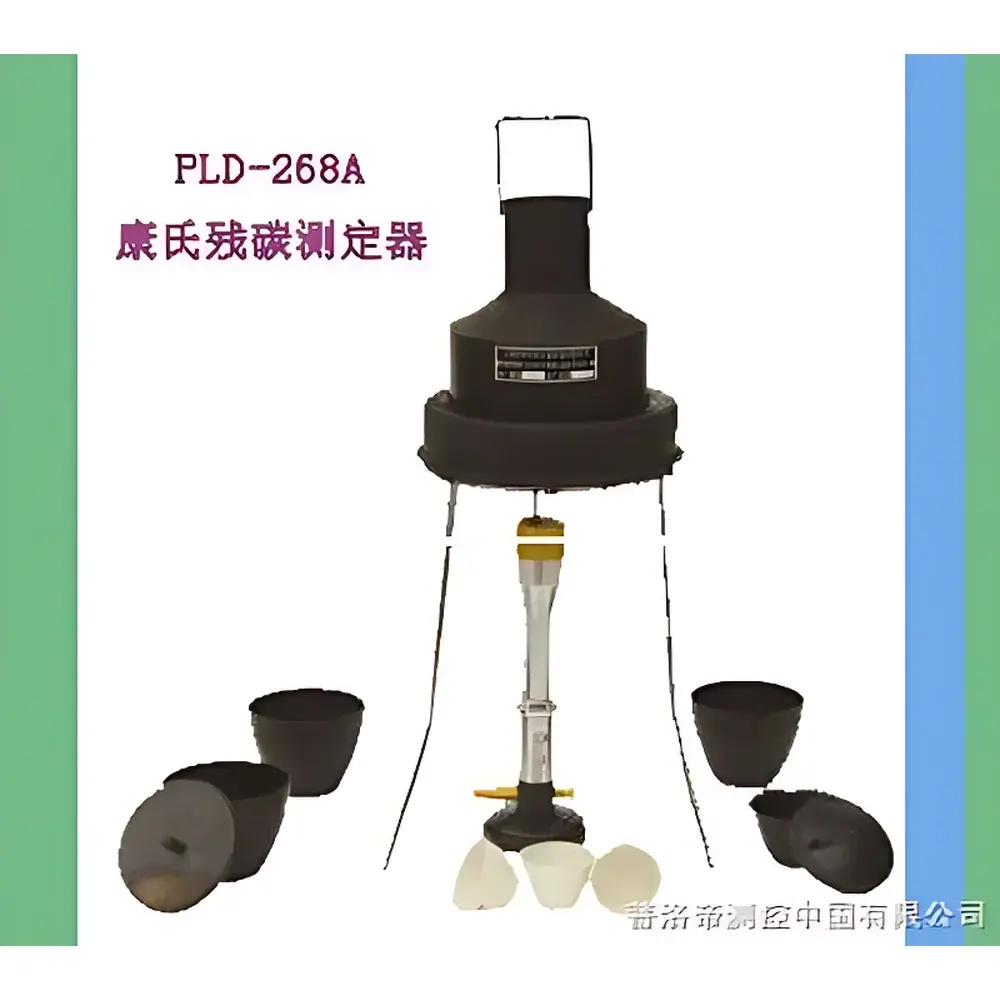
PULUODY PLD-268A Conradson Carbon Residue Tester
| Brand | PULUODY |
|---|---|
| Origin | Shaanxi, China |
| Manufacturer Type | Direct Manufacturer |
| Country of Origin | China |
| Model | PLD-268A |
| Ceramic Crucible | Low-form, 30 mL |
| Inner Iron Crucible | Galvanized steel, 75 ± 5 mL with lid |
| Outer Iron Crucible | Galvanized steel, 190 ± 10 mL with lid |
| Tripod Stand | Stainless steel, height 250 ± 10 mm, ring diameter Φ130 ± 5 mm |
| Flame Shield | Stainless steel, conical bore—top opening Φ90 ± 2 mm, bottom opening Φ82 ± 2 mm |
| Stainless Steel Cover | Lower cylindrical section height 50–53 mm |
| Gas Burner | Metric-pattern gas blowtorch (Conradson-type) |
Overview
The PULUODY PLD-268A Conradson Carbon Residue Tester is a precision-engineered laboratory instrument designed exclusively for the quantitative determination of carbon residue in petroleum products according to ASTM D189 and GB/T 268—both standardized test methods based on the classical Conradson (C.R.) procedure. This gravimetric technique involves controlled pyrolysis of a weighed sample under specified thermal conditions in a confined, non-ventilated environment, followed by oxidation of volatile matter and final weighing of the residual carbonaceous deposit. The PLD-268A replicates the original Conradson geometry and thermal dynamics with high fidelity, ensuring method compliance and inter-laboratory reproducibility essential for refinery QC, fuel specification verification, and lubricant stability assessment.
Key Features
- Exact geometric replication of ASTM D189/GB/T 268 apparatus specifications—including dimensional tolerances for inner/outer iron crucibles, ceramic crucible volume, tripod height and ring diameter, flame shield taper, and fire bridge elevation.
- Stainless steel construction for critical structural components (tripod, flame shield, cover), providing thermal stability, corrosion resistance, and long-term dimensional integrity during repeated heating cycles up to 550 °C.
- Dual-layer crucible system: A low-form 30 mL porcelain crucible nests inside a 75 ± 5 mL galvanized inner iron crucible, which in turn sits within a 190 ± 10 mL outer iron crucible—ensuring uniform heat distribution and minimizing thermal shock-induced cracking.
- Integrated flame-height control via calibrated Φ3 mm iron wire fire bridge, positioned at 50 ± 3 mm above the base plane to standardize burner flame impingement geometry per method requirements.
- Optimized flame shield design with tapered stainless steel bore and compressed asbestos liner, enabling consistent oxygen-limited pyrolysis atmosphere while suppressing convective interference during coking.
- Modular assembly with tool-free component alignment—facilitating rapid setup, cleaning, and traceable calibration verification between test runs.
Sample Compatibility & Compliance
The PLD-268A is validated for use with distillate fuels (e.g., diesel, jet fuel), residual fuels (e.g., bunker C, heavy fuel oil), lubricating oils, and cracked stocks where carbon residue correlates with coke-forming tendency and combustion chamber deposit potential. It fully satisfies the physical apparatus requirements of ASTM D189, ISO 6615 (identical technical basis), and GB/T 268. While the instrument itself does not perform automated data logging, its mechanical design supports GLP-compliant manual recordkeeping when used within a documented SOP framework—including sample identification, pre- and post-test crucible mass entries, burner pressure settings, and pyrolysis duration tracking. All metallic parts are fabricated from materials certified free of catalytic impurities that could artificially elevate residue yield.
Software & Data Management
The PLD-268A operates as a standalone benchtop apparatus with no embedded electronics or firmware. As such, it requires manual execution of the Conradson protocol and external documentation of results. Laboratories integrating this tester into regulated environments (e.g., ISO/IEC 17025-accredited labs or those operating under FDA 21 CFR Part 11 or EU Annex 11 guidelines) are advised to pair it with validated electronic lab notebooks (ELNs) or LIMS platforms supporting audit-trail-enabled entry of raw mass values, calculated % carbon residue, operator ID, and environmental parameters (ambient temperature/humidity). Calibration records for analytical balances used in conjunction with the PLD-268A must be maintained per ISO/IEC 17025 Clause 6.5 and NIST SP 810 guidance.
Applications
- Refinery process control: Monitoring carbon residue trends in vacuum residuum and coker feedstocks to optimize delayed coker drum cycle times and minimize drum fouling.
- Fuel quality assurance: Verifying compliance of marine distillate and residual fuels against IMO MARPOL Annex VI limits and ISO 8217 specifications.
- Lubricant formulation R&D: Evaluating thermal stability of base oils and additive packages under simulated high-temperature engine conditions.
- Research correlation studies: Establishing empirical relationships between Conradson carbon residue and other thermal degradation metrics (e.g., Ramsbottom carbon residue, microcarbon residue).
- Educational laboratories: Teaching fundamental principles of petroleum thermochemistry, gravimetric analysis, and standardized test method implementation.
FAQ
Is the PLD-268A compatible with ASTM D189 revision 2023?
Yes—the mechanical dimensions, material specifications, and functional configuration conform strictly to the apparatus requirements defined in ASTM D189–23 Section 6.1.
Does the instrument include calibration certificates for individual components?
No; calibration of associated equipment (e.g., analytical balance, gas pressure regulator) must be performed separately by the end user per ISO/IEC 17025 or national metrology standards.
Can the asbestos liner in the flame shield be replaced with a non-asbestos alternative?
Yes—ceramic fiber gasket material meeting ASTM C941 compressive strength and thermal stability requirements may be substituted, provided validation confirms equivalent flame attenuation and residue yield consistency.
What safety precautions are recommended during operation?
Use only in a certified fume hood with adequate ventilation; wear heat-resistant gloves and face shield during crucible handling; verify gas line integrity and leak-tight connections prior to ignition.
Is routine maintenance required beyond cleaning?
Yes—inspect stainless steel components quarterly for warping or pitting; replace the asbestos (or approved substitute) liner after every 50 test cycles or if visibly degraded; recalibrate supporting instrumentation annually.





