
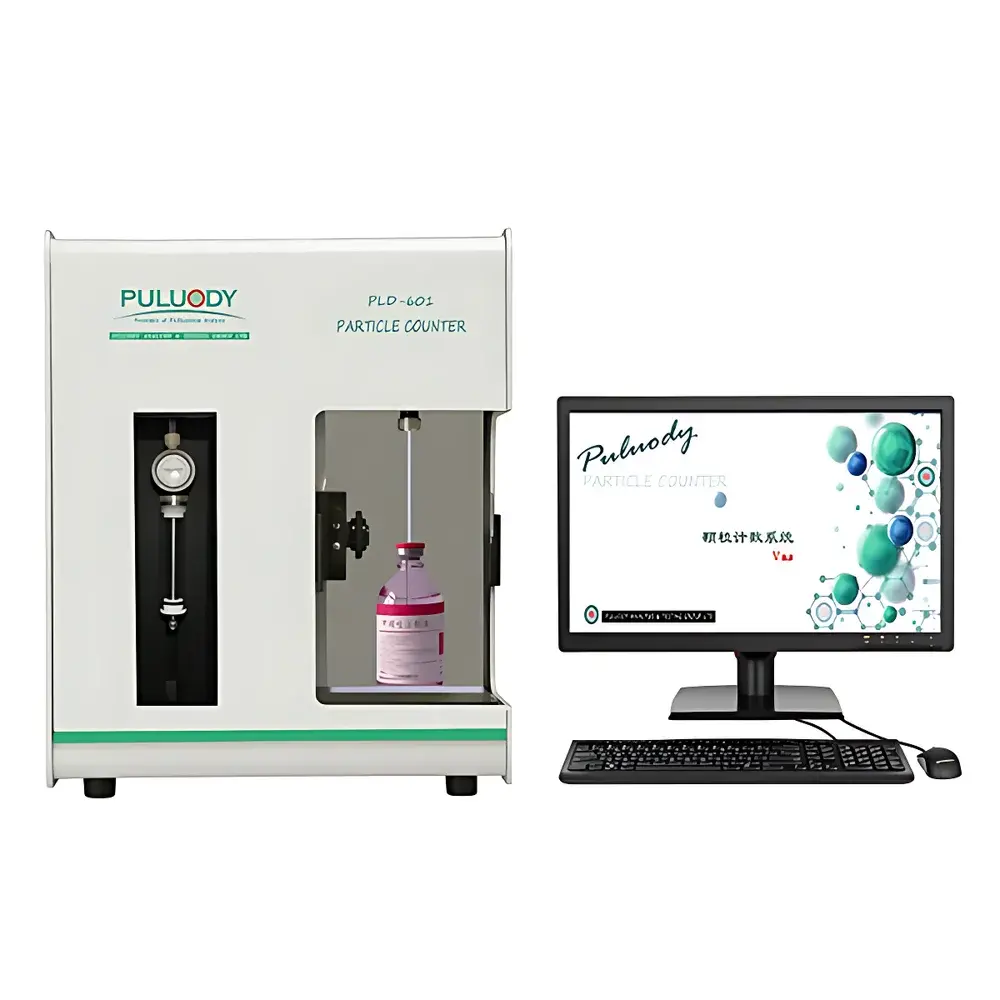
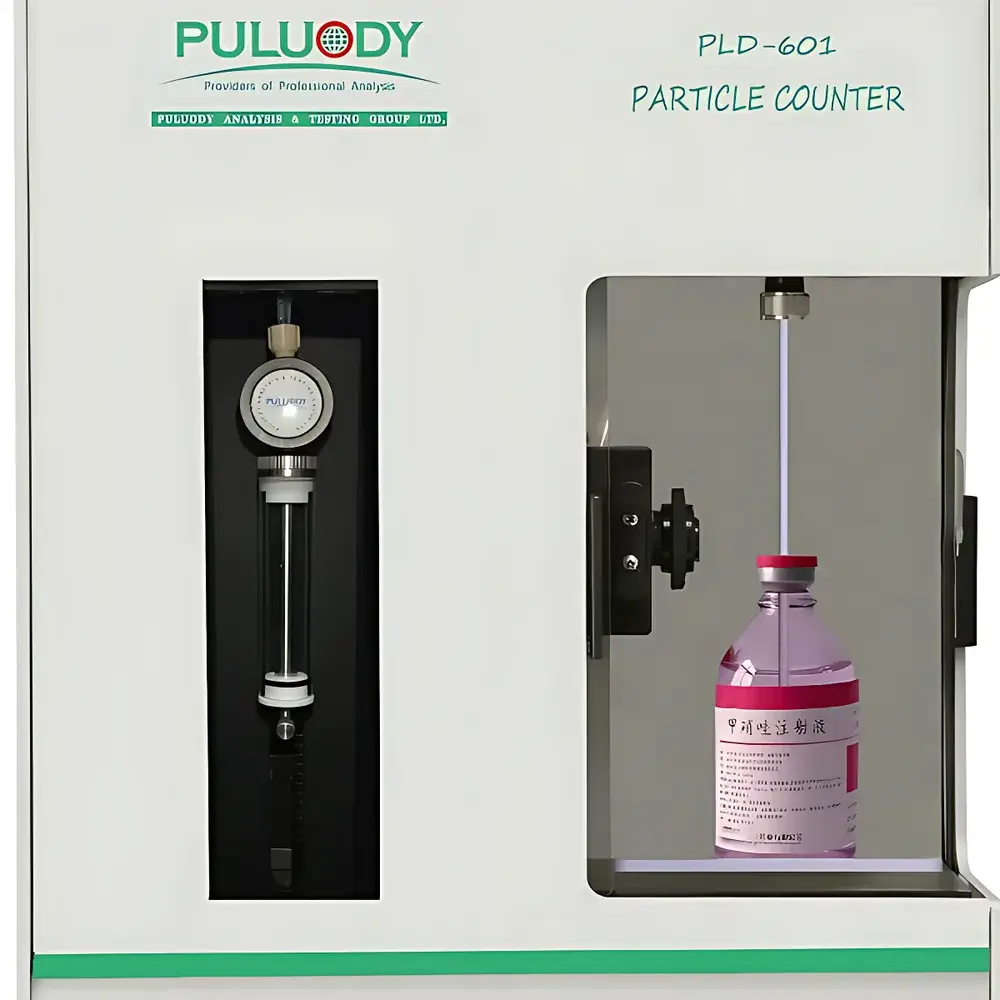
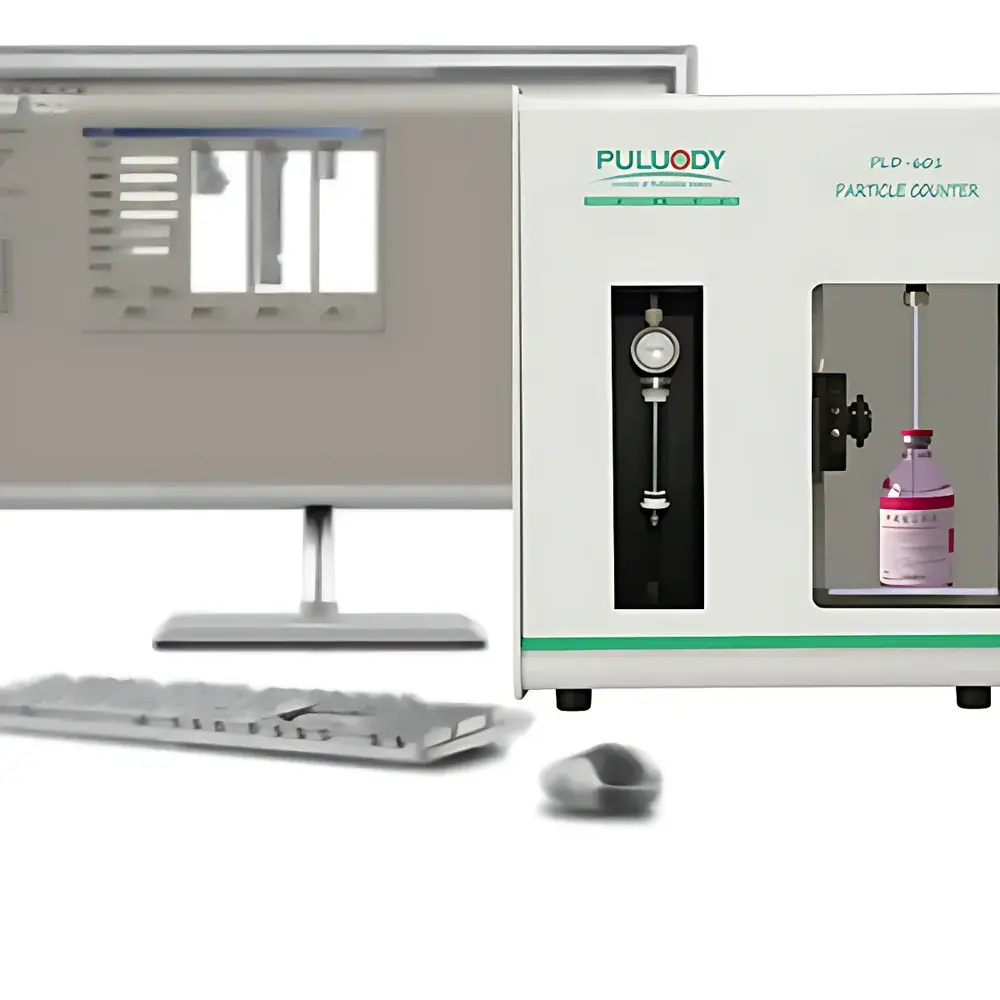
PULUODY PLD-601W Large-Volume Parenteral Insoluble Particle Analyzer
| Brand | PULUODY |
|---|---|
| Model | PLD-601W |
| Origin | Shaanxi, China |
| Detection Principle | Light Obscuration (LO) / Dual-Laser Narrow-Beam Particle Sensing |
| Sensor Generation | 8th-Generation Dual-Laser Narrow-Beam Detector |
| Flow Control | Precision Metering Plunger Pump + Ultra-Precise Electromagnetic Flow Control System |
| Measurement Range | 1–450 µm (customizable sub-ranges: 1–100 µm or 4–70 µm(c) |
| Channel Count | 1000 adjustable channels |
| Sampling Flow Rate | 5–150 mL/min |
| Cleaning Flow Rate | 5–500 mL/min |
| Sample Temperature Range | 0–80 °C |
| Ambient Operating Temperature | 0–50 °C |
| Accuracy | ±5% typical (per ChP 2020 & USP <788>) |
| Coincidence Limit | ≤5% at 1000 particles/mL |
| Resolution | >95% (ChP-calibrated), <10% (USP/ISO 21501-calibrated) |
| Sampling Precision | <±1% |
| Compliance Standards | ChP 0903 (2015/2020), USP <788>, <789>, <797>, EP 10.0, BP 2019, YBB00272004-2015, ISO 21501-4, ISO 4406, NAS 1638, GB/T 11446.9-2013, JJG 1061 |
| Software | V8.9 Integrated Analysis Suite (PC & embedded touchscreen) with 5-level user权限 management, audit trail, electronic signature, and 21 CFR Part 11 compliance |
| Data Integrity | Auto-backup, restore, power-fail recovery, GLP/GMP-ready reporting |
Overview
The PULUODY PLD-601W Large-Volume Parenteral Insoluble Particle Analyzer is an engineered solution for quantitative particulate contamination assessment in sterile pharmaceutical preparations and high-purity process liquids. It operates on the light obscuration (LO) principle—where particles suspended in a liquid stream pass through a focused dual-laser narrow-beam sensing zone, generating transient signal pulses proportional to their cross-sectional area. This eighth-generation sensor architecture delivers enhanced signal-to-noise ratio and reduced optical scatter interference, enabling robust discrimination of sub-micron contaminants in viscous or optically complex matrices. Designed specifically for regulatory-grade testing of large-volume parenterals (LVPs), the instrument meets the physical measurement requirements of pharmacopoeial monographs—including Chinese Pharmacopoeia (ChP) General Chapter 0903, United States Pharmacopeia (USP) , , and , European Pharmacopoeia (EP) 10.0, and British Pharmacopoeia (BP) 2019. Its core function is not merely enumeration but metrologically traceable particle sizing and counting across a 1–450 µm dynamic range, supporting both routine QC release testing and root-cause investigation of filtration inefficiency, container-closure integrity failure, or manufacturing process drift.
Key Features
- 8th-generation dual-laser narrow-beam particle sensor with optimized beam geometry for improved resolution and reduced coincidence error at high particle concentrations
- Dual-mode precision flow control: metering plunger pump for volumetric accuracy (<±1%) combined with electromagnetic flow regulation for real-time velocity stabilization during sampling and cleaning cycles
- 1000-channel high-resolution pulse analysis architecture—enabling fully customizable binning (e.g., 4 to 128 user-defined size thresholds) aligned with pharmacopoeial or internal SOP requirements
- V8.9 integrated software platform compliant with FDA 21 CFR Part 11: featuring five-tier role-based access control, immutable audit trail with timestamped operator actions, electronic signatures, and cryptographic data integrity verification
- Embedded 10.1″ color touchscreen interface with optional wireless keyboard/mouse support—designed for glove-compatible operation in cleanroom environments (ISO Class 5–8)
- Thermally stabilized fluid path accommodating sample temperatures from 0 °C to 80 °C, ensuring consistent viscosity compensation and minimizing thermal-induced flow variance
- Full validation support package: includes traceable calibration using NIST-traceable latex standards (ISO 21501-4), JJG 1061-compliant verification protocols, and documentation templates for IQ/OQ/PQ execution
Sample Compatibility & Compliance
The PLD-601W accommodates a broad spectrum of liquid-phase samples critical to pharmaceutical quality assurance and industrial cleanliness control. Validated applications include aqueous and non-aqueous injectables (solution-type, lyophilized powders, concentrated solutions), ophthalmic preparations, vaccines, sterile active pharmaceutical ingredients (APIs), injection-grade water (WFI, PW), primary and secondary packaging materials (glass vials, polymer bags, elastomeric stoppers), and infusion devices (filters, tubing, connectors). It further supports particulate assessment in ultrapure water systems (electronic-grade, semiconductor-grade), CMP slurries, nanofluids, lubricants, and cosmetic emulsions. Regulatory alignment extends beyond pharmacopoeias to international cleanliness standards including ISO 4406 (hydraulic fluids), NAS 1638 (aerospace), SAE AS4059F, and MIL-STD-1246C. All firmware and software modules undergo periodic revision control per ICH Q9/Q10 principles, with change logs archived for GMP audit readiness.
Software & Data Management
The V8.9 software suite provides a unified environment for method development, acquisition, statistical analysis, and report generation. Each test method stores full parameter metadata—including flow rate, temperature setpoint, channel configuration, and calibration ID—ensuring method reproducibility across instruments and sites. Raw pulse data are retained in binary format with lossless compression; processed results export to CSV, PDF, or XML for LIMS integration. Audit trail records capture every user-initiated event: login/logout, parameter modification, result approval/rejection, calibration execution, and backup initiation. Electronic signatures comply with ALCOA+ principles (Attributable, Legible, Contemporaneous, Original, Accurate) and satisfy FDA, EMA, and PMDA expectations for electronic records. Optional cloud-sync enables secure remote review by QA auditors without compromising local data sovereignty.
Applications
- Pharmaceutical QC labs: batch release testing of LVPs per ChP 0903 and USP ; filter challenge studies evaluating terminal sterilizing filter efficiency (e.g., 0.22 µm PES membranes)
- Biologics manufacturing: monitoring microaggregates in monoclonal antibody formulations and viral vector suspensions
- Medical device evaluation: quantifying extractables/leachables from IV sets, syringes, and infusion pumps under simulated use conditions
- Water system qualification: trending particle counts in purified water (PW) and water for injection (WFI) distribution loops per EU Annex 1 and FDA guidance
- Semiconductor fabrication: monitoring CMP slurry stability and detecting wafer-scratching contaminants in rinse baths
- Chemical R&D: characterizing dispersion stability of nanomaterials, pigment suspensions, and functional coatings
FAQ
Does the PLD-601W meet FDA 21 CFR Part 11 requirements for electronic records and signatures?
Yes—the V8.9 software implements full Part 11 functionality, including role-based permissions, automated audit trails, electronic signatures with biometric or token-based authentication, and data encryption at rest and in transit.
Can the instrument be calibrated using ISO 21501-4 reference materials?
Absolutely. The system accepts NIST-traceable polystyrene latex (PSL) standards certified to ISO 21501-4, and calibration reports include uncertainty budgets per ISO/IEC 17025.
Is it possible to define custom particle size channels outside pharmacopoeial defaults?
Yes. Users may configure up to 1000 discrete channels or group them into any number of contiguous bins (e.g., 4, 8, 16, 32, 64, 128) with independent threshold settings.
What maintenance intervals are recommended for the plunger pump and fluidic system?
Plunger seals require replacement every 6 months under continuous operation; the entire wetted path is autoclavable, and the system supports automated cleaning validation via conductivity or TOC verification protocols.
How does the instrument handle high-viscosity samples such as oil-based injectables?
The dual-flow control architecture maintains stable laminar flow across viscosities up to 500 cP; optional heated sample lines (up to 80 °C) reduce viscosity-related pulsation and improve count accuracy.
Related Products





