
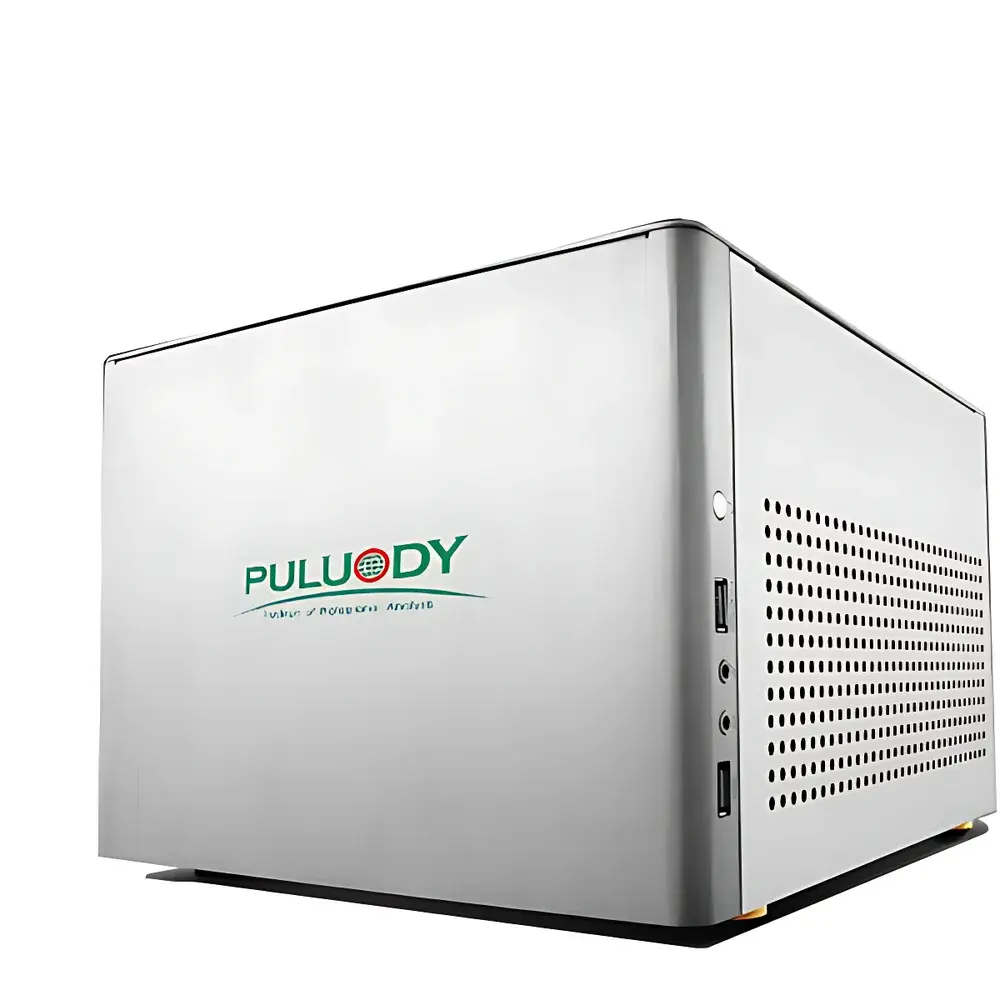
PULUODY PMT-2LD Optical Particle Counter for Aluminum Electrolytic Capacitor Electrolytes
| Brand | PULUODY |
|---|---|
| Model | PMT-2LD |
| Instrument Type | Optical Particle Counter |
| Detection Principle | Dual-Laser Narrow-Beam Light Obscuration |
| Detection Range | 0.5–20.0 µm (standard) |
| Sensor Generation | 8th-Generation Dual-Laser Narrow-Beam Detector |
| Sampling Method | Precision Metering Piston Pump |
| Flow Control | Dual-Stage Electromagnetic + Precision Piston Pump |
| Accuracy | ±3% typical |
| Volume Accuracy | ±1% |
| Coincidence Limit | ≤2.5% error at 1000 particles/mL |
| Output | 4–20 mA analog interface with configurable particle concentration alarm |
| Calibration Standards | JJG 1061, ISO 21501-4, NIST-traceable latex sphere reference |
| Software | V8.3 Integrated Analysis & Calibration Software (PC + touchscreen UI) |
| Display | Color LCD touchscreen + optional wireless keyboard/mouse |
| Power Input | 100–265 VAC, 50–60 Hz |
| Compliance | Designed for GLP/GMP-aligned environments |
Overview
The PULUODY PMT-2LD Optical Particle Counter is a high-precision, dual-laser narrow-beam light obscuration instrument engineered specifically for the quantitative assessment of insoluble particulate contamination in aluminum electrolytic capacitor electrolytes and other ultra-clean process liquids. Its core measurement principle relies on calibrated light extinction detection—where particles suspended in a laminar liquid stream pass through two spatially separated, collimated laser beams, generating pulse signals proportional to their cross-sectional area. This dual-beam architecture significantly reduces false counts from air bubbles, refractive index fluctuations, and transient flow anomalies—critical for low-conductivity, low-viscosity electrolyte formulations where traditional single-beam sensors exhibit elevated noise floors. The system operates under strict volumetric metering control via a precision piston pump and electromagnetic flow stabilization, ensuring repeatable sample aspiration across both online and offline configurations. Designed for integration into semiconductor-grade cleanroom workflows and capacitor manufacturing QC labs, the PMT-2LD meets the stringent sensitivity and reproducibility demands of ISO 11171, ISO 21501-4, and IEC 60384-14 compliance frameworks.
Key Features
- Dual-laser narrow-beam optical detection architecture—8th-generation sensor platform optimized for sub-micron particle resolution in low-scatter media such as organic solvent-based electrolytes.
- Independent calibration and analysis software modules (V8.3) eliminate signal interference between metrological verification and routine testing workflows.
- Configurable detection thresholds: standard 0.5–20.0 µm range; extended modes support user-defined channels from 1–100 µm or 4–70 µm(c), including optional 0.1 µm(c) critical size detection.
- High-fidelity volumetric sampling: ±1% volume accuracy enabled by dual-stage flow control—precision metering piston pump coupled with real-time electromagnetic flow compensation.
- Real-time analog output (4–20 mA) with programmable alarm thresholds for continuous process monitoring in inline electrolyte filtration loops or filling line validation stations.
- Full GLP/GMP readiness: audit trail logging, role-based user authentication, electronic signature support, and 21 CFR Part 11-compliant data integrity controls (software-enabled).
Sample Compatibility & Compliance
The PMT-2LD is validated for use with non-aqueous and weakly conductive liquids common in capacitor manufacturing—including ethylene glycol/DMF-based electrolytes, γ-butyrolactone solutions, and ammonium adipate/borate blends. It also supports aqueous systems such as ultrapure water (UPW), semiconductor cleaning chemistries (SC-1, SC-2), and polymer precursor solutions. All wetted components are chemically inert (316L SS, sapphire flow cell, PFA tubing) and compatible with ISO 8573-4 compressed air purity standards when used in pressurized sampling configurations. Regulatory alignment includes traceability to JJG 1061 (Chinese national metrology regulation), ISO 21501-4 (light extinction particle counters), and ASTM F3231 (microcontamination monitoring in electronics processing fluids). Calibration is performed using NIST-traceable polystyrene latex (PSL) spheres certified per ISO 21501-4 Annex B.
Software & Data Management
The V8.3 software suite provides dual-mode operation: a standalone calibration module for periodic sensor verification (per ISO 21501-4 Annex D), and a production testing module for routine particle counting, size distribution histogramming, and ISO 4406/ISO 11171 contamination grading. Data export supports CSV, PDF, and XML formats with embedded metadata (operator ID, timestamp, calibration certificate ID, environmental conditions). All test records are stored in an encrypted local database with automatic backup to network drives. The system supports remote diagnostics via secure TLS 1.2 connections and integrates with LIMS platforms through OPC UA and RESTful API interfaces. Audit trails record every parameter change, report generation, and user login event—retained for ≥36 months per GMP data retention guidelines.
Applications
- Quality control of aluminum electrolyte formulations prior to impregnation—ensuring <100 particles/mL above 0.5 µm to prevent dielectric breakdown.
- In-line monitoring of electrolyte recirculation loops during capacitor aging and formation processes.
- Validation of final filtration stages (e.g., 0.1 µm PTFE membranes) in high-reliability capacitor production lines.
- Contamination benchmarking of UPW and cleaning solvents used in wafer-level packaging facilities.
- Stability studies of polymer gel electrolytes and nanocomposite suspensions under thermal stress conditions.
- Root cause analysis of field failures linked to particulate-induced short circuits in automotive-grade capacitors.
FAQ
What particle size standards does the PMT-2LD support for calibration?
It accepts NIST-traceable PSL spheres per ISO 21501-4, as well as calibration per JJG 1061 (China) and ISO 11171 (hydraulic fluids)—with optional custom reference material certification.
Can the instrument be integrated into a PLC-controlled production line?
Yes—via 4–20 mA analog output with configurable alarm relays and Modbus RTU/TCP protocol support for direct SCADA connectivity.
Is the flow cell compatible with aggressive organic solvents like DMF or γ-butyrolactone?
All fluid-contact materials (sapphire window, 316L stainless steel, PFA seals) are chemically resistant to common capacitor electrolyte solvents per ASTM D471 compatibility testing.
Does the system meet FDA 21 CFR Part 11 requirements for electronic records?
When configured with password-protected user roles, digital signatures, and immutable audit logs, it satisfies Part 11 criteria for regulated pharmaceutical and medical device manufacturing environments.
What is the minimum detectable particle concentration for 0.5 µm particles?
At optimal flow rate (10 mL/min), the lower limit of quantitation (LOQ) is 10 particles/mL with ≤5% relative standard deviation over 60-second acquisitions.



