
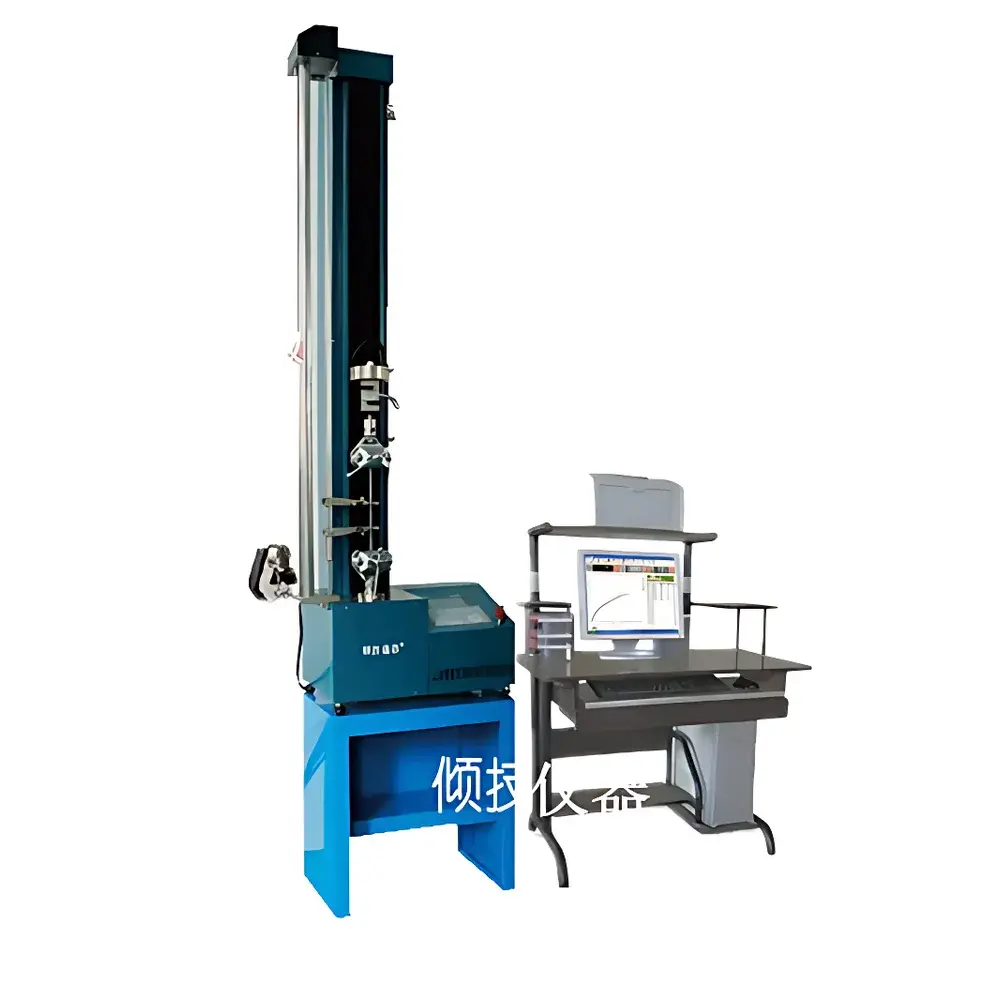
Qingji QJ210A Electronic Tensile Testing Machine for Thin Films
| Brand | Qingji |
|---|---|
| Origin | Shanghai, China |
| Model | QJ210A |
| Maximum Load Capacity | 5000 N |
| Accuracy Class | 0.5 |
| Effective Test Width | 150 mm |
| Effective Stroke | 800 mm |
| Speed Range | 0.01–500 mm/min |
| Speed Accuracy | ±0.5% of indicated value |
| Force Resolution | 500,000 counts (full-scale, no range switching) |
| Displacement & Strain Measurement Accuracy | ±0.5% of indicated value |
| Load Cell | High-precision sensor (USA-made) |
| Drive System | Panasonic AC servo motor + Taiwan-made gearmotor |
| Control System | Full-digital servo controller |
| Safety Protection | Software diagnosis, electronic limit switches, overload protection (10% above max load) |
| Power Supply | 200 V, 400 W |
| Dimensions (L×W×H) | 590 × 355 × 1640 mm |
| Weight | ~85 kg |
| Compliance | GB, ISO, ASTM, JIS, DIN, YB, YY, QC, HG, and other international & industrial standards |
| Optional Accessories | Lenovo LCD PC, HP color inkjet printer |
Overview
The Qingji QJ210A Electronic Tensile Testing Machine is a precision-engineered mechanical testing system designed specifically for the quantitative evaluation of tensile, compressive, flexural, peel, puncture, and bending properties of thin-film materials and related flexible substrates. Built upon a robust dual-column frame architecture and driven by a high-stability Panasonic AC servo motor coupled with a Taiwan-sourced planetary gear reducer, the QJ210A delivers smooth, low-vibration vertical motion via preloaded ball screws—ensuring long-term mechanical repeatability and minimal thermal drift. Its measurement principle follows standardized uniaxial force-displacement transduction: load is captured in real time via a traceable, USA-manufactured strain-gauge-based load cell; displacement is derived from high-resolution encoder feedback synchronized with the servo drive; and deformation (where applicable) is monitored using extensometer-compatible inputs or digital image correlation-ready mounting points. The system operates within a calibrated force range of 5 N to 5000 N (with interchangeable load cells enabling seamless scaling across sub-newton to kilonewton regimes), and maintains a certified accuracy class of 0.5 per ISO 7500-1 and ASTM E4.
Key Features
- Full-range, no-switching force resolution of 500,000 counts—ensuring consistent sensitivity from 0.2% to 100% of full scale without manual range adjustment
- Programmable crosshead speed from 0.01 to 500 mm/min, with closed-loop velocity control accuracy maintained within ±0.5% of setpoint
- Integrated dual-mode positioning: rapid manual return to home position and programmable automatic return post-test
- Dual-stage safety architecture—hardware-based electronic limit switches complement software-driven diagnostic monitoring and real-time overload cutoff (triggered at 110% of selected capacity)
- Modular fixture interface supporting custom-designed grips, peel blocks, dart impact fixtures, and pneumatic clamping kits for low-force film handling
- High-contrast monochrome LCD panel with real-time dynamic display of force (N, kN, kgf, lbf, gf), displacement (mm), strain (%), and stress–strain curve overlay
- Standard RS232 and USB 2.0 interfaces for bidirectional communication with host PCs; compatible with Windows-based acquisition and reporting software
Sample Compatibility & Compliance
The QJ210A accommodates specimens up to 150 mm wide and 800 mm in active gauge length—making it suitable for standard ASTM D882 (thin plastic film), ISO 527-3 (polymer films), GB/T 1040.3 (plastics tensile testing), YY/T 0148 (medical packaging peel strength), and JIS Z 1707 (laminated film adhesion). It supports both rigid and compliant substrates including PET, BOPP, PE, PVC, aluminum foil laminates, biodegradable cellulose films, and coated release liners. All mechanical and metrological performance parameters comply with ISO 7500-1 (static calibration), ISO 5893 (dynamic testing), and ASTM E8/E8M (tension testing of metallic materials, where applicable). The system’s data acquisition architecture meets GLP audit requirements, with timestamped raw data logs, user-accessible calibration certificates, and configurable operator authentication protocols.
Software & Data Management
The QJ210A operates with Qingji’s proprietary TMS (Tensile Measurement Suite) v3.2 software—deployable on Windows 10/11 platforms. The application provides ISO-compliant test method templates (e.g., “ASTM D882 – Film Tensile”, “ISO 1133 – Melt Flow Index Support”), customizable pass/fail criteria, multi-curve overlay for batch comparison, and automated report generation in PDF, Excel, and XML formats. All test data—including raw force/displacement arrays, derivative modulus calculations (Young’s, secant, tangent), yield point detection (0.2% offset), and elongation-at-break—are stored with embedded metadata: operator ID, environmental conditions (optional external hygrothermograph integration), calibration status, and instrument firmware version. Audit trails record all parameter modifications, test starts/stops, and result exports—supporting FDA 21 CFR Part 11 compliance when paired with electronic signature modules and network-based server archiving.
Applications
- Quantification of tensile strength, elongation, and Young’s modulus in polymer films used in food packaging, pharmaceutical blister cards, and agricultural mulch films
- Peel strength assessment of heat-seal layers, adhesive laminates, and pressure-sensitive tape backing systems
- Mechanical validation of barrier-coated substrates under controlled humidity and temperature (when integrated with environmental chambers)
- Quality assurance of medical device pouches per ISO 11607-2 and ASTM F88/F903
- R&D screening of nanocomposite films, electrospun membranes, and graphene-enhanced flexible electronics substrates
- Conformance testing for automotive interior trim films, solar encapsulant sheets, and battery separator membranes
FAQ
What load cell options are available for the QJ210A?
The base configuration includes a 5000 N load cell; optional lower-capacity transducers (5 N, 10 N, 100 N, 500 N) are available for high-resolution testing of ultra-thin or brittle films.
Can the system perform cyclic or fatigue testing?
Yes—when equipped with optional waveform generation modules and closed-loop strain control firmware, the QJ210A supports programmed sinusoidal, triangular, or trapezoidal loading profiles up to 5 Hz (within mechanical resonance limits).
Is third-party calibration certification included?
Each unit ships with a factory-issued calibration certificate traceable to NIM (China National Institute of Metrology); ISO/IEC 17025-accredited calibration services are available upon request.
How is specimen alignment ensured during film testing?
The machine features adjustable parallelism screws on both upper and lower grip mounts, plus optional self-aligning pneumatic grips with ±0.1° angular tolerance to minimize eccentric loading errors.
Does the software support LIMS integration?
Yes—TMS v3.2 provides HL7 and ASTM E1384-compliant API endpoints for direct interfacing with laboratory information management systems, enabling automated result ingestion and sample tracking.



