
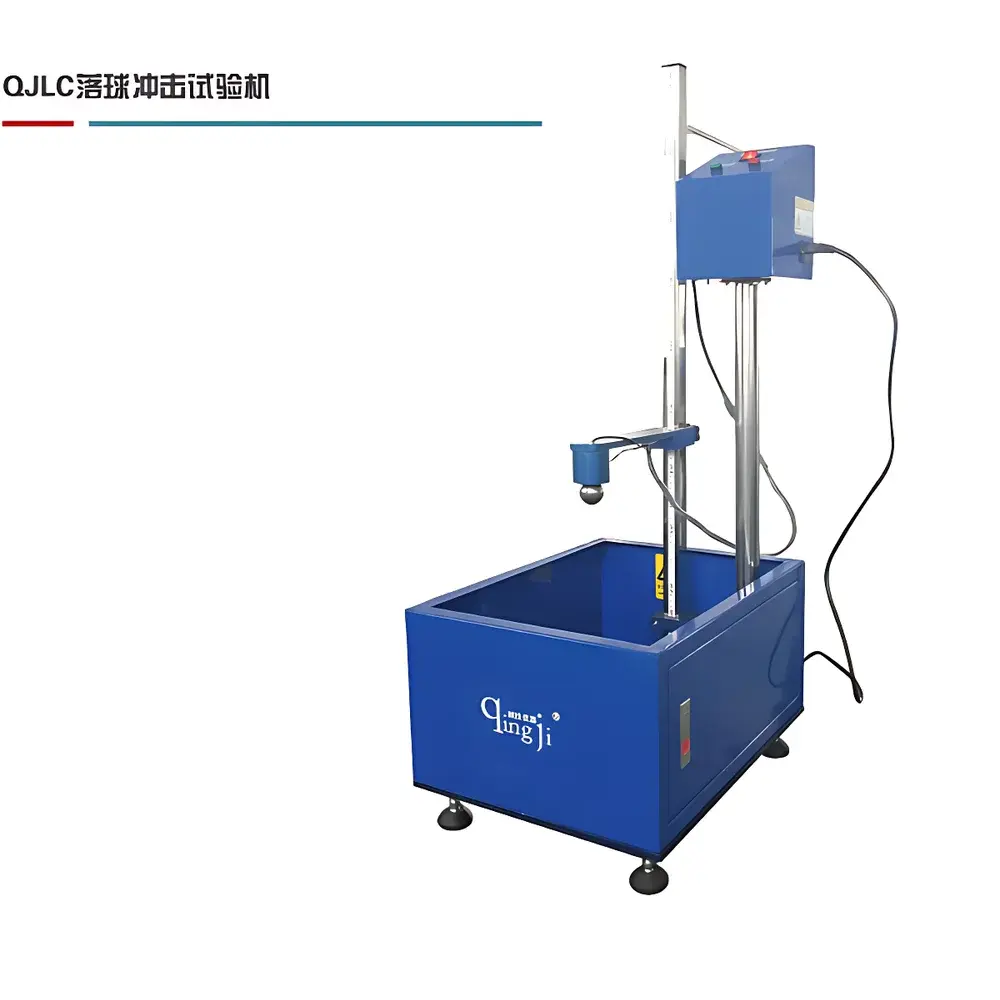
QJLC Glass Lens Impact Tester
| Origin | Shanghai |
|---|---|
| Manufacturer Type | Distributor |
| Origin Category | Domestic (China) |
| Model | QJLC |
| Quotation | ¥26,000 |
| Instrument Type | Other Impact Testing Machine |
| Impact Energy | 5.5 J, 11 J, 22 J |
| Impact Velocity | 3.5 m/s |
| Pendulum Torque (Impact Constant) | 5.5 J, 11 J, 22 J |
| Load Cell Range | 0.5 N |
| Maximum Lifting Height | 22 mm |
| Steel Ball Mass Options | 5 g, 10 g, 20 g, 30 g, 50 g (±5 g tolerance) |
| Drop Height Adjustment Range | 0–2000 mm (graduated steel scale, ±1 mm resolution) |
| Drop Rod | Square-section rod |
| Dimensions (L×W×H) | Approx. 500 × 400 × 2200 mm |
| Net Weight | 30 kg |
| Power Supply | AC 220 V, 50 Hz |
Overview
The QJLC Glass Lens Impact Tester is a precision-engineered free-fall impact testing system designed for evaluating the mechanical resilience of flat and curved optical components—particularly tempered glass lenses used in smartphones, biometric fingerprint modules, AR/VR displays, and protective cover plates. Unlike pendulum-based Charpy or Izod impact testers, this instrument implements a vertically oriented electromagnetic drop-tower configuration, enabling controlled, repeatable, and traceable impact events under gravity-driven conditions. It operates on the principle of potential-to-kinetic energy conversion: a calibrated steel ball is electromagnetically suspended at a defined height, then released to strike the test specimen surface at a known velocity (3.5 m/s). The resulting damage—crack initiation, radial fracture propagation, or penetration—is assessed per standardized visual or metrological criteria. The system complies with technical revisions derived from JIS R 3206 (Tempered Glass for Building Use) and aligns with key clauses of GB/T 15763.2–2005 (Safety Glass – Part 2: Tempered Glass), ensuring relevance for quality assurance in optoelectronic component manufacturing and incoming material inspection.
Key Features
- Electromagnetic release mechanism ensures zero pre-strike acceleration interference and eliminates mechanical hysteresis—critical for high reproducibility across sequential impacts.
- Modular steel ball set (5 g to 50 g, ±5 g tolerance) allows systematic variation of impact momentum while maintaining ISO/IEC 17025-compliant calibration traceability.
- Adjustable drop height range (0–2000 mm) with engraved stainless-steel scale and integrated right-angle alignment gauge enables precise positioning within ±1 mm uncertainty—essential for ASTM D256-compliant comparative studies.
- Integrated safety enclosure constructed from welded steel mesh (mesh aperture ≤10 mm) meets EN 61496-1 requirements for Type 2 electro-sensitive protective equipment.
- Square-section drop rod minimizes lateral oscillation during descent, reducing angular deviation (<0.5°) and ensuring normal-incidence impact alignment.
- Static powder-coated frame (RAL 7035) provides corrosion resistance and mechanical stability; base plate incorporates anti-vibration rubber mounts for consistent energy transfer into rigid test fixtures.
Sample Compatibility & Compliance
The QJLC tester accommodates planar specimens up to 150 mm × 150 mm and thicknesses ranging from 0.3 mm (chemically strengthened aluminosilicate) to 3.0 mm (fully tempered soda-lime glass). Fixture adaptability supports clamping of curved lens substrates using vacuum-assisted holders (optional accessory). Test protocols are structured to satisfy functional requirements of IEC 60950-1 (impact resistance of display covers), MIL-STD-810H Method 516.8 (drop shock), and internal OEM specifications for consumer electronics supply chains. All operational parameters—including energy levels (5.5 J, 11 J, 22 J), impact velocity (3.5 m/s), and pendulum torque values—are referenced to SI units and cross-validated against NIST-traceable force and displacement standards.
Software & Data Management
While the base QJLC model operates via manual trigger and analog readout, optional digital upgrade kits support USB 2.0 connectivity and PC-based acquisition software compliant with FDA 21 CFR Part 11 Annex 11 requirements. The software logs timestamped event records—including drop height, ball mass, impact time, and operator ID—with audit trail functionality, electronic signature support, and encrypted database storage. Raw data exports to CSV and PDF formats facilitate integration into LIMS environments and GLP/GMP documentation workflows.
Applications
- Evaluation of crack resistance in chemically strengthened glass (e.g., Gorilla Glass variants) during early-stage R&D screening.
- Quality control verification for automotive HUD combiner substrates subjected to thermal cycling and impact stress.
- Comparative analysis of coating adhesion durability (e.g., oleophobic layers) on touch-sensitive cover glasses.
- Validation of packaging integrity for fragile optical assemblies during logistics simulation (ISTA 3A-aligned drop profiles).
- Failure mode mapping for brittle fracture initiation in thin-film transistor (TFT) display laminates.
FAQ
Is the QJLC tester suitable for testing curved or non-planar lens geometries?
Yes—when equipped with optional vacuum chuck fixtures, it supports radius-of-curvature ranges from R10 mm to R500 mm, provided the chord length remains within 120 mm.
Can impact energy be calibrated independently of drop height?
Yes—energy calibration is performed using certified reference masses and laser-interferometric height measurement; NIST-traceable certificates are available upon request.
Does the system meet ISO 17025 accreditation requirements for third-party testing labs?
The mechanical architecture and measurement chain (load cell, height scale, timing circuit) are designed to support ISO/IEC 17025:2017 Clause 6.4.1 (equipment suitability) when operated within specified environmental conditions (23 ±2 °C, RH <60%).
What maintenance intervals are recommended for long-term accuracy retention?
Electromagnet coil resistance and release timing should be verified quarterly; steel ball surfaces must be inspected for pitting before each test series; calibration of the height scale is advised annually using gauge blocks certified to ISO 3650.



