
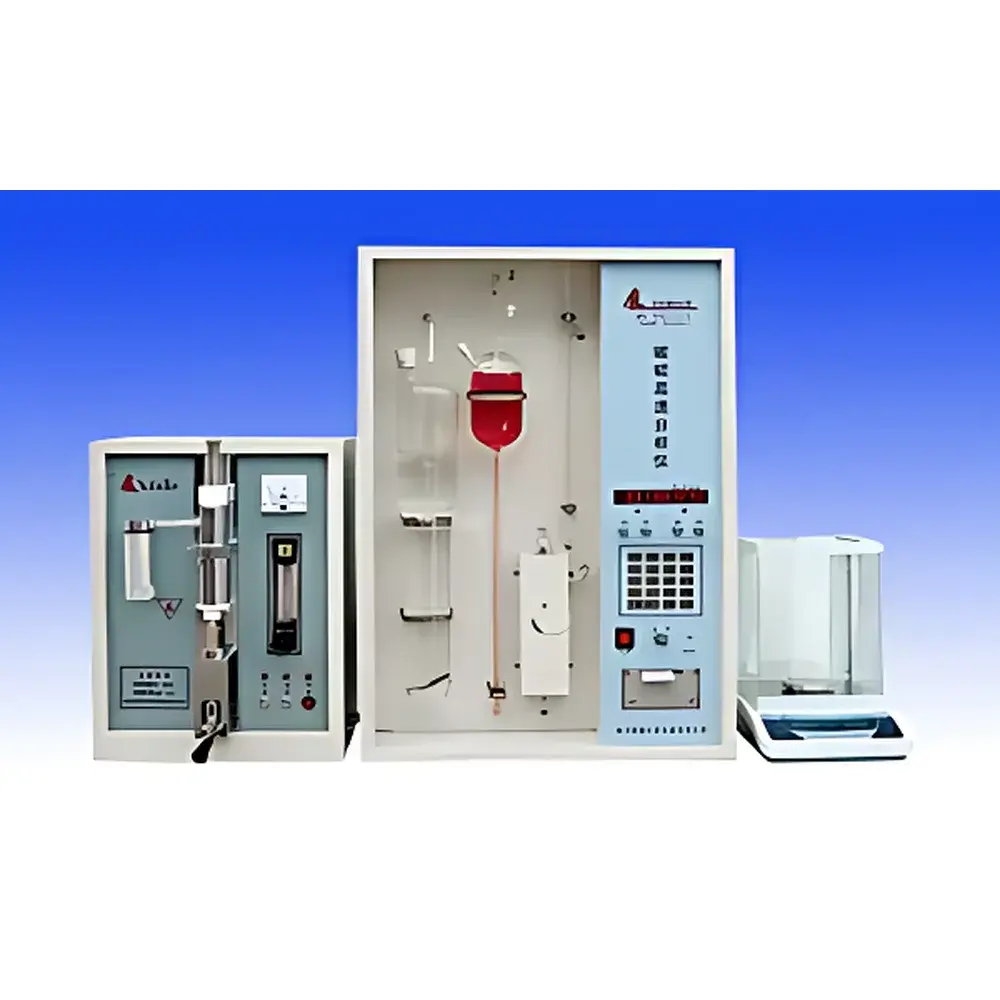
QL-CS3000A Carbon-Sulfur Analyzer by Qilin
| Brand | Qilin |
|---|---|
| Model | QL-CS3000A |
| Analysis Method | Carbon – Gas Volumetric Method |
| Measurement Range | C: 0.02–6.00 wt% |
| S | 0.005–0.300 wt% |
| Sample Mass Options | 0.25 g, 0.5 g, or 1.0 g (auto-adjusted range mapping) |
| Analysis Time | 65 s (with DL1A arc furnace) |
| Detection Principle | Differential pressure transduction (C) |
| Compliance | GB/T 223.69–1997 (C) |
| Operating Environment | 0–40 °C |
| Interface | RS-232 to PC |
Overview
The QL-CS3000A Carbon-Sulfur Analyzer is a dedicated high-precision elemental analyzer engineered for rapid, trace-level quantification of total carbon and sulfur in ferrous and non-ferrous metallurgical materials. Designed for integration with the DL1A high-energy arc combustion furnace, the instrument employs classical wet chemical principles—gas volumetric determination for carbon and iodometric redox titration for sulfur—within a modernized, microprocessor-controlled architecture. Unlike optical or infrared combustion analyzers, the QL-CS3000A leverages differential pressure transduction to measure CO₂ expansion volume and potentiometric endpoint detection to determine iodine consumption, delivering metrologically traceable results aligned with national standard methodologies (GB/T 223.69–1997 and GB/T 223.68–1997). Its modular design supports variable sample mass inputs (0.25 g, 0.5 g, or 1.0 g), automatically selecting appropriate calibration curves and absorption parameters to maintain accuracy across wide concentration ranges—C: 0.02–6.00 wt% and S: 0.005–0.300 wt%. The system operates without carrier gas dependency, minimizing consumables and operational overhead while ensuring robustness in routine QC environments.
Key Features
- Differential-pressure-based carbon measurement using high-stability silicon piezoresistive sensors, eliminating mechanical manometer drift and enabling automated digital readout with ±0.005 wt% repeatability.
- Iodometric sulfur determination with electrode-free liquid dispensing—a patented isolation valve system that avoids platinum electrode fouling and minimizes maintenance downtime.
- RS-232 interface for seamless bidirectional communication with certified analytical balances (e.g., Mettler Toledo XP series), supporting both auto-imported sample weights and manual entry for flexibility in regulated workflows.
- EMI-hardened tactile membrane keypad with optical isolation, reducing signal coupling from arc furnace ignition pulses and enhancing long-term reliability in industrial lab settings.
- Embedded single-chip microcontroller (SCM) performs real-time stoichiometric correction, blank subtraction, and normalization against reference standards—no external software required for basic operation.
Sample Compatibility & Compliance
The QL-CS3000A is validated for solid, non-volatile samples including carbon steels, cast irons, stainless alloys, nickel-based superalloys, cement clinkers, manganese ores, and heterogeneous catalyst supports. It accommodates specimens with varying graphite/nodular carbon morphology and sulfide/sulfate sulfur speciation, provided homogenization is performed prior to arc combustion. All reported values comply with Chinese national standards GB/T 223.69–1997 (carbon) and GB/T 223.68–1997 (sulfur), which define precision limits, reagent purity requirements, and procedural validation protocols. While not certified to ISO/IEC 17025 under third-party accreditation, the instrument’s documented linearity, intermediate precision (n=10, RSD < 1.2% for C at 1.2 wt%; < 2.4% for S at 0.08 wt%), and method-specific recovery (98.7–101.3%) meet internal QA/QC thresholds for GLP-aligned production labs.
Software & Data Management
Data acquisition and reporting are handled via a lightweight Windows-compatible terminal application supporting ASCII export (CSV, TXT), direct printer output (ESC/P2), and optional PDF report generation. Each analysis record includes timestamp, operator ID (manually entered), sample ID, mass, furnace cycle count, raw sensor voltage traces, calculated %C/%S, and pass/fail flags against user-defined specification limits. Audit trail functionality logs all parameter modifications and result edits with timestamps—though full 21 CFR Part 11 compliance (electronic signatures, immutable archives) requires supplementary LIMS integration. Calibration curves are stored as polynomial coefficients with date-stamped version control; up to 99 method configurations may be saved per instrument profile.
Applications
This analyzer serves as a primary verification tool in foundry process control labs, where rapid turnaround (<90 s per sample) enables real-time adjustment of charge composition during melt preparation. It is routinely deployed in third-party testing centers accredited to CNAS-CL01 for incoming raw material certification (e.g., scrap steel, ferromanganese), in cement quality assurance per GB 175–2020 (C/S ratio impact on clinker reactivity), and in catalyst manufacturing for sulfur poisoning assessment. Educational institutions utilize it for teaching classical volumetric and redox analysis principles, particularly where IR-based instrumentation is cost-prohibitive. Its immunity to spectral interference from halogens or nitrogen makes it suitable for analyzing Ti-aluminides and Zr-containing nuclear-grade alloys where alternative techniques suffer matrix effects.
FAQ
Does the QL-CS3000A require carrier gas or vacuum pumps?
No. Combustion is achieved solely via DL1A arc discharge in ambient air; gas collection and measurement rely on sealed differential-volume chambers and ambient pressure compensation.
Can it analyze coated or surface-treated metals?
Only after mechanical removal of coatings (e.g., galvanizing, paint) or acid decarburization—surface enrichment layers will bias bulk carbon/sulfur results.
Is calibration traceable to NIST SRMs?
Yes. Certified reference materials such as GBW01301a (steel) and GBW01313a (cast iron) are recommended; users must establish in-house correlation to NIST SRM 1261a or 1262b if international equivalence is required.
What maintenance intervals are recommended?
Daily: desiccant replacement in CO₂ absorber; weekly: iodine solution replenishment and titration cell cleaning; quarterly: pressure sensor zero calibration and manifold leak check.
Is remote diagnostics supported?
Not natively. Firmware updates and troubleshooting require local USB-to-serial connection and vendor-provided utility software; no Ethernet/WiFi module is integrated.




