
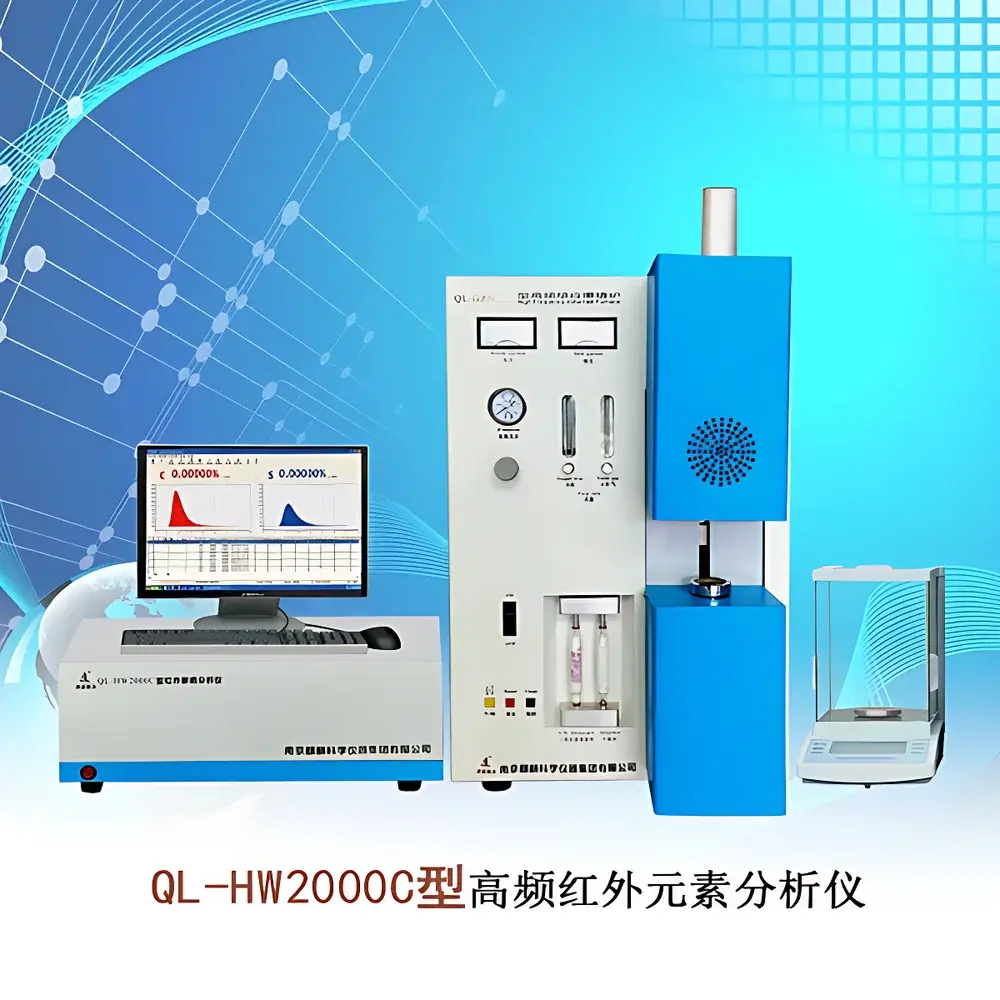
QL-HW2000C High-Frequency Infrared Carbon-Sulfur Analyzer
| Brand | Qilin (QL) |
|---|---|
| Origin | Jiangsu, China |
| Model | HW2000C |
| Measurement Principle | Non-Dispersive Infrared (NDIR) Absorption |
| Heating System | 20 MHz High-Frequency Induction Furnace (2200 W) |
| Carbon Range | 0.0001–25.0000 wt% (extendable to 99.999%) |
| Sulfur Range | 0.0001–15.0000 wt% (extendable to 99.999%) |
| Sensitivity | 0.1 ppm for both C and S |
| Analysis Time | Adjustable 20–100 s (typical 35 s) |
| Precision | Compliant with GB/T 20123–2006 and ISO 15350:2000 |
| Sample Mass | 0.5 g (standard steel reference) |
| Detection Wavelengths | CO₂ @ 4.26 µm, SO₂ @ 7.4 µm |
| Dust Filter | 0.4 µm sintered metal filter |
| Optical Path | Gold-plated absorption cell, Pt-based infrared source (800 °C), pyroelectric detector, 64 Hz optical chopper |
Overview
The QL-HW2000C High-Frequency Infrared Carbon-Sulfur Analyzer is a precision elemental analyzer engineered for quantitative determination of total carbon (C) and total sulfur (S) in solid metallic and non-metallic materials. It operates on the principle of non-dispersive infrared (NDIR) absorption spectroscopy — a physically rigorous, trace-level gas-phase detection method grounded in quantum-mechanical vibrational-rotational transitions of diatomic and triatomic polar molecules. When sample material is combusted quantitatively in a high-frequency induction furnace under controlled oxygen flow, carbon and sulfur are fully oxidized to CO₂ and SO₂, respectively. These gaseous species exhibit strong, spectrally distinct infrared absorption bands at 4.26 µm (CO₂ asymmetric stretch) and 7.4 µm (SO₂ bending mode). The instrument employs dual-wavelength, single-beam NDIR detection with thermally stabilized platinum filament IR sources, gold-coated absorption cells, narrow-band interference filters, and high-sensitivity pyroelectric detectors. Signal modulation at 64 Hz enables synchronous detection, effectively rejecting ambient thermal drift and electronic noise. This architecture delivers high reproducibility, low baseline drift, and robust performance in demanding QC/QA laboratory environments.
Key Features
- 20 MHz high-frequency induction furnace (2200 W output) with real-time power, current, and voltage monitoring; programmable temperature control via power modulation for optimal combustion across diverse matrices (steels, cast irons, alloys, ores, catalysts, cements, foundry sands)
- Dual-channel NDIR detection system with independently optimized optical paths for CO₂ and SO₂; 0.4 µm sintered metal dust filter ensures complete particulate separation prior to gas analysis
- Gold-plated, thermostatically stabilized absorption cells and high-efficiency Pt-based IR sources operating at 800 °C ensure long-term spectral stability and minimal aging effects
- Modular dual-CPU architecture: Atmega162 microcontroller handles real-time furnace control and gas flow management; host PC executes signal processing, calibration, and data reporting via USB 2.0 interface
- Fiber-optic coupling (Agilent 1521/2521) between furnace and detector modules, combined with multi-stage galvanic isolation, eliminates electromagnetic interference from high-frequency operation
- Automated diagnostic routines for leak detection, furnace seal integrity verification, and optical path alignment validation — all accessible through software interface
Sample Compatibility & Compliance
The QL-HW2000C is validated for use with ferrous and non-ferrous metals (including stainless steels, tool steels, aluminum and copper alloys), geological samples (ores, slags, limestone), refractory ceramics, catalysts, coal/coke, and industrial process materials such as foundry core sands and cementitious binders. It supports routine analysis of certified reference materials (CRMs) traceable to NIST and BAM standards. Analytical performance meets or exceeds requirements of GB/T 20123–2006 (equivalent to ISO 15350:2000) for combustion-infrared C/S determination. While not pre-certified for FDA 21 CFR Part 11, the system’s audit-trail-capable software architecture — including user access controls, electronic signatures, and immutable result logging — facilitates validation under GLP and GMP frameworks when deployed with documented SOPs and periodic system suitability testing.
Software & Data Management
The Windows-based analytical software (compiled in Delphi) provides full lifecycle data handling compliant with modern laboratory informatics expectations. It features channel-independent calibration curve management, dynamic real-time integration (20 Hz sampling rate), and customizable sample metadata fields (operator ID, batch number, material grade). All raw spectral data, time-resolved gas evolution profiles, and final quantified results are stored in encrypted Microsoft Access databases with timestamped records. Query functionality supports multi-parameter filtering (date range, analyst, sample ID, channel, pass/fail status). Statistical tools include RSD calculation, linear regression diagnostics, and comparative curve overlay. Reporting supports configurable templates for internal QA reports or external regulatory submissions; export options include CSV, PDF, and XML formats compatible with LIMS integration. Software includes built-in blank subtraction, drift correction, and automatic baseline normalization algorithms.
Applications
This analyzer serves critical roles in metallurgical process control (e.g., ladle analysis prior to casting), incoming raw material inspection (scrap, ferroalloys, fluxes), failure analysis laboratories investigating embrittlement mechanisms, and R&D settings studying carbide/sulfide phase formation kinetics. Its extended dynamic range (to 99.999% C/S) enables accurate quantification in specialty applications such as ultra-high-carbon steels, sulfide-bearing minerals, and carbon-rich catalyst supports. The 35-second typical analysis cycle supports throughput requirements in high-volume production labs, while sub-ppm sensitivity ensures compliance with stringent specifications for low-alloy steels, aerospace superalloys, and electronic-grade metals where residual C/S impurities directly impact mechanical or electrical performance.
FAQ
What types of samples require pre-treatment before analysis?
Most solid metallic samples require only surface cleaning and precise weighing. Non-conductive or high-volatility matrices (e.g., polymers, organics) may necessitate mixing with tungsten or tin accelerator and encapsulation in ceramic crucibles to ensure complete combustion.
Is helium required for carrier gas?
No — the system operates with high-purity oxygen (≥99.995%) as both combustion and carrier gas; optional argon flushing is available for specific sulfur-sensitive applications.
Can the instrument be integrated into an existing LIMS environment?
Yes — via standardized ODBC/JDBC drivers and structured export files; API-level integration requires custom middleware development aligned with site-specific LIMS protocols.
What maintenance intervals are recommended for optimal performance?
Daily: Dust filter inspection and cleaning; weekly: IR source output verification and optical window inspection; quarterly: absorption cell purge and detector gain calibration using certified gas standards.
Does the system support ASTM E1019 or ISO 4935 methodology?
While designed to meet ISO 15350:2000 and GB/T 20123–2006, its combustion efficiency, gas handling, and detection linearity satisfy the fundamental technical requirements of ASTM E1019 and ISO 4935; method adaptation requires documented validation per ISO/IEC 17025.




