
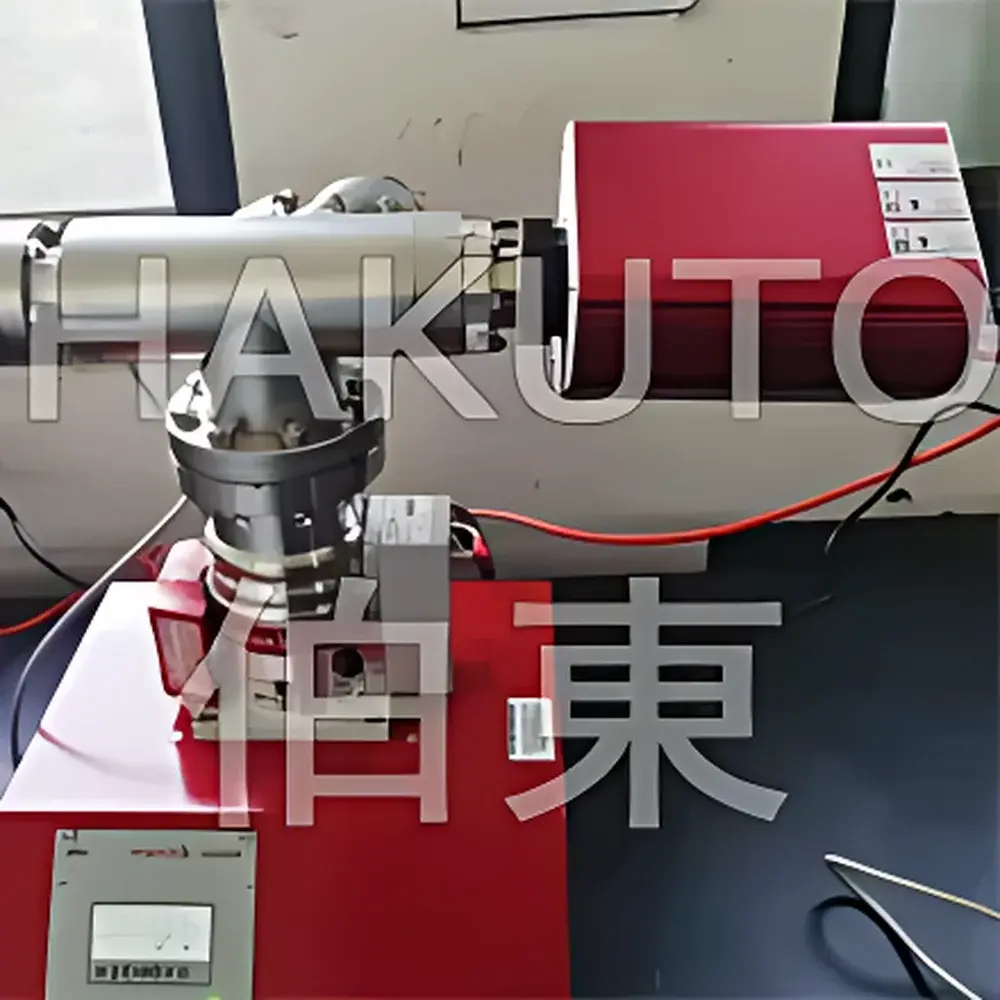
QMG250 Residual Gas Analyzer (RGA) for Mine Methane & Multi-Component Gas Monitoring
| Brand | Pfeiffer Vacuum |
|---|---|
| Origin | Germany |
| Model | QMG 250 |
| Detection Principle | Quadrupole Mass Spectrometry |
| Configuration | Online, Integrated Vacuum System |
| Mass Range | up to 300 amu |
| Repeatability | ≤ ±0.5% RSD (for masses < 300) |
| Response Time | < 1 s (typical for partial pressure monitoring) |
| System Includes | QMG 250 quadrupole mass spectrometer, HiCube 80 turbomolecular pump set, PKR 251 cold cathode vacuum gauge, and custom four-way stainless-steel chamber assembly |
Overview
The QMG250 Residual Gas Analyzer is a high-stability, benchtop quadrupole mass spectrometer engineered for real-time, multi-component gas analysis under controlled vacuum conditions. Unlike electrochemical or catalytic bead sensors—commonly mischaracterized in non-technical summaries—the QMG250 operates on the principle of mass-selective ion filtering via radiofrequency (RF) and direct-current (DC) voltage modulation across a hyperbolic quadrupole rod assembly. Ions generated by electron impact (EI) ionization at 70 eV are separated according to their mass-to-charge ratio (m/z), enabling quantitative detection of gases from helium (m/z = 4) through butane (m/z = 58), hydrogen sulfide (m/z = 34), carbon dioxide (m/z = 44), nitrogen (m/z = 28), oxygen (m/z = 32), argon (m/z = 40), and trace inert species—all critical in coal mine atmosphere hazard assessment. Its operation requires a base pressure ≤ 1 × 10⁻⁶ mbar, achieved via the integrated HiCube 80 turbomolecular pumping station, ensuring minimal background interference and high signal-to-noise ratio for low-concentration hydrocarbon detection.
Key Features
- Mass resolution: unit mass resolution (ΔM/M ≈ 10%) optimized for industrial gas speciation without sacrificing scan speed
- Digital signal processing with 16-bit ADC and real-time peak tracking for stable quantification across dynamic concentration ranges
- Auto-tuning and calibration routines compliant with ISO/IEC 17025 traceability requirements when paired with certified gas standards
- Rugged stainless-steel ion source and detector housing rated for continuous duty in laboratory and field-deployable enclosures
- Integrated vacuum interlock and pressure monitoring via PKR 251 cold cathode gauge, supporting automated safety shutdown below operational pressure thresholds
- RS-485 and Ethernet interfaces for integration into SCADA or DCS platforms used in underground ventilation monitoring systems
Sample Compatibility & Compliance
The QMG250 is compatible with gas streams sampled directly from mine boreholes or ventilation ducts via heated capillary inlets (optional), minimizing condensation of water vapor and heavier hydrocarbons (e.g., C₅+ alkanes). It detects all major explosive constituents—including CH₄ (m/z = 16), C₂H₆ (m/z = 30), C₃H₈ (m/z = 44), and C₄H₁₀ (m/z = 58)—as well as toxic markers such as H₂S (m/z = 34) and CO (m/z = 28). The system meets mechanical and electromagnetic compatibility requirements per EN 61326-1 and EN 61000-6-2. While not intrinsically safe for Zone 0/1 installation without additional certification, it is routinely deployed in surface-based monitoring stations feeding data to explosion-proof PLCs per IEC 60079-0 and ATEX Directive 2014/34/EU.
Software & Data Management
Operation is managed via Pfeiffer’s Quadera software, which supports method-driven acquisition, spectral library matching (NIST MS Search compatible), and time-resolved trend logging. Raw mass spectra and partial pressure time-series data are stored in HDF5 format, enabling post-acquisition reprocessing and multivariate analysis (e.g., PCA for gas fingerprinting). Audit trails, user access control, and electronic signatures comply with FDA 21 CFR Part 11 when configured with Windows OS Group Policy enforcement. Data export to CSV, XML, or OPC UA servers facilitates integration with mine safety information systems (MSIS) and historical databases aligned with ISO 45001 occupational health record retention protocols.
Applications
- Real-time methane concentration profiling during longwall mining operations to maintain CH₄ < 1.0% v/v in return airways
- Detection of abnormal ethane/propane ratios as early indicators of spontaneous coal oxidation
- Verification of inertization efficacy during fire suppression using nitrogen or CO₂ injection
- Quantitative analysis of outgassing profiles from core samples in geotechnical labs (ASTM D5142)
- Calibration validation of fixed-point electrochemical CH₄ sensors using RGA-derived reference values
- Research on gas desorption kinetics from coal matrix under variable temperature/pressure conditions (ISO 11722)
FAQ
Does the QMG250 require carrier gas or calibration standards for routine mine gas analysis?
No—quadrupole mass spectrometers operate in vacuum and rely on absolute ion current measurement; however, periodic sensitivity verification using certified 100 ppm CH₄/N₂ standard is recommended every 3 months per ISO 17025 internal quality control protocols.
Can the system detect water vapor interference in raw mine air samples?
Yes—the QMG250 resolves H₂O⁺ (m/z = 18) and its fragment ions (OH⁺ at m/z = 17); optional heated inlet lines (120 °C) and cryo-traps reduce condensation artifacts in high-humidity environments.
Is remote diagnostics supported for underground deployment scenarios?
Yes—Quadera includes VNC-enabled remote desktop mode and diagnostic log export; firewall-configured VPN tunnels allow secure offsite support while maintaining network segmentation per IEC 62443-3-3.
What vacuum pumping time is required before stable analysis begins?
With the HiCube 80 pump set and pre-evacuated chamber, base pressure ≤ 5 × 10⁻⁷ mbar is typically achieved within 15–20 minutes; analysis may commence at ≤ 1 × 10⁻⁵ mbar for qualitative screening, though quantitative accuracy requires full base pressure stabilization.







