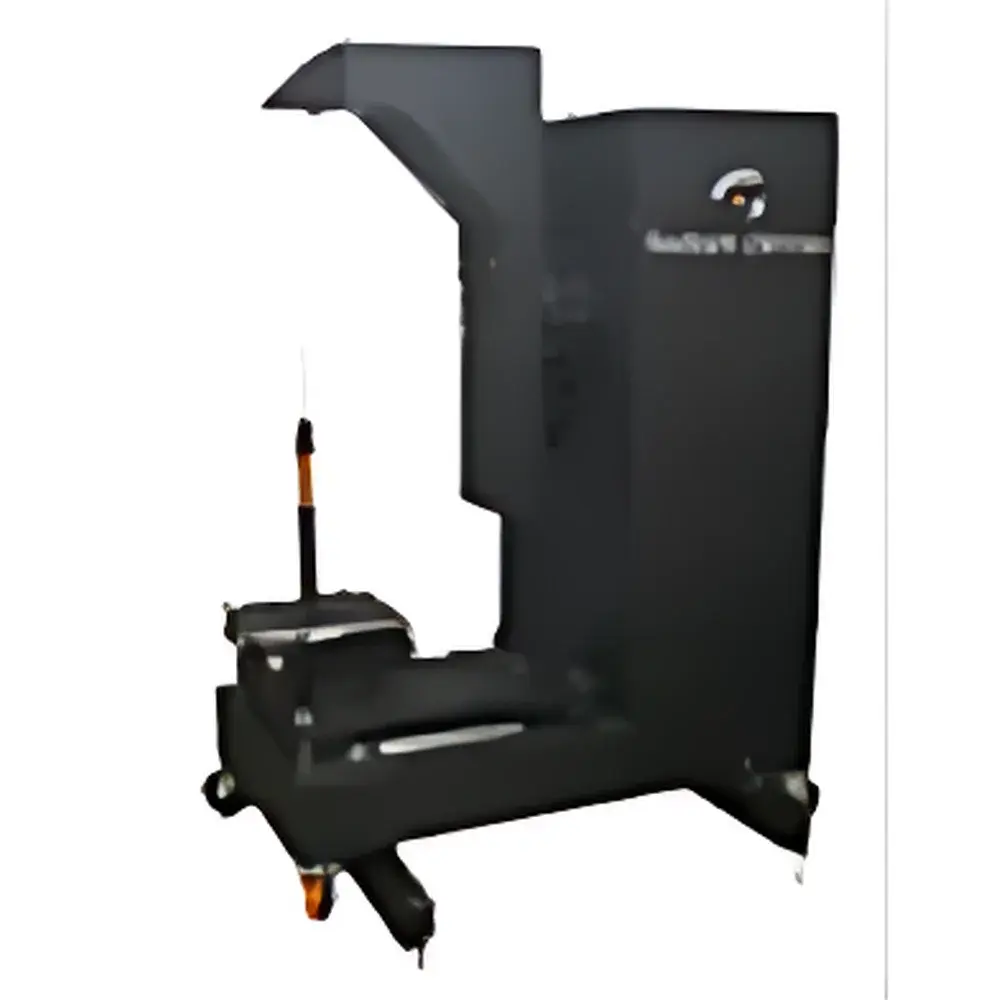
Radiant Zemax SIG-310 Imaging Goniophotometer
| Brand | Radiant Zemax |
|---|---|
| Origin | USA |
| Model | SIG-310 |
| CCD Type | Full-frame, thermoelectrically cooled CCD |
| Dynamic Range | 16-bit (65,536:1) |
| Resolution Options | 512 × 512 or 1024 × 1024 pixels |
| FOV (Standard) | 6–160 mm (512×512) |
| FOV (Macro) | 300 mm (512×512 only) |
| Color Filters | CIE 1931 XYZ tristimulus with ND filters (ND0–ND5) |
| Polar Rotation | −10° to +370° |
| Azimuthal Tilt | ±20° from lamp axis |
| Angular Step Resolution | 0.10°/min |
| Mechanical-Optical-Software Runout | ≤0.100 mm |
| System Dimensions | 145 cm × 133 cm × 204 cm |
| Operating Footprint | 343 cm × 312 cm |
| Weight | 640 kg |
| Structural Frame | Welded steel cast body with thermal-stability design |
| Software | SIG 2.0 — supports luminance, illuminance, chromaticity (CIE x,y |
Overview
The Radiant Zemax SIG-310 Imaging Goniophotometer is a high-precision, automated near-field measurement system engineered for the spatially resolved characterization of large-area light sources. It operates on the principle of imaging goniometry—combining calibrated digital imaging with precise mechanical angular positioning to capture luminance and chromaticity distributions across the full emission hemisphere. Unlike point-sensor photometers, the SIG-310 acquires full two-dimensional radiometric and colorimetric data at each angular orientation, enabling reconstruction of physically accurate Radiant Source Models (RSM) in industry-standard format. This model serves as the foundational input for optical simulation tools—including LightTools, ASAP, TracePro, and Zemax OpticStudio—supporting rigorous ray-trace-based design validation and tolerance analysis. Its thermoelectrically cooled, full-frame CCD sensor ensures low-noise acquisition across an extended 16-bit dynamic range, critical for resolving both high-brightness emitters (e.g., LED modules, OLED panels) and low-luminance peripheral zones within a single measurement sequence.
Key Features
- Full-hemispherical goniometric scanning with independent polar (−10° to +370°) and azimuthal (±20° tilt) motion control, optimized for vertical and horizontal source mounting configurations.
- Selectable CCD resolutions: 512 × 512 or 1024 × 1024 pixels, each supporting multiple standard and macro field-of-view optics (6–400 mm FOV coverage) to balance spatial resolution and measurement throughput.
- CIE 1931-compliant XYZ tristimulus colorimetry with six neutral density filter positions (ND0–ND5), enabling linear response over luminance ranges spanning >10⁶:1 without saturation or clipping.
- Integrated mechanical-optical-software runout compensation (≤0.100 mm), ensuring sub-pixel registration fidelity across multi-angle acquisitions required for RSM generation.
- Structural architecture based on welded steel cast body with passive thermal management—designed to minimize thermal drift during extended measurement campaigns (>8 hr continuous operation).
- SIG 2.0 software platform with GLP-aligned audit trail logging, user-access controls, and 21 CFR Part 11–compliant electronic signatures for regulated environments.
Sample Compatibility & Compliance
The SIG-310 accommodates light-emitting devices up to 400 mm in maximum dimension, including backlit displays, automotive lighting modules, architectural LED panels, and projection engine arrays. Its modular optical path supports interchangeable lenses and macro attachments, allowing adaptation to divergent beam profiles and étendue constraints. All photometric and colorimetric measurements conform to CIE Publication No. 127 (2007), IES LM-79-19, and ISO/CIE 11664-1:2019 for colorimetry. The RSM output format complies with Radiant’s documented RSM v3.0 specification—an open, XML-based schema adopted by major optical design vendors for deterministic ray sampling and far-field prediction.
Software & Data Management
SIG 2.0 provides end-to-end workflow automation—from motorized stage sequencing and exposure optimization to real-time luminance visualization, environmental reference capture, and pixel-wise non-uniformity correction. Data export includes native RSM files plus CSV, HDF5, and industry-standard .rad formats. Integrated charting tools generate cross-sectional intensity profiles, 3D luminance surfaces, isoluminance contours, and polar candela distributions—all traceable to NIST-traceable calibration certificates. Audit logs record operator ID, timestamp, instrument configuration, calibration epoch, and raw image metadata—fully compatible with FDA 21 CFR Part 11 requirements for electronic records in medical device illumination validation.
Applications
- Generation of near-field luminance and chromaticity models for predictive optical simulation of automotive headlamps, interior lighting, and adaptive driving beam systems.
- Validation of uniformity, hot-spot suppression, and color shift across viewing angles in large-format microLED and Mini-LED displays.
- Compliance testing against UNECE R149, SAE J1383, and EN 13201-3 for public lighting photometric performance.
- Characterization of spectral spatial non-uniformity in UV-C disinfection arrays used in healthcare and HVAC applications.
- Support for DOE SSL Program benchmarks requiring high-fidelity source modeling in lumen maintenance and thermal derating studies.
FAQ
What file formats does the SIG-310 support for optical simulation import?
The system exports Radiant Source Model (RSM) files compliant with RSM v3.0 specification, directly readable by Zemax OpticStudio, Synopsys LightTools, Lambda Research TracePro, and Ansys Speos.
Is the SIG-310 suitable for measuring OLED or microLED display panels?
Yes—the system’s high dynamic range, low-noise cooled CCD, and macro-FOV optics enable accurate near-field characterization of emissive flat-panel sources, including spatial CCT gradients and viewing-angle-dependent chromaticity shifts.
Does the SIG-2.0 software meet regulatory requirements for quality-controlled environments?
Yes—SIG 2.0 includes configurable user roles, electronic signature workflows, immutable audit trails, and calibration certificate linkage, satisfying FDA 21 CFR Part 11 and ISO 17025 documentation requirements.
Can the SIG-310 measure both luminance and illuminance?
It measures absolute luminance (cd/m²) and chromaticity at each pixel and angle; illuminance (lux) is derived computationally via solid-angle-weighted integration and requires known detector-to-source geometry.
What maintenance is required for long-term measurement stability?
Annual recalibration against NIST-traceable standards is recommended; the steel cast frame and thermal-stable optics minimize drift, and built-in reference image acquisition supports daily verification of photometric linearity and color channel consistency.