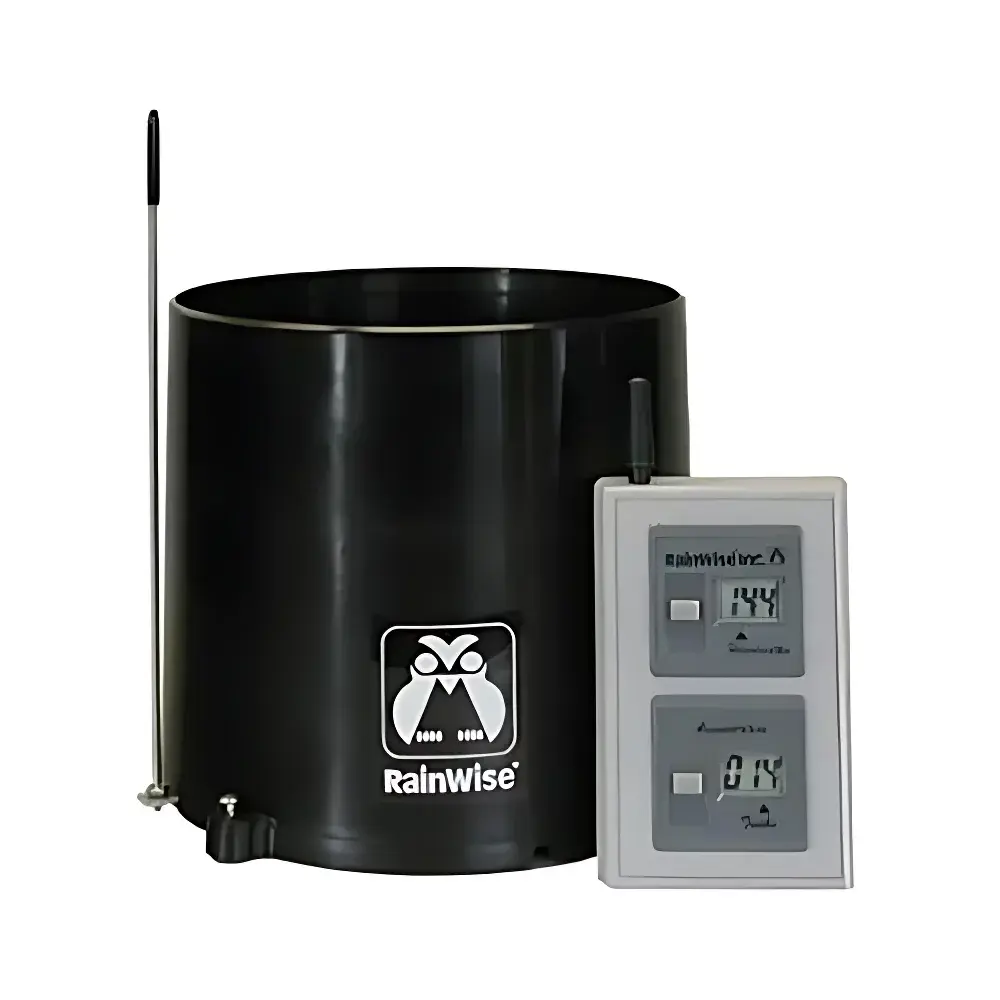
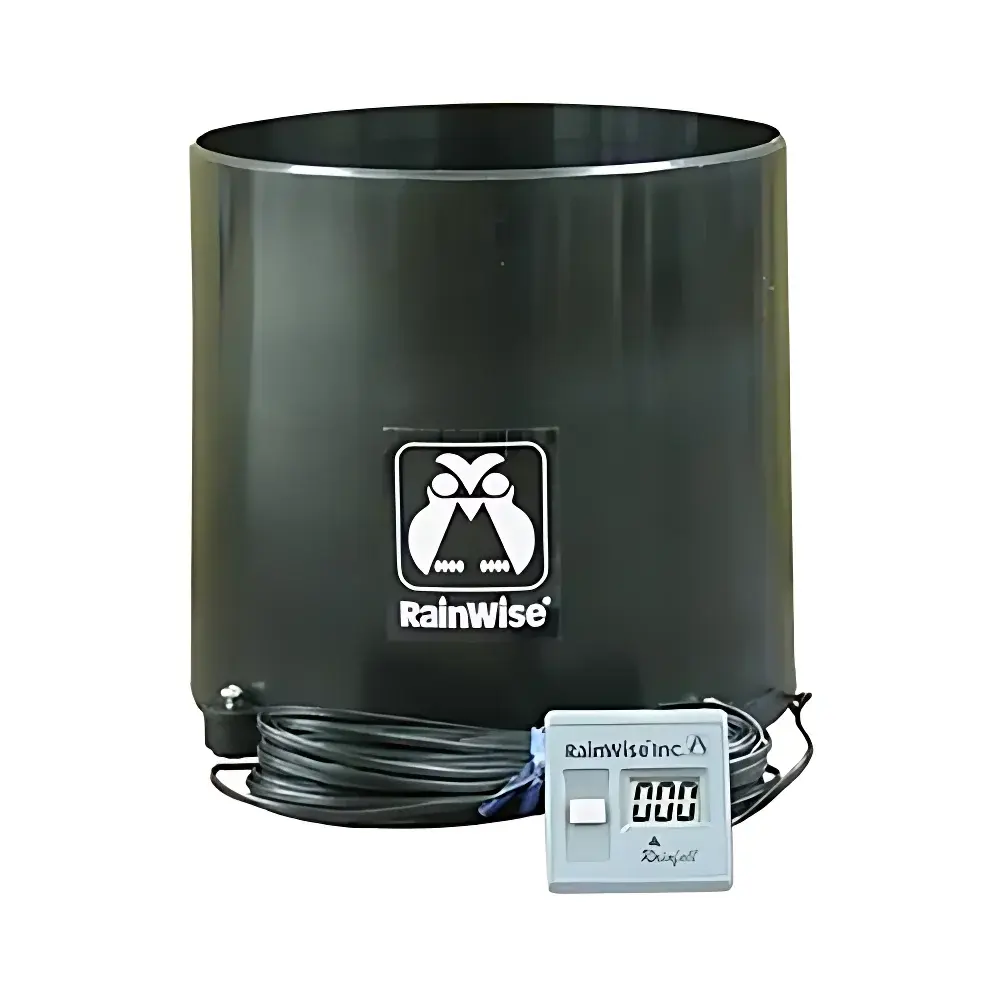
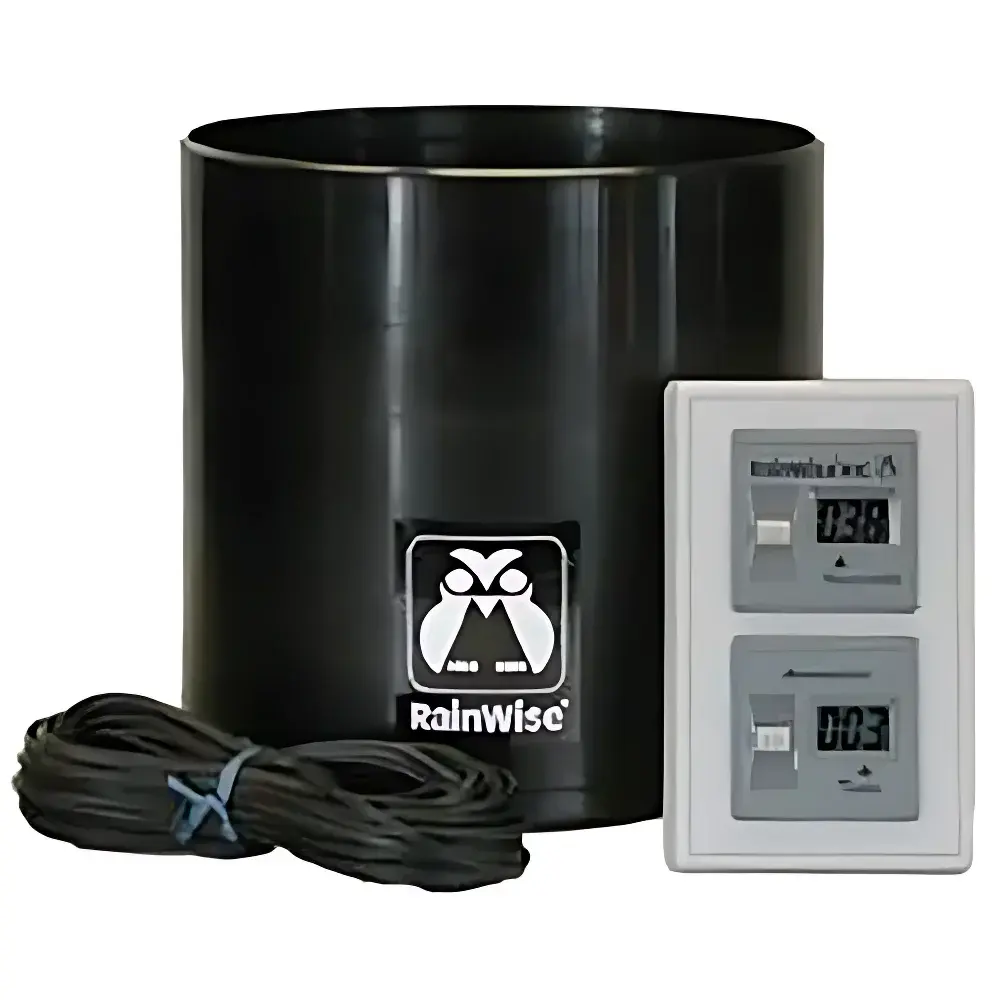
RainWise Rainew Automatic Tipping Bucket Rain Gauge
| Brand | RainWise |
|---|---|
| Origin | USA |
| Model | Rainew |
| Measurement Resolution | 0.01 in (0.254 mm) per tip |
| Collection Orifice Diameter | 8 in (203.2 mm) |
| Display Range | 0.00–9.99 in |
| Power | Long-life alkaline battery (display unit) |
| Compliance | Meets NOAA/NWS accuracy specifications for standard precipitation measurement |
| Output | Pulse signal (1 pulse = 0.01 in) |
| Cable Options | 60 ft (Rainew 111), wireless up to 300 ft (Rainewireless) |
| Warranty | Lifetime on collector assembly |
Overview
The RainWise Rainew Automatic Tipping Bucket Rain Gauge is a precision-engineered meteorological instrument designed for reliable, long-term quantitative precipitation measurement in field, agricultural, hydrological, and environmental monitoring applications. Operating on the well-established tipping bucket principle, the device captures rainfall in a calibrated 8-inch-diameter orifice—dimensionally compliant with NOAA’s National Weather Service (NWS) standard for representative catchment area and wind-induced undercatch mitigation. Each 0.01-inch (0.254 mm) increment of accumulated rainfall triggers a mechanical tip of the dual-bucket assembly, generating a discrete electrical pulse transmitted to the indoor display unit. This binary counting architecture ensures high reproducibility, minimal hysteresis, and immunity to analog drift—critical attributes for unattended operation across seasonal temperature extremes and variable humidity conditions.
Key Features
- 8-inch (203.2 mm) diameter collection orifice engineered to meet NWS geometric and aerodynamic specifications for standardized precipitation capture efficiency.
- Tipping mechanism calibrated to 0.01 inch (0.254 mm) per tip—traceable to NIST-traceable volumetric standards and validated per ASTM D7551-19 (Standard Practice for Calibration of Tipping-Bucket Rain Gauges).
- Indoor display unit with dual-mode capability: single-event accumulation (e.g., storm total) and running cumulative total; user-initiated reset via tactile button without interrupting data continuity.
- Three configuration variants optimized for deployment flexibility: Rainew 111 (wired, 60-ft shielded cable), Rainew 211 (dual-display wired unit), and Rainewireless (300-ft line-of-sight RF transmission, 433 MHz ISM band, low-power protocol).
- Collector assembly constructed from UV-stabilized acrylonitrile-butadiene-styrene (ABS) with stainless-steel pivot shaft and precision-machined aluminum funnel—guaranteed for lifetime service under normal outdoor exposure.
- Display unit powered by industrial-grade alkaline battery (typical life >2 years at 1 tip/min average frequency); no external power required for basic operation.
Sample Compatibility & Compliance
The Rainew gauge is compatible with all liquid-phase precipitation forms—including drizzle, rain, melting snow, and sleet—provided ambient temperatures remain above freezing during collection. It is not intended for solid-only snowfall measurement without supplemental heating or melt-collection integration. The instrument conforms to key regulatory and operational benchmarks: it satisfies the geometric and performance criteria outlined in NOAA Technical Memorandum NWS HYDRO-3 (2018) for standard surface rain gauges; its resolution and repeatability support compliance with USGS NWIS (National Water Information System) data submission requirements; and its pulse-output interface enables seamless integration into SCADA, Campbell Scientific CR-series, or Onset HOBO data logger ecosystems. While not certified for FDA 21 CFR Part 11 environments (as it lacks audit-trail firmware), its deterministic pulse output supports GLP-aligned manual logging protocols when paired with timestamped logbooks or validated spreadsheet templates.
Software & Data Management
The Rainew operates as a self-contained sensor node with no embedded firmware or onboard memory. Data acquisition relies entirely on external systems: the pulse output (open-collector TTL-compatible) connects directly to digital input channels on industry-standard dataloggers (e.g., Campbell Scientific CR1000X, Onset U30, or Arduino-based custom interfaces). Users may configure sampling intervals, apply event-triggered logging, or aggregate tips into configurable time bins (e.g., 5-min, hourly, daily totals) using native logger software (LoggerNet, BoxCar Pro, or HOBOware). For wireless deployments, Rainewireless units transmit raw tip counts with embedded UTC timestamps via proprietary low-overhead protocol—requiring RainWise-provided USB receiver dongle and companion Windows application for visualization and CSV export. All configurations support manual calibration verification through simulated tip injection using calibrated syringe test procedures per ISO 9060:2017 Annex E guidelines.
Applications
- Urban stormwater management: Real-time inflow estimation for detention basin control and CSO (Combined Sewer Overflow) event detection.
- Agricultural irrigation scheduling: Integration with evapotranspiration (ET) models to optimize water use efficiency in vineyards, orchards, and row-crop systems.
- Climate station networks: Contributing validated precipitation metrics to regional mesonets (e.g., COOP, RAWS, or state-level agro-climatic observatories).
- Environmental impact assessment: Long-term trend analysis for watershed-scale hydrologic modeling (HEC-HMS, SWAT) and regulatory reporting under Clean Water Act Section 303(d).
- Educational meteorology labs: Hands-on instruction in precipitation physics, sensor error sources (wind bias, wetting loss), and statistical validation of gauge networks.
FAQ
What is the measurement uncertainty of the Rainew gauge under standard NWS installation conditions?
Typical systematic uncertainty is ±2% for rainfall rates between 0.01–5 in/hr at wind speeds < 5 m/s (11 mph), per NWS HYDRO-3 validation reports. Random uncertainty due to bucket inertia is 0.1 in/hr.
Can the Rainew be used in freezing conditions?
The standard Rainew collector is not heated; ice accumulation will halt operation until thaw. For sub-zero environments, users must integrate third-party de-icing solutions or select complementary heated-gauge systems.
Is the pulse output compatible with Modbus or SDI-12 protocols?
No—the Rainew provides only dry-contact pulse output. Modbus or SDI-12 compatibility requires an external signal converter or datalogger with pulse-counting and protocol translation capability.
How often does the collector require maintenance?
Annual visual inspection and cleaning of the orifice and bucket pivot are recommended. No scheduled recalibration is required unless physical damage occurs; the 8-in orifice geometry and 0.01-in tip calibration are mechanically fixed and stable over time.
Does RainWise provide NIST-traceable calibration documentation?
Factory calibration certificates reference NIST-traceable volumetric standards but do not include full uncertainty budgets. Third-party accredited labs (e.g., A2LA-accredited) may perform ISO/IEC 17025-compliant verification upon request.