
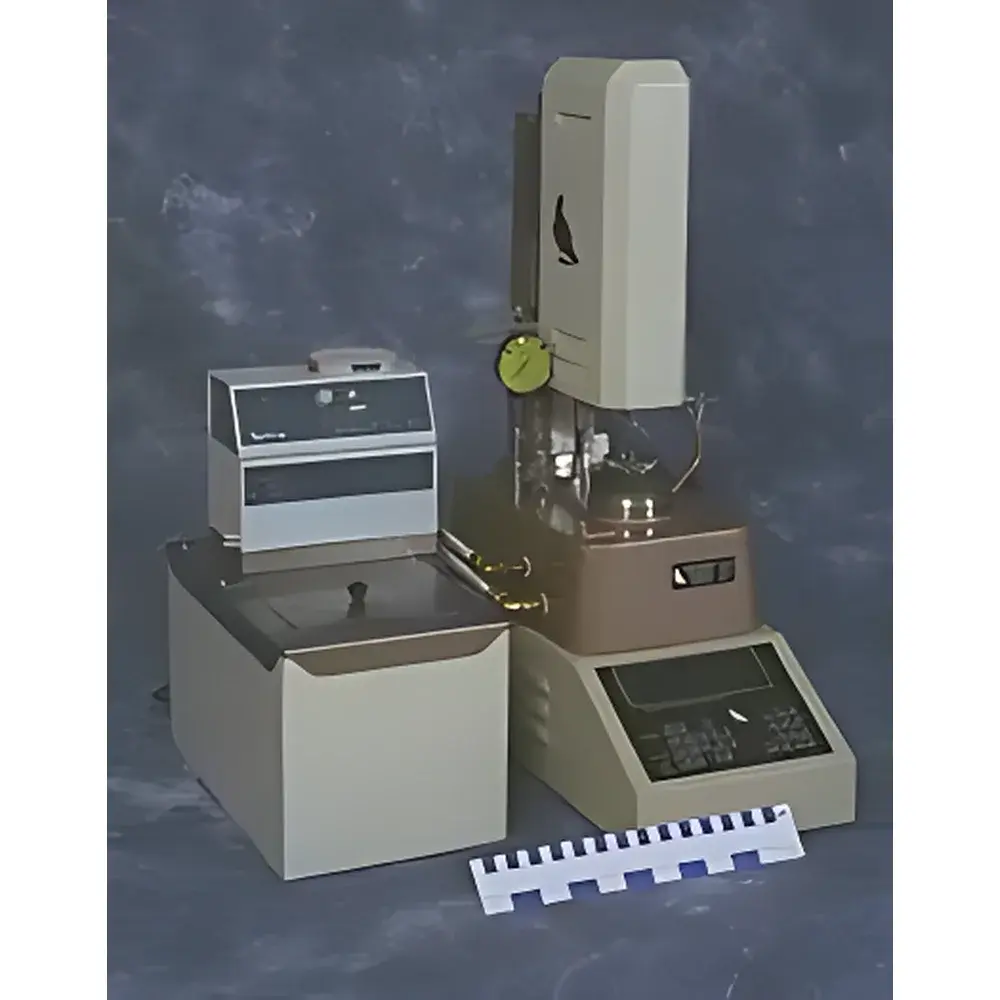
Ravenfield BS/C High-Temperature High-Shear Dynamic Viscosity Tester
| Brand | Ravenfield |
|---|---|
| Origin | United Kingdom |
| Model | BS/C |
| Compliance | ASTM D4741, SH/T 0618-95, IP 320, CEC L-36-A-90, SAE J300 |
| Temperature Range | 60 °C to 180 °C |
| Shear Rate Range | 1 × 10⁵ s⁻¹ to 1.5 × 10⁶ s⁻¹ |
| Measurement Principle | Cone-and-plate Couette flow (Ravensberg method) |
| Output | Dynamic viscosity (mPa·s), torque (mN·m), temperature (°C) |
| Interface | RS-232 serial port |
| Automation Level | Fully automated with embedded microcontroller and guided workflow |
Overview
The Ravenfield BS/C High-Temperature High-Shear Dynamic Viscosity Tester is an engineered solution for precise determination of dynamic viscosity under conditions simulating severe engine operating environments. It operates on the fundamental principle of controlled Couette flow within a precision-machined cone-and-plate geometry—commonly referred to in lubricant rheology as the Ravensberg configuration. In this configuration, a rotating conical rotor engages with a stationary flat plate (stator), generating a well-defined, radially uniform shear field across the sample gap. The instrument maintains thermal equilibrium at elevated temperatures (60 °C to 180 °C) while delivering shear rates ranging from 1 × 10⁵ s⁻¹ to 1.5 × 10⁶ s⁻¹—conditions representative of hydrodynamic lubrication regimes in modern internal combustion engines. Its design directly implements the physical basis of ASTM D4741 and SH/T 0618-95, making it suitable for regulatory compliance testing, formulation development, and quality assurance in lubricant manufacturing.
Key Features
- Fully automated operation with embedded microcontroller and step-by-step guided workflow—minimizing operator dependency and inter-laboratory variability.
- Digital real-time display of critical parameters: bath temperature, measured torque, and calculated dynamic viscosity (in mPa·s).
- Adjustable rotor–stator gap enabling precise control over shear rate without mechanical recalibration.
- Rapid throughput: completes one test in 2–3 minutes; capacity of 20–30 samples per hour under continuous operation.
- Solvent-free cleaning protocol: residual contamination is removed using only a small volume of fresh sample—reducing operational cost and chemical exposure risk.
- Integrated RS-232 interface for bidirectional communication with external PCs, supporting data logging, remote parameter adjustment, and batch reporting.
- Pre-programmed test sequences—including standardized 150 °C dynamic viscosity measurement—execute automatically upon sample loading.
Sample Compatibility & Compliance
The BS/C system is validated for use with mineral-based, synthetic, and semi-synthetic engine oils—including low-SAPS (Sulfated Ash, Phosphorus, Sulfur) formulations required for modern aftertreatment systems. It meets all geometric, thermal, and kinematic requirements specified in ASTM D4741, SH/T 0618-95 (China’s arbitration method for high-temperature high-shear viscosity), IP 320, CEC L-36-A-90, and SAE J300 viscosity classification standards. Its cone-and-plate architecture ensures reproducible gap definition and minimal wall-slip error—critical for non-Newtonian shear-thinning fluids such as multigrade oils. The instrument’s thermal stability (< ±0.1 °C at 150 °C) and torque resolution support GLP-compliant data generation when paired with audit-trail-capable software.
Software & Data Management
While the BS/C operates autonomously via its onboard controller, the RS-232 interface enables integration with laboratory information management systems (LIMS) or custom data acquisition platforms. Users may export timestamped datasets containing temperature, applied rotational speed, measured torque, and derived dynamic viscosity values in CSV or ASCII format. When deployed in regulated environments (e.g., ISO/IEC 17025-accredited labs), the system supports traceability through manual annotation of sample IDs and test conditions. Though not natively 21 CFR Part 11 compliant, the hardware architecture permits third-party software validation for electronic records and signatures where required.
Applications
- Verification of HTHS viscosity for API SP, CK-4, FA-4, and GF-6 engine oil specifications.
- Development and screening of viscosity index improvers (VIIs) and shear-stable polymer additives.
- Stability assessment of formulated oils under simulated boundary-to-mixed lubrication transitions.
- Quality control release testing for OEM-specified lubricants used in passenger cars, heavy-duty diesel engines, and turbocharged gasoline direct injection (TGDI) powertrains.
- Research into thermal degradation kinetics and oxidative thickening behavior at sustained high shear.
FAQ
What standards does the BS/C tester explicitly comply with?
ASTM D4741, SH/T 0618-95, IP 320, CEC L-36-A-90, and SAE J300—all referenced in global engine oil licensing protocols.
Is calibration traceable to national standards?
Yes—calibration is performed using NIST-traceable Newtonian reference oils certified per ISO 8217 or ASTM D445 procedures.
Can the instrument operate unattended for extended periods?
It supports sequential single-sample runs with manual reloading; fully unattended multi-sample operation requires optional autosampler integration.
What maintenance is required for long-term accuracy?
Annual verification of temperature uniformity, rotor concentricity, and torque sensor linearity is recommended per manufacturer guidelines.
Does the BS/C meet FDA or pharmaceutical-grade validation requirements?
No—it is designed exclusively for petroleum-based fluid analysis and is not configured for GMP or USP compliance.
Related Products






