
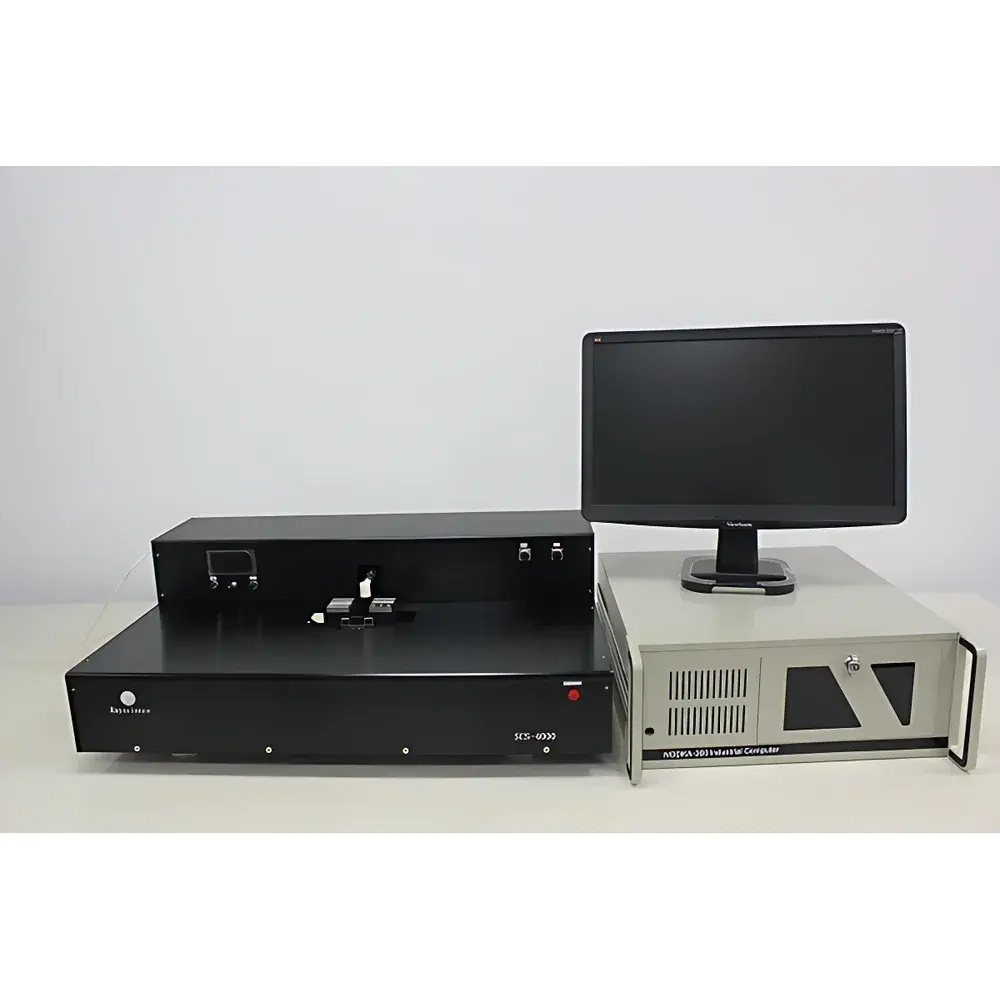
Rayscience SCS-4000-ST Single-Mode Fiber Fusion Tapering System
| Brand | Rayscience |
|---|---|
| Origin | Shanghai, China |
| Model | SCS-4000-ST |
| Product Type | Motorized Translation Stage |
| Pulling Precision | 0.2 µm |
| Pulling Speed | 0.2–10,000 µm/s |
| Max Biaxial Pulling Distance | 80 mm |
| Fiber Clamping Range | Ø0.1–0.5 mm |
| Flame Axial Stroke | 0–20 mm |
| Flame Translation Speed | 0–4 mm/s |
| H₂ Flow Rate | 0–500 SCCM (adjustable) |
| O₂ Flow Rate | 0–200 SCCM (adjustable) |
| Detector Options | InGaAs (800–1700 nm), Si (400–1000 nm), Ge (1000–1800 nm) |
| Light Sources | 1310/1550 nm FP Laser (1 mW), 633 nm HeNe (2 mW), 850/1310 nm Multimode LD |
| Packaging Temperature Range | 0–200 °C |
| Input Voltage | 220 V AC |
| Max Current | 6 A |
Overview
The Rayscience SCS-4000-ST Single-Mode Fiber Fusion Tapering System is an engineered platform for the reproducible fabrication of fused fiber couplers, tapered waveguides, and specialty photonic devices via controlled thermal drawing. It operates on the principle of flame-based fusion tapering—where stripped single-mode fibers are precisely aligned, heated in a hydrogen-oxygen micro-flame, and simultaneously drawn under programmable axial tension to form adiabatic or resonant biconical structures. The system integrates high-resolution motorized translation stages, gas-flow-regulated combustion control, and optical monitoring capability to support R&D and small-batch production of telecom-grade passive components compliant with ITU-T G.652 and IEC 61300-2-4 standards.
Key Features
- Sub-micron pulling resolution (0.2 µm) enabled by imported linear guides and precision ground ball screws (2 mm pitch), ensuring mechanical repeatability across extended biaxial travel (±40 mm per side, 80 mm total).
- Dual-gas flame delivery system featuring an internally mixed H₂/O₂ burner head—designed in-house by Shanghai瞬渺—to eliminate thermal instability associated with conventional top-bottom oxygen injection, delivering uniform heating profiles over variable taper lengths.
- Programmable flame kinematics: independent control of axial stroke (0–20 mm), translation speed (0–4 mm/s), and real-time modulation of H₂/O₂ flow rates (0–500 SCCM / 0–200 SCCM) synchronized with draw velocity and target taper geometry.
- Modular optical detection architecture supporting interchangeable detectors: InGaAs (800–1700 nm), Si (400–1000 nm), or Ge (1000–1800 nm), paired with selectable broadband or wavelength-specific sources including 1310/1550 nm FP lasers, 633 nm HeNe, and multimode LDs.
- Optional CCD visual alignment subsystem for real-time observation of core alignment, flame-fiber interaction, and taper neck formation—critical for polarization-maintaining (PM) fiber processing and asymmetric coupler development.
- Industrial-grade enclosure with brushed stainless-steel finish and extended 700 × 470 × 250 mm optical breadboard footprint—designed to accommodate future upgrades such as automated cladding etching modules or integrated spectral analyzers.
Sample Compatibility & Compliance
The SCS-4000-ST accommodates bare single-mode fibers with outer diameters from 125 µm to 500 µm (including coated-to-stripped transitions), supporting both parallel burn and knotting configurations. Its clamping fixtures are customizable to match fiber coating hardness, numerical aperture, and mode field diameter—enabling consistent tapering of standard SMF-28, dispersion-shifted (DSF), and photosensitive fibers. All fabricated couplers meet industry benchmarks for insertion loss (≤0.2 dB), split-ratio tolerance (±2% at 50:50), and bandwidth stability (±40 nm at 1310/1550 nm). Device packaging supports thermal curing (0–200 °C) and optional UV-curable epoxies, with final encapsulation dimensions conforming to Telcordia GR-1209-CORE and IEC 61300-2-5 mechanical robustness requirements.
Software & Data Management
The proprietary control software provides deterministic trajectory planning for multi-segment taper profiles—including linear, exponential, and parabolic draw laws—each parameterized against real-time optical throughput feedback. Process logs record timestamped values for position, gas flows, flame position, detector signal amplitude, and ambient temperature, stored in CSV-compatible format for traceability. Audit trails comply with GLP documentation standards, and raw data export supports post-processing in MATLAB, Python (NumPy/Pandas), or commercial optical simulation tools (e.g., MODE Solutions, Lumerical). No cloud connectivity or remote access functionality is implemented—ensuring full local data sovereignty and alignment with ISO/IEC 27001 laboratory IT security policies.
Applications
- Development and prototyping of 1×2 and 2×2 single-mode fused couplers for DWDM, PON, and quantum photonics systems.
- Fabrication of fiber-based Mach-Zehnder interferometers (MZIs), long-period gratings (LPGs), and modal interferometers for refractive index, strain, and temperature sensing.
- Production of tapered fiber tips for near-field scanning optical microscopy (NSOM) and evanescent field excitation in biosensing platforms.
- Research into nonlinear optical effects (e.g., supercontinuum generation, four-wave mixing) in subwavelength-diameter fiber tapers.
- Calibration and characterization of specialty fibers, including hollow-core photonic bandgap fibers and multicore fibers requiring precise inter-core coupling control.
FAQ
What fiber types can be processed on the SCS-4000-ST?
Standard SMF-28, HI1060, PM1550, and other silica-based single-mode fibers with cladding diameters between 125 µm and 500 µm are supported. Custom fixturing is available for non-circular or polymer-clad fibers.
Is hydrogen gas handling certified for lab use?
The system includes integrated leak-tested gas manifolds, pressure regulators, and flashback arrestors meeting EN ISO 25037 and CGA P-1 safety guidelines. Local institutional approval for H₂ storage and ventilation remains the user’s responsibility.
Can the system produce polarization-maintaining couplers?
Yes—when equipped with rotational alignment stages and polarization-resolved detection, the platform enables active axis locking during flame heating, achieving extinction ratios >20 dB in PM-fiber couplers.
What level of process repeatability is achievable?
Under controlled environmental conditions (±0.5 °C, <30% RH), batch-to-batch deviation in coupling ratio is ≤±1.2% for 50:50 devices across 50 consecutive runs, verified using NIST-traceable optical power meters.
Does the system support automated recipe storage and recall?
Yes—up to 128 user-defined taper programs can be saved with full parameter sets (position profile, gas flows, detector gain, source wavelength), each assignable to hardware keys for rapid operator deployment without software reconfiguration.






