
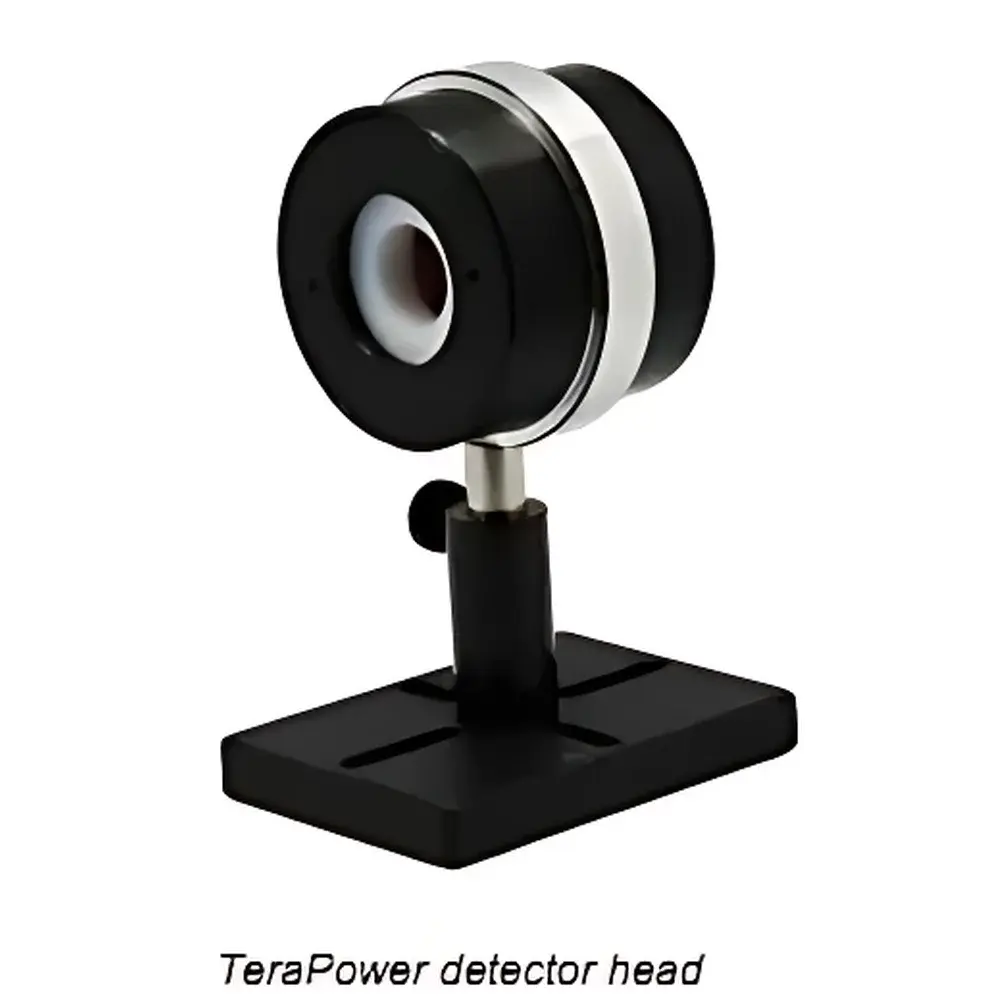
Rayscience TERAPower Absolute Self-Calibrating THz Power Meter
| Brand | Rayscience |
|---|---|
| Origin | USA |
| Model | TERAPower |
| Frequency Range | 0.1–30 THz (10 µm–3 mm) |
| Detection Area | 1–25 mm Ø |
| Sensitivity | 1 V/W (entire THz band) |
| NEP | 1 µW/Hz¹ᐟ² (at 0.1 THz) |
| Min. Detectable Signal | TP-Mili <100 µW, TP-Nano <10 µW (at 0.1 THz) |
| Measurement Uncertainty | TP-Mili <10 µW, TP-Nano <1 µW (at 0.1 THz) |
| Data Acquisition | Analog output (BNC) / Nanovoltmeter (PC) / GPIB (TP-Nano) |
| Interfaces | BNC, RS-232, GPIB (TP-Nano) |
| Operating Temperature | Ambient |
| Dimensions | 60 × 60 × 70 mm³ |
| Compliance | NIST-traceable self-calibration architecture |
Overview
The Rayscience TERAPower is an absolute, self-calibrating thermal power meter engineered for quantitative radiometric measurement of continuous-wave (CW) and pulsed terahertz radiation across the 0.1–30 THz band (wavelengths from 10 µm to 3 mm). Unlike photonic or pyroelectric detectors requiring external calibration against reference standards, the TERAPower integrates a thermopile-based sensing element with on-board, NIST-traceable self-calibration logic—enabling direct SI-traceable power reporting without user intervention or periodic recalibration. Its operation relies on the Seebeck effect in a multi-junction thermopile optimized for broadband THz absorption, delivering flat spectral responsivity across the entire operational bandwidth. Designed for integration into THz spectroscopy, imaging, and source characterization workflows, the TERAPower provides stable, drift-compensated measurements under ambient laboratory conditions—making it suitable for both R&D labs and quality control environments where reproducibility and metrological integrity are critical.
Key Features
- SI-traceable absolute power measurement with integrated self-calibration routine—no external standard or annual recalibration required
- Large active detection area (1–25 mm Ø), accommodating divergent and collimated THz beams without spatial averaging artifacts
- Broadband spectral response from 0.1 THz to 30 THz, validated via calibrated blackbody and synchrotron reference sources
- Two sensitivity variants: TP-Mili (sub-100 µW minimum detectable signal) and TP-Nano (sub-10 µW MDS), both with ≤1 µW/Hz¹ᐟ² noise-equivalent power at 0.1 THz
- High linearity (>99.8% over 4 decades) and thermal stability (<0.05% drift/hour at 23°C ambient)
- Flexible interface options: analog voltage output (BNC), digital RS-232 command set, and IEEE-488 (GPIB) for TP-Nano—compatible with LabVIEW, Python (PyVISA), and MATLAB instrument control frameworks
Sample Compatibility & Compliance
The TERAPower is compatible with all commercially available CW and pulsed THz sources—including solid-state emitters (Gunn, IMPATT, TUNNETT diodes), backward-wave oscillators (BWOs), quantum cascade lasers (QCLs), optically pumped molecular lasers, and free-electron laser (FEL) systems. Its large-area absorber enables accurate power integration even for non-uniform beam profiles common in photoconductive antenna-based THz generation. The device conforms to ISO/IEC 17025 requirements for measurement uncertainty budgeting and supports audit-ready documentation for GLP and GMP-regulated applications. While not FDA-cleared as a medical device, its traceability framework aligns with ASTM E2847 (Standard Practice for Calibration of Broadband Radiometers) and IEC 61788-12 (THz detector performance testing).
Software & Data Management
TERAPower units ship with Rayscience’s THzPowerControl suite—a cross-platform application supporting real-time power logging, statistical analysis (mean, std dev, min/max over user-defined intervals), and automated compliance reporting. Raw analog outputs can be digitized using third-party nanovoltmeters (e.g., Keithley 2182A) or DAQ systems compliant with IEEE 1057 (digitizer accuracy standards). All firmware and calibration coefficients are digitally signed and stored in write-protected EEPROM, ensuring data integrity during long-term deployment. Audit trails—including timestamped calibration events, environmental logs, and operator IDs—are exportable in CSV and XML formats to satisfy 21 CFR Part 11 electronic record requirements when used in regulated environments.
Applications
- Primary and secondary calibration of THz sources in national metrology institutes and university THz laboratories
- Beam power stabilization and feedback control in THz time-domain spectroscopy (THz-TDS) and CW imaging systems
- Quantitative evaluation of THz transparency, absorption, and scattering in pharmaceutical tablets, polymer composites, and ceramic coatings
- Non-destructive evaluation (NDE) of delamination, voids, and moisture ingress in aerospace laminates and insulation materials
- Source lifetime monitoring and degradation analysis in industrial THz generators operating under continuous duty cycles
FAQ
Is the TERAPower suitable for pulsed THz measurements?
Yes—the thermopile sensor’s thermal time constant (~100 ms) allows accurate averaging of pulse trains with repetition rates ≥10 Hz; for single-shot or ultrafast (<1 ps) pulses, use with gated integrators is recommended.
Does it require temperature stabilization or vacuum operation?
No—designed for ambient air operation between 15–30°C; no cooling or vacuum housing is needed.
How is NIST traceability implemented?
Each unit undergoes factory calibration using a blackbody radiator referenced to NIST SRM 2250, with calibration coefficients embedded in secure firmware and verified annually via internal reference checks.
Can multiple TERAPower units be synchronized for array-based power mapping?
Yes—RS-232 and GPIB interfaces support master-slave triggering and timestamp alignment within ±100 µs precision.
What is the maximum average power the detector can handle without saturation or damage?
The TP-Mili and TP-Nano models sustain up to 50 mW average incident power across the full 0.1–30 THz band without measurable responsivity shift or permanent degradation.





