
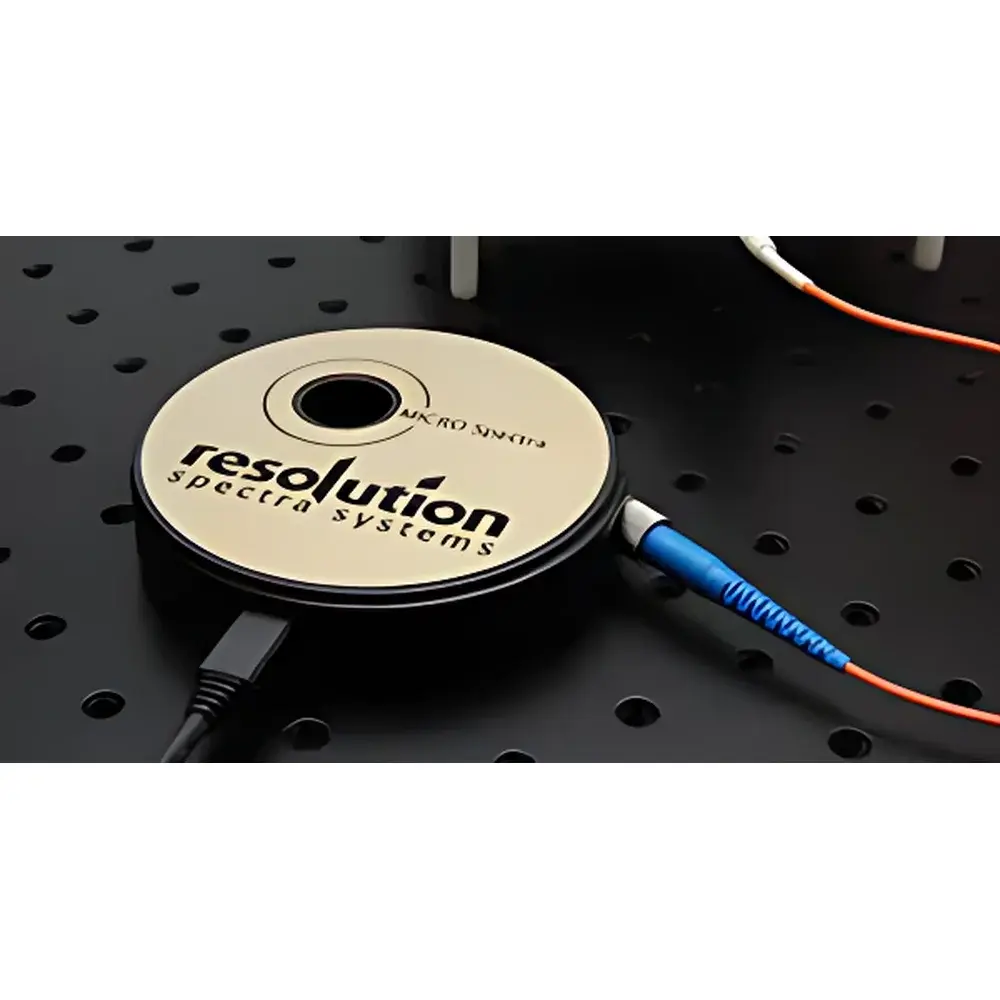
Resolution Spectra Systems MICRO Spectra Portable Raman Spectrometer
| Brand | Resolution Spectra Systems |
|---|---|
| Origin | France |
| Model | MICRO Spectra |
| Instrument Type | Portable / Handheld Raman Spectrometer |
| Spectral Range | 630–1070 nm |
| Spectral Resolution | 0.01 nm (FWHM) |
| Spatial Resolution | 0.01 nm |
| Minimum Wavenumber Accuracy | 0.01 nm |
| Spectral Repeatability | ±0.01 nm |
| Calibration Stability | Drift-free over time and temperature |
| Technology | SWIFTS™ (Stationary Wave Interferometer Fourier Transform Spectrometer) |
Overview
The Resolution Spectra Systems MICRO Spectra is a compact, solid-state portable Raman spectrometer engineered for high-fidelity spectral characterization of lasers across the visible to near-infrared range (630–1070 nm). Unlike conventional scanning or grating-based spectrometers, the MICRO Spectra leverages patented SWIFTS™ (Stationary Wave Interferometer Fourier Transform Spectrometer) technology — a monolithic, all-solid-state interferometric architecture with no moving parts. SWIFTS operates on the physical principle of evanescent field sampling from a stationary optical wave interference pattern formed within a single-mode planar waveguide. This approach originates from Gabriel Lippmann’s 1892 Nobel Prize-winning work on interference-based color photography and was re-engineered in 2004 by researchers at Université Joseph Fourier and Institut National Polytechnique (Grenoble, France) for photonic spectral analysis. The result is a fundamentally new class of spectrometer offering intrinsic wavelength stability, exceptional repeatability (±0.01 nm), and immunity to mechanical drift or thermal hysteresis — critical for long-term deployment in field, production, or embedded OEM environments.
Key Features
- Monolithic SWIFTS™ optical engine: No moving components, no alignment sensitivity, no periodic recalibration required
- High spectral fidelity: 0.01 nm full-width-at-half-maximum (FWHM) resolution across 630–1070 nm
- Thermally stable calibration: Factory-traceable wavelength reference maintained over operating temperatures (15–35 °C) and extended operational lifetime
- Compact footprint: Sub-100 cm³ form factor optimized for integration into laser test benches, handheld diagnostic tools, or process monitoring stations
- Real-time spectral acquisition: Supports multi-shot averaging, trigger-synchronized capture, and burst-mode acquisition for transient laser characterization
- Low power consumption: Operates via USB 3.0 bus power; compatible with battery-powered field operation
Sample Compatibility & Compliance
The MICRO Spectra is designed for direct coupling to free-space or fiber-coupled laser sources, including tunable diode lasers, multimode Fabry–Pérot lasers, and mode-unstable broadband emitters. It does not require external sample chambers or optical tables. Its input interface accepts standard SMA905 or FC/PC fiber connectors (optional adapters available). While primarily intended for source spectral analysis rather than material Raman scattering, the instrument complies with IEC 61326-1:2013 (EMC for laboratory equipment) and meets CE marking requirements for electromagnetic compatibility and safety. All firmware and calibration data are stored in non-volatile memory with cryptographic integrity checks, supporting audit-ready documentation for GLP-compliant laboratories.
Software & Data Management
The included Spectra Resolver software (v4.2+) provides a deterministic, deterministic spectral processing environment built on a deterministic real-time acquisition kernel. Key capabilities include automated peak detection with sub-pixel centroiding, multi-channel spectral overlay, wavelength drift trending, and batch export in HDF5 and CSV formats. The software implements full audit trail functionality per FDA 21 CFR Part 11 requirements — including user authentication, electronic signatures, and immutable event logging for all calibration, acquisition, and export actions. Raw interferogram data and calibrated spectra are stored separately to support independent reprocessing and traceability. API support (C/C++, Python, MATLAB) enables integration into automated test systems and Industry 4.0 data pipelines.
Applications
- Laser development labs: Real-time monitoring of wavelength drift, mode hopping, and side-mode suppression ratio (SMSR) during burn-in and aging tests
- OEM integration: Embedded spectral feedback in tunable laser modules, quantum cascade laser drivers, and photonic integrated circuit (PIC) test platforms
- Field service diagnostics: Handheld verification of laser source compliance against ITU-T G.694.1 grid specifications in telecom infrastructure maintenance
- Academic research: High-repetition-rate spectral dynamics studies of ultrafast lasers, frequency combs, and optomechanical oscillators
- Quality control: Final-test spectral verification for laser diode manufacturing lines requiring <0.02 nm pass/fail thresholds
FAQ
Does the MICRO Spectra require periodic recalibration?
No. The SWIFTS™ core is inherently self-referencing and factory-calibrated using NIST-traceable line sources. No user-performed recalibration is needed under normal operating conditions.
Can it measure Raman shifts from samples?
No. The MICRO Spectra is optimized for high-resolution laser source characterization, not dispersive Raman spectroscopy. It lacks excitation filtering, sample illumination optics, or Raman-shift calibration standards.
Is it compatible with third-party DAQ or control systems?
Yes. The device exposes a documented USB HID protocol and supports SCPI-like command syntax. Full SDKs are provided for Windows, Linux, and real-time OS targets.
What is the typical measurement uncertainty for absolute wavelength?
±0.005 nm (k=2) at 785 nm, verified against stabilized HeNe and iodine absorption references during final calibration.
How is thermal stability achieved without active temperature control?
Through symmetric monolithic waveguide design, low-CTE fused silica substrate, and differential interferometric signal processing that rejects common-mode thermal expansion effects.





