
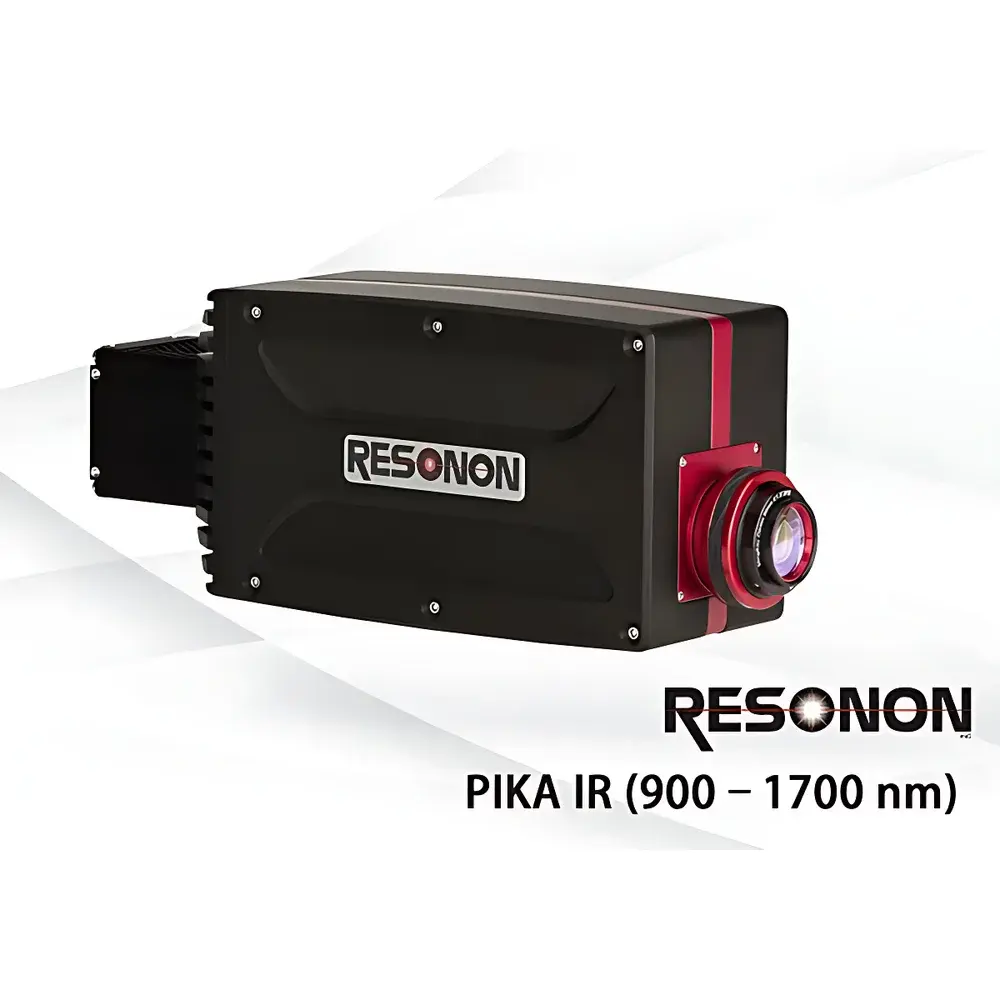
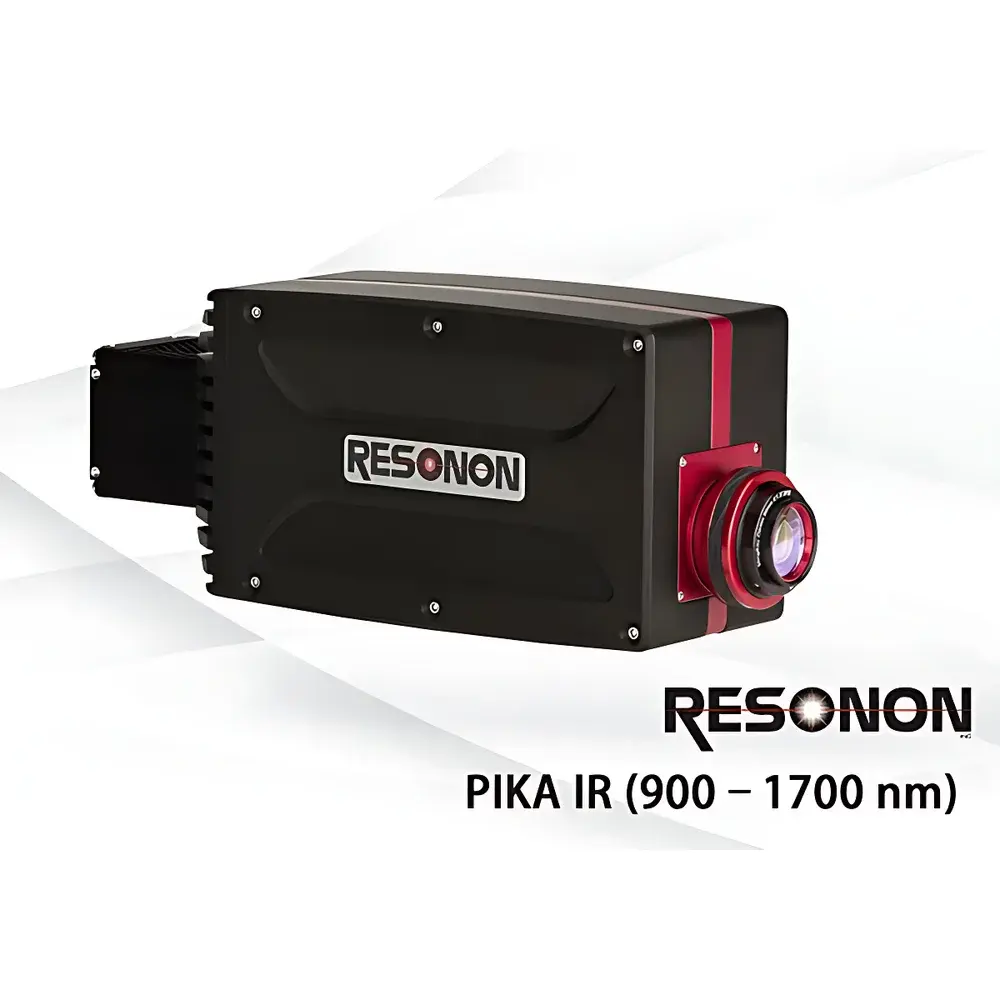
Resonon Pika IR Hyperspectral Imaging System
| Brand | Resonon |
|---|---|
| Origin | USA |
| Model | Pika IR |
| Instrument Type | Online Hyperspectral Imager |
| Principle | Push-broom Imaging Spectroscopy |
| Spectral Range | 900–1700 nm |
| Spectral Resolution | 4.9 nm |
| Spectral Bands | 164 |
| Spatial Pixels per Line | 320 |
| Max Frame Rate | 520 fps |
| Bit Depth | 14-bit |
| Weight | 2.7 kg |
| Dimensions (L×W×H) | 11.0 × 29.6 × 8.9 cm |
| Interface | Gigabit Ethernet |
| Operating Temperature | 5–40 °C |
| Aperture | f/1.8 |
| Pixel Size | 30 µm |
| Average RMS Spot Radius | 10 µm |
| Smile (Peak-to-Peak) | 10 µm |
| Keystone (Peak-to-Peak) | 10 µm |
| Radiometric Calibration | Included |
| Pre-installed Software | SpectrononPro, Resonon Acquisition & Analysis Suite |
Overview
The Resonon Pika IR is a compact, lightweight, and high-performance push-broom hyperspectral imaging system engineered for precision spectral-spatial data acquisition in the short-wave infrared (SWIR) region. Operating on the fundamental principle of line-scanning spectroscopy, the Pika IR captures contiguous spectral bands across a 900–1700 nm range with a nominal spectral resolution of 4.9 nm—enabling robust discrimination of chemical absorption features associated with C–H, O–H, and N–H bonds. Its optical design incorporates a reflective fore-optic and a high-efficiency transmission grating spectrometer, minimizing chromatic aberrations and delivering low smile (<10 µm p-p) and keystone (<10 µm p-p) distortion—critical for quantitative pixel-level radiometric consistency. With a frame rate of up to 520 fps and 320 spatial pixels per line, the system supports real-time data streaming over GigE, making it suitable for both laboratory-based material characterization and dynamic industrial inline monitoring applications.
Key Features
- Optimized SWIR performance: Covers the chemically informative 900–1700 nm window with 164 calibrated spectral channels
- High geometric fidelity: Engineered optical architecture ensures <10 µm peak-to-peak smile and keystone—essential for accurate spectral unmixing and classification
- Low-noise acquisition: f/1.8 aperture and 14-bit digitization yield high signal-to-noise ratio (SNR), supported by factory-applied radiometric calibration
- Compact and rugged form factor: Weighs only 2.7 kg with dimensions of 11.0 × 29.6 × 8.9 cm—designed for integration into UAV payloads, conveyor-mounted inspection stations, or benchtop analytical workstations
- Real-time capability: Sustained 520 fps line rate enables high-throughput scanning of moving samples without motion blur
- Plug-and-play operation: Pre-configured with SpectrononPro for advanced spectral analysis and Resonon’s native acquisition software for hardware control and metadata tagging
Sample Compatibility & Compliance
The Pika IR is compatible with solid, semi-solid, and granular samples—including agricultural produce, pharmaceutical tablets, polymer blends, mineral specimens, and food products—without requiring contact or sample preparation. Its non-destructive, reflectance-based measurement modality conforms to ASTM E1777 (Standard Practice for Hyperspectral Imaging Data Collection) and supports workflows aligned with ISO 17025-accredited laboratories. Radiometric calibration traceability is maintained through NIST-traceable standards, and raw data output adheres to ENVI-compatible BIL/BIP formats for interoperability with third-party chemometric platforms. The system operates within an ambient temperature range of 5–40 °C and meets IEC 61000-6-2 (immunity) and IEC 61000-6-3 (emissions) for industrial electromagnetic compatibility.
Software & Data Management
The Pika IR ships with two integrated software environments: SpectrononPro—a validated, GUI-driven platform supporting spectral library matching, PCA, MCR, and supervised classification—and Resonon’s Acquisition & Analysis Suite, which provides low-level hardware control, live preview, ROI selection, and automated dark/light reference capture. All software modules log full acquisition metadata (wavelength calibration, exposure time, integration time, GPS timestamp if synchronized) and support audit-trail generation compliant with FDA 21 CFR Part 11 requirements when deployed in regulated environments. Data export options include HDF5, TIFF stack, and CSV spectral profiles, enabling seamless ingestion into Python (scikit-learn, PySpectra), MATLAB, or commercial tools such as Unscrambler X or Pirouette.
Applications
- Industrial quality assurance: Real-time detection of foreign material, moisture gradients, or coating uniformity on pharmaceutical blister packs and battery electrode films
- Agricultural phenotyping: Quantification of nitrogen content, water stress, and disease biomarkers in leaf canopies during field trials
- Recycling sorting: Discrimination of black plastics (e.g., ABS vs. PS) and polymer composites based on SWIR spectral signatures
- Geological surveying: Mineral identification (e.g., clays, carbonates, sulfates) from core samples or airborne surveys
- Food safety: Detection of mycotoxin contamination in grains and adulteration in powdered dairy products
- Research-grade spectral modeling: Generation of ground-truth datasets for training deep learning models in spectral segmentation and anomaly detection
FAQ
Is the Pika IR suitable for outdoor or UAV-based deployments?
Yes—the system’s low mass, passive thermal design, and GigE interface enable stable operation on fixed-wing and multirotor UAV platforms; mounting brackets and vibration-damping options are available.
Does the system support radiometric calibration for absolute reflectance measurements?
Yes—each unit ships with factory-applied radiometric calibration coefficients and includes protocols for user-performed dark/light reference correction using standardized panels (e.g., Spectralon®).
Can SpectrononPro be used for regulatory submissions under GLP or GMP?
SpectrononPro supports electronic signatures, audit trails, and version-controlled method files—meeting core elements of GLP and GMP data integrity requirements when configured with appropriate IT governance controls.
What is the typical integration time required for optimal SNR in reflectance mode?
Integration time is adjustable from 10 µs to 100 ms; optimal settings depend on illumination intensity and sample reflectivity—but most industrial applications operate between 1–10 ms for balanced throughput and SNR.
Is OEM integration supported for embedded systems or custom control interfaces?
Yes—Resonon provides documented C/C++ and Python SDKs, including example code for TCP/IP command-and-control, trigger synchronization, and real-time data streaming via memory-mapped buffers.
Related Products







