
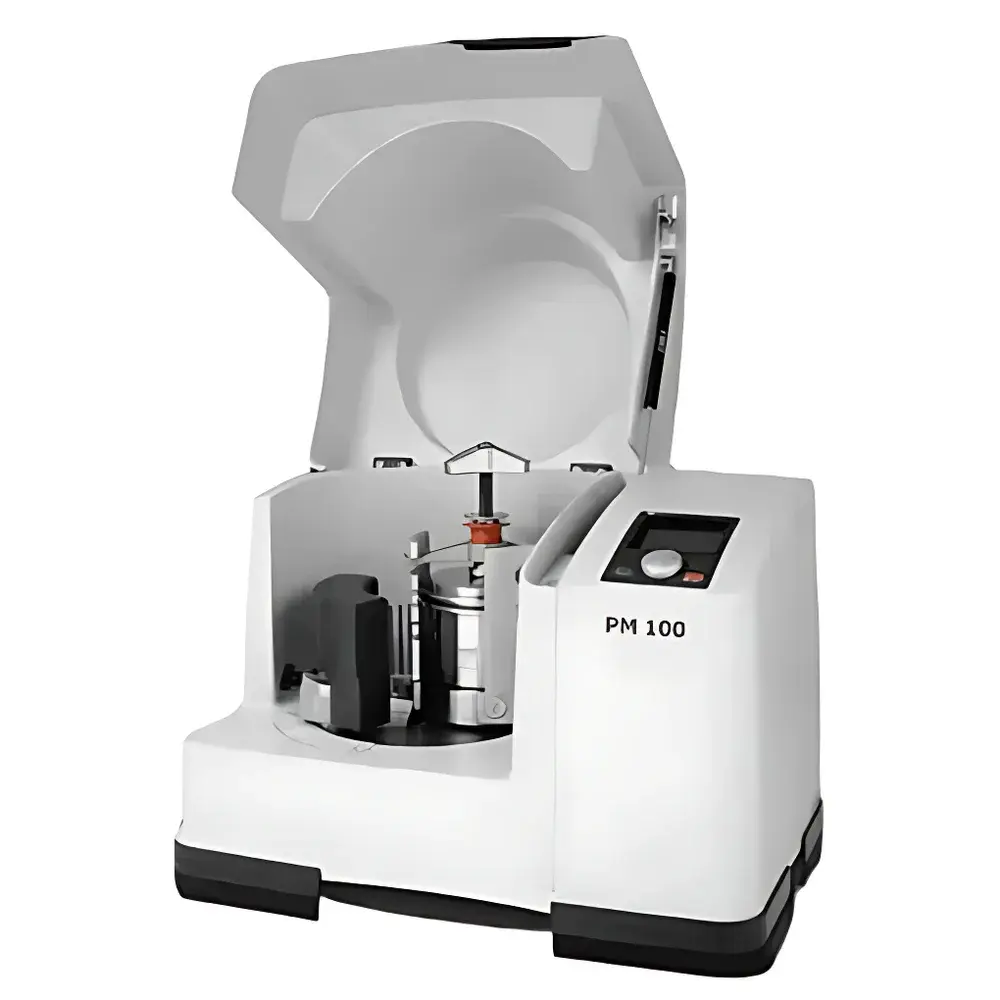
RETSCH PM 100 Planetary Ball Mill
| Brand | RETSCH |
|---|---|
| Origin | Germany |
| Model | PM 100 |
| Instrument Type | Planetary Ball Mill |
| Sample Applicability | Hard and brittle materials |
| Feed Size | < 10 mm |
| Final Particle Size | < 0.01 mm (10 µm) |
| Colloidal Grinding Output | < 0.1 µm |
| Batch Volume | up to 1 × 220 mL (standard) |
| Maximum Compensated Mass | 8 kg |
Overview
The RETSCH PM 100 is a high-performance, benchtop planetary ball mill engineered for reproducible, high-energy comminution of hard, brittle, and fibrous materials. Operating on the principle of planetary motion—where grinding jars rotate eccentrically around a sun wheel while simultaneously rotating on their own axes—the PM 100 generates centrifugal accelerations up to 65 g, enabling efficient size reduction through impact, shear, and friction forces. This kinematic design ensures uniform energy input across the entire sample volume, making it especially suitable for applications demanding sub-micron fineness, amorphization, mechanical alloying, and homogenization of heterogeneous mixtures. As a CE-compliant instrument manufactured in Germany, the PM 100 meets stringent requirements for laboratory safety, electromagnetic compatibility (EMC Directive 2014/30/EU), and mechanical integrity (Machinery Directive 2006/42/EC).
Key Features
- Single-grinding-station architecture with automatic center-of-gravity compensation for masses up to 8 kg—eliminating manual balancing and ensuring stable operation at high rotational speeds.
- Programmable digital control interface supporting precise setting of grinding time (1 s–99 h 59 min), speed (0.1–650 rpm), and pause intervals for thermal management.
- Robust stainless-steel housing with integrated safety interlock system; grinding chamber remains locked during operation and only releases after full deceleration.
- Wide range of compatible grinding media (e.g., tungsten carbide, stainless steel, zirconium oxide, agate) and jar materials (50–500 mL capacity), enabling optimization for contamination-sensitive or reactive samples.
- Low-noise design compliant with ISO 7779 and ISO 9296 acoustic emission standards for routine use in shared laboratory environments.
Sample Compatibility & Compliance
The PM 100 accommodates diverse sample types including metals (e.g., Fe, Al, Ni alloys), inorganic oxides (TiO₂, SiO₂, Al₂O₃), geological matrices (limestone, kaolin, slag), biological tissues (bone, hair, plant matter), polymers, ceramics, and electronic waste. Its ability to achieve final particle sizes below 10 µm—and down to < 0.1 µm under optimized colloidal grinding conditions—supports downstream analytical workflows such as X-ray diffraction (XRD), scanning electron microscopy (SEM), laser diffraction particle sizing (ISO 13320), and inductively coupled plasma mass spectrometry (ICP-MS). The instrument complies with ISO 17025:2017 requirements for method validation when used in accredited testing laboratories, and its traceable calibration protocols support GLP and GMP documentation needs.
Software & Data Management
While the PM 100 operates via an intuitive front-panel controller without mandatory PC connectivity, optional integration with RETSCH’s EASY MILL software (via RS-232 or USB) enables remote parameter configuration, real-time monitoring of rotational speed and elapsed time, and export of grinding logs in CSV format. All operational parameters—including start/stop timestamps, speed profiles, and emergency stops—are automatically recorded with device-specific identifiers and user-defined batch IDs. This audit trail satisfies data integrity requirements under FDA 21 CFR Part 11 when configured with electronic signature functionality and access-controlled user accounts.
Applications
- Mechanical activation of catalysts and battery electrode materials (e.g., LiCoO₂, graphite composites).
- Preparation of homogeneous reference materials for geochemical analysis (e.g., certified soils, ores, slags).
- Production of nanostructured metal–organic frameworks (MOFs) and amorphous pharmaceutical intermediates.
- Routine sample homogenization prior to elemental analysis (XRF, ICP-OES) or leaching tests (TCLP, SPLP per EPA Method 1311/1312).
- Particle size reduction of refractory ceramics and abrasives for rheological characterization and sintering studies.
FAQ
What is the maximum recommended continuous operating time per cycle?
The PM 100 supports uninterrupted grinding cycles up to 99 hours and 59 minutes; however, for heat-sensitive samples, intermittent operation with programmable pauses is recommended to maintain thermal stability.
Can the PM 100 be used for cryogenic grinding?
Yes—when equipped with liquid nitrogen-cooled grinding jars and appropriate safety accessories (e.g., insulated gloves, face shield), the PM 100 enables cryomilling of thermolabile polymers and biological tissues.
Is validation documentation available for regulatory submissions?
RETSCH provides Factory Acceptance Test (FAT) reports, IQ/OQ templates, and material compliance certificates (RoHS, REACH) upon request—supporting qualification in pharmaceutical, environmental, and academic QA/QC environments.
How is cross-contamination prevented between batches?
Grinding jars and media are fully removable and autoclavable (for compatible materials); RETSCH also offers single-use polymer jars and dedicated cleaning protocols validated per ASTM E1847 for residue detection.
Does the PM 100 meet explosion-proof requirements for organic solvent-based wet grinding?
The standard PM 100 is not ATEX-certified; however, RETSCH offers the explosion-protected PM 100 CM variant (Category 2G, Zone 1) for use with flammable solvents under IEC 60079-0 and EN 60079-15 standards.



