
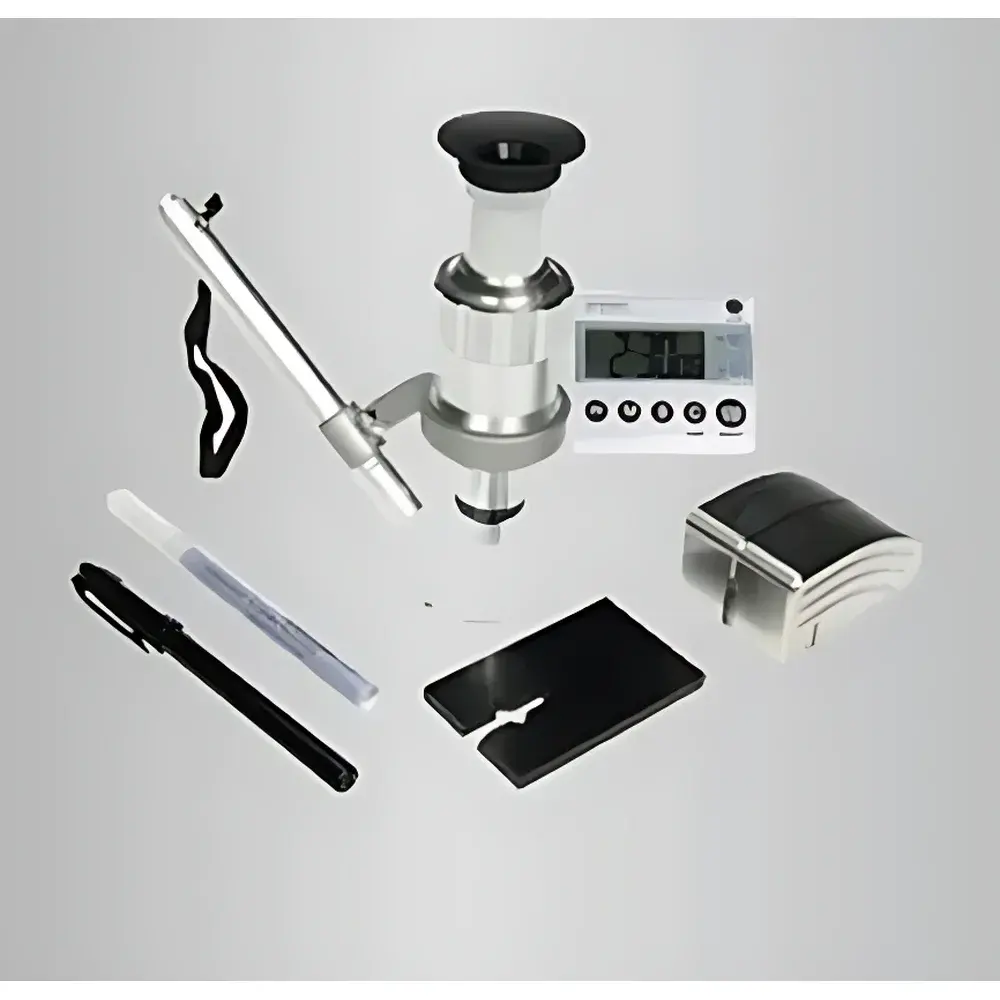
TQC Buchholz Indentation Hardness Tester
| Brand | TQC |
|---|---|
| Origin | Netherlands |
| Manufacturer Type | Authorized Distributor |
| Origin Category | Imported Instrument |
| Model | Buchholz Indentation Tester |
| Pricing | Upon Request |
Overview
The TQC Buchholz Indentation Hardness Tester is a precision-engineered instrument designed for the quantitative assessment of coating hardness according to the indentation principle defined in ISO 2815:2003, “Paints and varnishes — Determination of indentation hardness by means of the Buchholz test.” This method evaluates the resistance of organic coatings—such as paints, lacquers, and powder coatings—to permanent deformation under controlled static load. The tester applies a standardized indenter (a hardened steel wheel with a precisely defined edge geometry) onto the coated surface at a fixed load (typically 1.0 kgf or 9.81 N) for a specified dwell time (usually 30 seconds). The resulting indentation width is measured optically under magnification, and hardness is inversely correlated with the measured indentation dimension—smaller indentations indicate higher coating hardness. The instrument is widely employed in R&D laboratories, quality control departments, and certification bodies serving architectural, automotive, coil-coating, and industrial finishing sectors.
Key Features
- Calibrated Buchholz indenter wheel with certified edge geometry and Rockwell C60+ hardness, ensuring repeatable mechanical loading per ISO 2815 requirements.
- Integrated 20× illuminated stereo magnifier with adjustable focus and glare-free LED illumination for precise visual assessment of indentation boundaries.
- Digital timer with ±0.1 s resolution and automatic start/stop functionality synchronized with indenter contact and release.
- Integrated spirit level and leveling feet to guarantee perpendicular load application and eliminate angular deviation errors.
- Standardized test template with engraved reference lines and two calibrated marking pencils for consistent sample positioning and post-test annotation.
- Compact, robust aluminum-alloy chassis engineered for long-term dimensional stability and vibration resistance in shared lab environments.
Sample Compatibility & Compliance
The TQC Buchholz Indentation Hardness Tester accommodates flat, rigid substrates with coating thicknesses ranging from 20 µm to 500 µm—including metal panels (steel, aluminum), glass, and rigid plastics. It is not suitable for flexible films, elastomeric coatings, or highly textured surfaces where indentation recovery or substrate deflection may compromise measurement validity. The instrument complies fully with ISO 2815:2003 and is formally recognized by Qualicoat (for architectural aluminum anodizing and coating), QIB (Quality Initiative Bavaria), and GSB International (Global Standardization Board for architectural coatings). These certifications confirm its suitability for audits under EN 13523-4 (coil-coated metals) and support compliance with customer-specific specifications requiring third-party validated hardness testing protocols.
Software & Data Management
This analog-digital hybrid instrument does not incorporate embedded firmware or proprietary software. All measurements are manually recorded and traceable via operator logs, adhering to GLP principles. Digital timer output and magnifier calibration certificates are supplied with each unit, enabling full metrological traceability to national standards (NIST-traceable calibration reports available upon request). For laboratories operating under FDA 21 CFR Part 11 or ISO/IEC 17025 requirements, manual data entry into LIMS or ELN systems is supported through standardized reporting templates provided in the user manual. Audit trails, instrument calibration history, and operator training records remain the responsibility of the end-user laboratory per Good Documentation Practice (GDP).
Applications
- Quality assurance of decorative and protective coatings on aluminum extrusions and sheet metal prior to installation or further processing.
- Batch-to-batch hardness verification in coil coating production lines to ensure consistency across curing parameters (temperature, dwell time, line speed).
- Comparative evaluation of crosslink density in thermosetting systems (e.g., epoxy-polyester hybrids) during formulation development.
- Failure analysis of coating softening due to overbaking, undercuring, solvent retention, or plasticizer migration.
- Supporting technical documentation for CE marking, AAMA 2603/2604/2605 submissions, and ISO 9001 internal audits.
FAQ
What standard does the TQC Buchholz Indentation Tester comply with?
ISO 2815:2003 is the primary governing standard; additional recognition is held from Qualicoat, QIB, and GSB.
Is the indenter wheel replaceable, and how often should it be recalibrated?
Yes—the indenter wheel is a consumable component and must be replaced after 500 test cycles or if visible wear is observed under 20× magnification; annual recalibration against certified reference specimens is recommended.
Can this instrument be used on curved surfaces?
No—only flat, rigid substrates meeting minimum stiffness and thickness requirements (e.g., ≥0.5 mm steel or ≥1.0 mm aluminum) are valid per ISO 2815.
Does the tester include calibration certification?
Each unit ships with a factory-issued calibration certificate for the indenter wheel, timer, and magnifier; accredited third-party calibration is available separately.
How is measurement repeatability ensured across operators?
Through standardized operator training, use of the included leveling system and alignment template, and adherence to the 30-second dwell time protocol defined in ISO 2815.





