
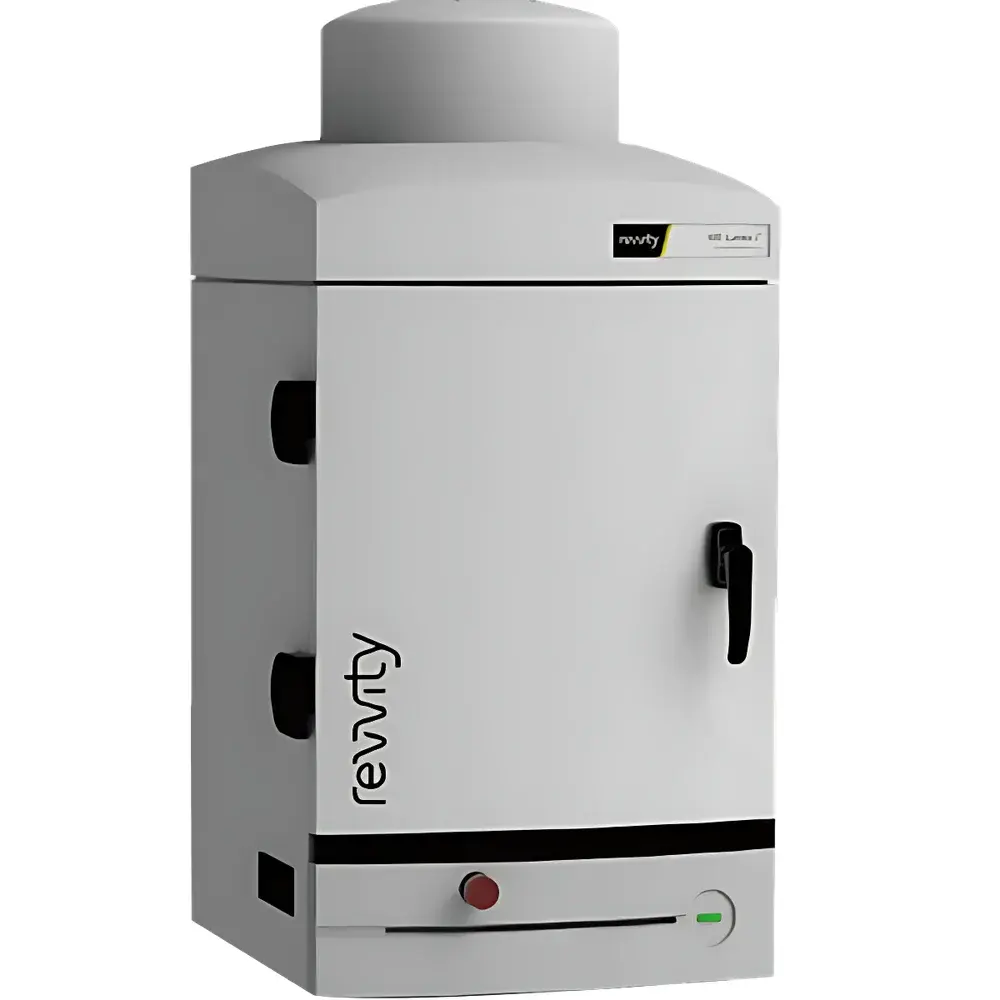
Revvity IVIS Lumina LT Small Animal In Vivo Optical Imaging System
| Brand | Revvity |
|---|---|
| Origin | USA |
| Manufacturer Type | Original Equipment Manufacturer (OEM) |
| Origin Category | Imported |
| Model | IVIS Lumina LT |
| Instrument Type | Optical Imaging System |
| Animal Model | Mouse |
| Imaging Modality | Bioluminescence, Fluorescence (Visible to NIR), Cerenkov Luminescence Imaging |
Overview
The Revvity IVIS® Lumina LT Small Animal In Vivo Optical Imaging System is a third-generation, high-sensitivity 2D optical imaging platform engineered for quantitative longitudinal studies in preclinical research. Based on photon detection principles—specifically bioluminescence (BLI), fluorescence (FLI), and Cerenkov luminescence imaging (CLI)—the system enables non-invasive, real-time visualization of biological processes in living mice under controlled physiological conditions. Its core architecture integrates a back-illuminated, thermoelectrically cooled scientific-grade CCD sensor (1024 × 1024 pixels, 13 × 13 mm² active area), operating at −90 °C to minimize dark current and maximize signal-to-noise ratio across the visible to near-infrared (NIR) spectrum (400–900 nm). The light-tight imaging chamber features an f/0.95 high-aperture lens, motorized stage control, and integrated environmental management—including heated animal staging, gas anesthesia delivery (isoflurane), and ECG monitoring—ensuring consistent animal physiology during acquisition. Designed for reproducibility and cross-laboratory data comparability, every IVIS instrument undergoes rigorous factory optical calibration traceable to NIST standards.
Key Features
- Quantitative dual-modality imaging: simultaneous high-fidelity bioluminescence and fluorescence detection with absolute radiometric calibration
- Adjustable field-of-view (FOV): motorized zoom lens supports FOVs from 2.5 × 2.5 cm² to 24 × 24 cm²—enabling concurrent imaging of up to five mice or two medium-sized rats
- Full-spectrum fluorescence capability: standard 8-position emission filter wheel with optional upgrade to 7-emission/19-excitation configuration for multicolor spectral unmixing
- Integrated physiological support: temperature-regulated stage (25–40 °C), precision vaporizer-based isoflurane anesthesia with intra-chamber ports, and real-time ECG monitoring
- Automated acquisition and alignment: motorized lens, filter wheel, stage, and focus—all software-controlled for protocol-driven repeatability
- High-dynamic-range detection: 16-bit digitization and Peltier-cooled CCD deliver >5-log linear dynamic range for longitudinal signal quantification
Sample Compatibility & Compliance
The IVIS Lumina LT is validated for in vivo imaging of immunocompetent and immunodeficient mouse models—including transgenic, xenograft, syngeneic, and genetically engineered strains—as well as ex vivo applications such as cell culture plates, tissue sections, and organ explants. Its optical design complies with ISO 15197:2013 (for quantitative light measurement traceability) and supports GLP-compliant workflows through audit-trail-enabled software logging. While not a medical device, the system meets CE marking requirements for laboratory instrumentation (2014/30/EU EMC Directive and 2014/35/EU LVD Directive). Data integrity adheres to ALCOA+ principles; Living Image® software supports 21 CFR Part 11-compliant user authentication, electronic signatures, and immutable acquisition metadata.
Software & Data Management
Living Image® software v4.7+ serves as the unified acquisition, analysis, and reporting engine. It incorporates absolute photon flux calibration, auto-background subtraction, spectral unmixing algorithms (including proprietary Continuous Pure Spectrum™ CPS technology), and region-of-interest (ROI) quantification with statistical overlay. Time-series analysis tools enable longitudinal tracking across weeks or months, while batch processing and scripting (via Python API) support high-throughput screening pipelines. All image metadata—including exposure time, binning, filter position, anesthesia status, and animal ID—are embedded in DICOM-compatible .ivis files. Export options include TIFF, PNG, CSV, and FCS formats compatible with downstream analysis platforms (e.g., FlowJo, MATLAB, GraphPad Prism).
Applications
- Oncology: tumor growth kinetics, metastasis tracking, and therapeutic response assessment using luciferase-expressing models (e.g., 4T1-luc2) and enzyme-activated NIR probes (e.g., Cat B 680 FAST)
- Neuroinflammation & infection: dual-reporter imaging of bacterial bioluminescence (500 nm) and host GFAP expression (620 nm) in murine meningitis models
- Orthopedics: bone-targeted NIR agents (e.g., OsteoSense 800) for skeletal remodeling and metastatic lesion detection
- Cardiovascular biology: real-time monitoring of ischemia-reperfusion injury via ROS-sensitive fluorescent reporters
- Drug development: PK/PD correlation using co-localized reporter systems and dose-response longitudinal analysis over 35+ days
- In vitro validation: microplate-based cytotoxicity assays and 3D spheroid imaging with calibrated ROI normalization
FAQ
What is the minimum detectable photon flux for bioluminescence imaging?
The system achieves sub-100 photons/sec sensitivity under optimal conditions (1-minute exposure, f/0.95, −90 °C sensor), enabling detection of low-expression luciferase constructs in deep tissues.
Can the IVIS Lumina LT perform spectral unmixing without hardware upgrades?
No—multispectral separation requires the optional 19-filter excitation and 7-filter emission wheel upgrade, coupled with CPS algorithm licensing in Living Image®.
Is anesthesia delivery integrated directly into the imaging chamber?
Yes—dual isoflurane inlets are built into the chamber base, supporting simultaneous, independent flow control for up to five mice with real-time vapor concentration monitoring.
How does the system ensure inter-instrument data comparability?
Each unit undergoes factory photometric calibration using NIST-traceable standards; Living Image® applies instrument-specific correction maps to raw images, enabling cross-platform quantitative alignment.
Does the system support GMP-compliant documentation for IND-enabling studies?
While not certified for GMP manufacturing, the software’s 21 CFR Part 11 module—combined with IQ/OQ documentation packages and vendor-supplied calibration certificates—supports regulatory submission readiness for preclinical pharmacology/toxicology reports.




