
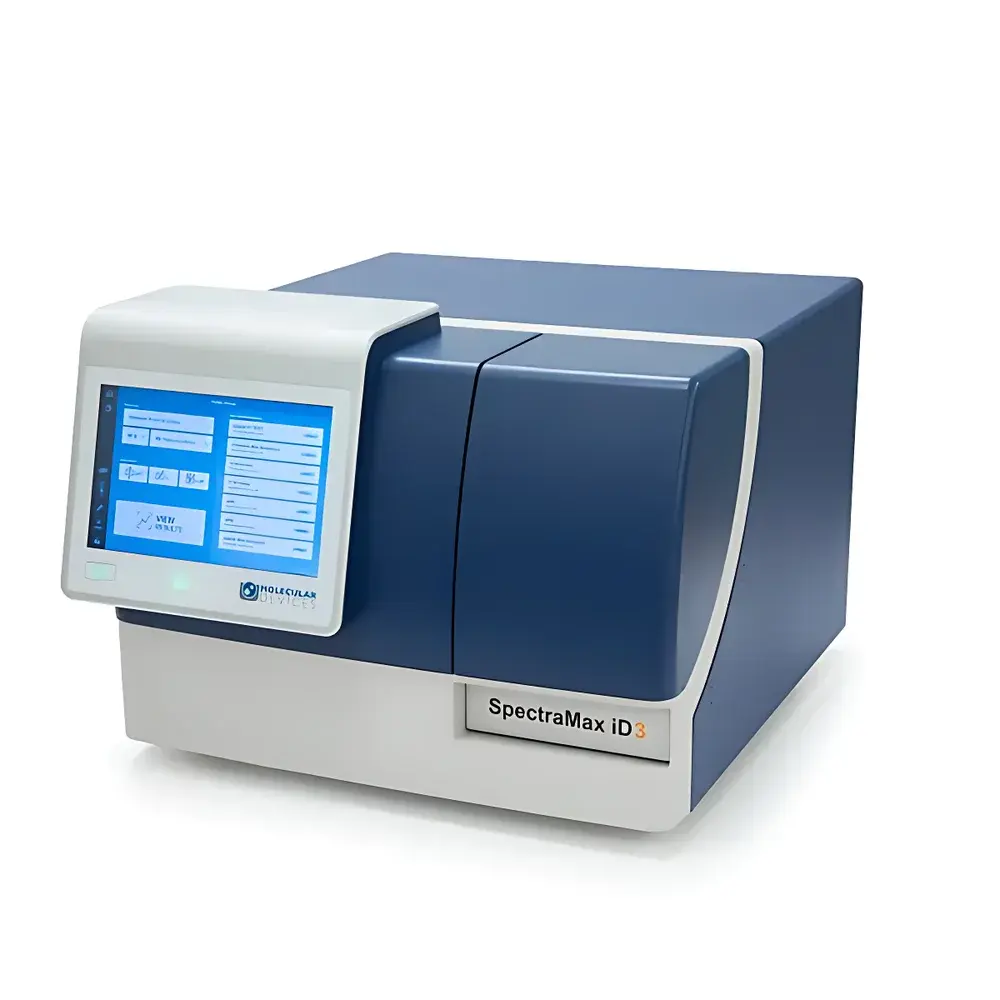
Molecular Devices SpectraMax iD3 Multi-Mode Microplate Reader
| Brand | Molecular Devices |
|---|---|
| Origin | Shanghai, China |
| Manufacturer Type | Authorized Distributor |
| Product Category | Domestic (China-manufactured) |
| Model | SpectraMax iD3 |
| Detection Methods | Absorbance, Fluorescence, Luminescence |
| Functionality | Multi-mode |
| Automation Level | Fully Automated |
| Assay Formats | Endpoint, Kinetic, Scanning |
| Curve Fitting | SoftMax Pro Software (Log-Log, 4PL, 5PL, PLA) |
| Detector Type | PMT and Photodiode |
| Wavelength Ranges | Absorbance 230–1000 nm |
| Absorbance Range | 0–4.0 OD |
| Linearity | ±0.010 OD (0–2.0 OD) |
| 96-Well Absorbance Read Time | ≤25 sec |
| Temperature Control | Ambient to 65 °C |
| Plate Formats | 6–384-well, SpectraDrop™ Microvolume Plates |
| Scan Density | Up to 20 × 20 wells/plate |
| Optical System | Dual-monochromator (QuadraGrating™), Xenon Flash Lamp, Cooled (−5 °C) PMT |
| Injection System | Dual SmartInject™ Reagent Injectors with Overflow Protection |
| Compliance | FDA 21 CFR Part 11, GLP/GMP-ready via SoftMax Pro GxP Edition |
Overview
The Molecular Devices SpectraMax iD3 Multi-Mode Microplate Reader is an integrated, fully automated platform engineered for precision quantification and kinetic profiling across absorbance, fluorescence, and luminescence detection modalities. Based on the proven SpectraMax architecture, it employs a high-stability xenon flash lamp coupled with a thermoelectrically cooled (−5 °C) photomultiplier tube (PMT) and dual-monochromator optical path (QuadraGrating™ technology) to deliver low-noise signal acquisition, wide dynamic range, and exceptional reproducibility. Its modular design supports endpoint, kinetic, and spectral scanning assays on standard microplates (6–384-well) as well as SpectraDrop™ ultra-low-volume plates—enabling reliable nucleic acid and protein quantitation from as little as 4 µL sample volume. The system is purpose-built for laboratories requiring regulatory-compliant workflows, particularly those operating under GLP, GMP, or FDA 21 CFR Part 11 frameworks.
Key Features
- Integrated 7-inch high-resolution capacitive touchscreen interface for method setup, real-time monitoring, and embedded video tutorials—no external PC required for basic operation
- NFC-enabled workflow personalization: Tap an NFC tag to instantly load user-specific protocols, instrument configurations, or assay templates
- Dual SmartInject™ reagent injectors with anti-overflow design ensure precise, consistent dispensing for luminescent and kinetic assays (e.g., Dual-Luciferase, ATP quantitation)
- Programmable temperature control (ambient to 65 °C) with uniform plate heating and optional orbital or double-orbital shaking for enhanced assay homogeneity
- High-speed optical performance: Full 96-well absorbance read in ≤25 seconds; spectral scanning across 230–1000 nm with 1-nm resolution
- Robust mechanical architecture with vibration-dampened optics and sealed optical chamber to minimize environmental interference
Sample Compatibility & Compliance
The SpectraMax iD3 accommodates all standard microplate formats (6-, 12-, 24-, 48-, 96-, 384-, and 1536-well), including opaque, clear, and black-walled plates optimized for absorbance or fluorescence detection. It is validated for use with SpectraDrop™ microvolume plates, enabling direct quantitation of DNA, RNA, and proteins at concentrations as low as 2 ng/µL in 4 µL volumes. Regulatory compliance is achieved through integration with SoftMax Pro GxP Edition software, which provides role-based user access control, electronic signatures, full audit trail logging (including timestamped operator actions and data modifications), and secure local or networked account management. The system supports IQ/OQ documentation packages and includes pre-validated test scripts for operational qualification per ISO/IEC 17025 and ASTM E2500 guidelines.
Software & Data Management
SoftMax Pro 7 software serves as the unified control, analysis, and reporting engine for the iD3. It offers over 200 pre-optimized assay templates for common applications—including BCA, Bradford, ELISA, CellTiter-Glo®, and Promega Dual-Luciferase—and supports custom protocol development using drag-and-drop logic. Advanced curve-fitting algorithms include linear, quadratic, log-log, 4-parameter logistic (4PL), 5-parameter logistic (5PL), and parallel-line analysis (PLA). Data export options include CSV, Excel, PDF, and XML formats compliant with LIMS integration. Network deployment allows centralized management of multiple iD3 units; raw data and analysis files are automatically pushed to designated workstations without manual retrieval. All software modules undergo periodic validation against USP and ICH Q5E standards.
Applications
The SpectraMax iD3 is routinely deployed in academic, pharmaceutical, and biotechnology laboratories for applications such as: enzyme kinetics (e.g., IC50/Km determination), cell viability and cytotoxicity screening (MTT, resazurin, ATP-based assays), receptor-ligand binding studies, reporter gene assays (luciferase, GFP), immunoassays (ELISA, AlphaScreen®), nucleic acid quantitation (A260/A280 ratios), and high-throughput compound profiling. Its broad wavelength coverage and low detection limits support both routine QC testing and exploratory research—such as monitoring rapid luminescent reactions with millisecond temporal resolution or generating multi-point calibration curves spanning five orders of magnitude (e.g., ATP from 10−11 to 10−6 M).
FAQ
Does the SpectraMax iD3 support FDA 21 CFR Part 11 compliance?
Yes—when used with SoftMax Pro GxP Edition software, the system implements electronic signature enforcement, audit trail generation, and role-based access controls required for regulated environments.
Can the iD3 perform spectral scanning in absorbance mode?
Yes—it performs full-spectrum scans from 230 to 1000 nm at 1-nm increments, supporting peak identification, multiplexed analyte detection, and background correction.
Is temperature control available during kinetic measurements?
Yes—the integrated Peltier-based thermal module maintains precise, stable temperatures throughout kinetic runs, critical for enzymatic or cell-based assays.
What microvolume plate formats are compatible?
The iD3 is fully compatible with SpectraDrop™ microplates, enabling accurate quantitation of 4–10 µL samples without dilution or transfer steps.
How is instrument verification performed?
Molecular Devices provides a comprehensive Validation Toolkit—including optical alignment checks, wavelength accuracy verification, OD linearity assessment, and injector calibration scripts—aligned with ISO/IEC 17025 and ASTM E2500 requirements.



