
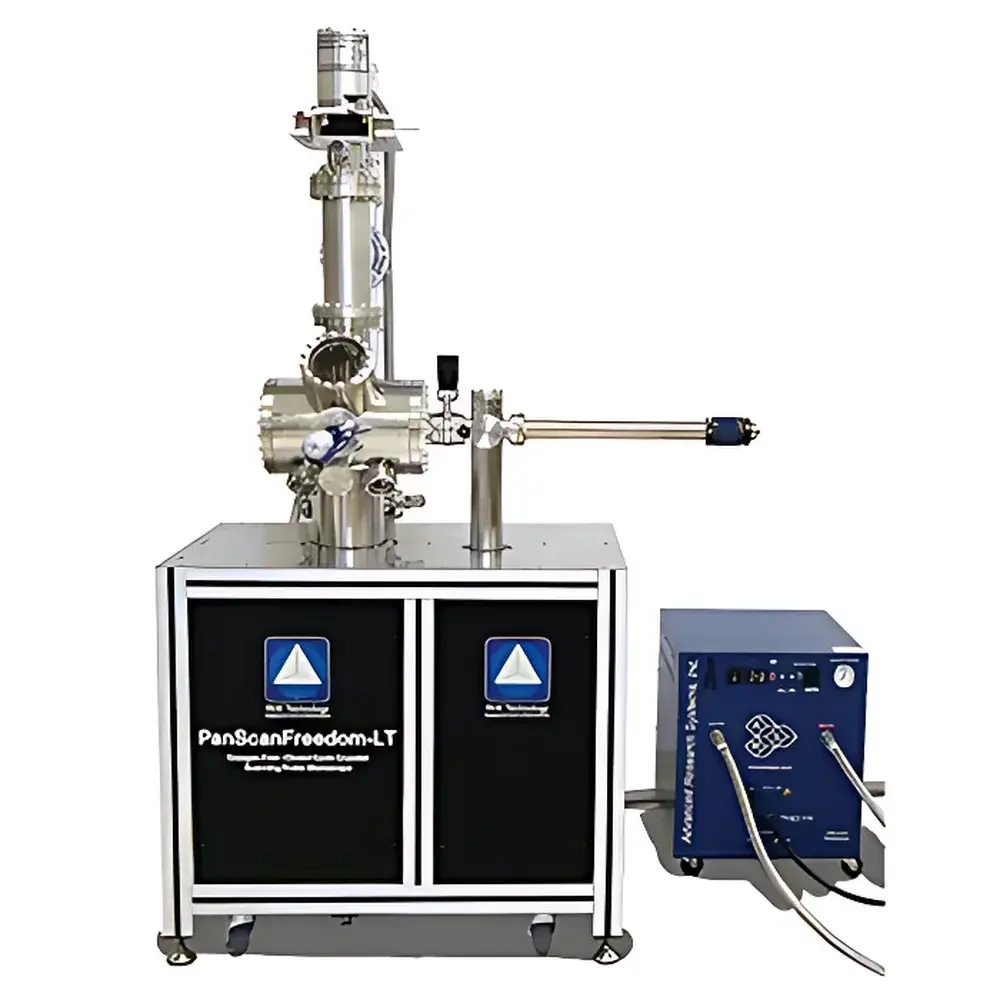
RHK Technology PanScan Freedom UHV Low-Temperature STM/qPlus AFM System
| Brand | RHK Technology |
|---|---|
| Origin | USA |
| Model | PanScan Freedom STM/qPlus AFM |
| Instrument Type | Ultra-High Vacuum Scanning Tunneling Microscope / qPlus Atomic Force Microscope |
| Position Detection Noise | <1 pm |
| Sample Size | 10 × 10 mm |
| Coarse XYZ Travel Range (RT) | 5 × 5 × 8 mm |
| Fine Scan Range (15 K) | 2 × 2 × 0.5 µm |
| Operating Temperature Range | 9 K – 400 K |
| XY Drift | 0.2 Å/hour |
| Z Drift | 0.2 Å/day |
| Magnetic Field Options | 5 T perpendicular or 1 T vector field (in-plane) |
Overview
The RHK Technology PanScan Freedom UHV Low-Temperature STM/qPlus AFM System is an integrated, cryogen-free scanning probe platform engineered for atomic-resolution surface characterization under ultra-high vacuum (UHV) and cryogenic conditions. Unlike conventional liquid-helium–dependent systems, this instrument employs a high-performance pulse-tube cryocooler to achieve stable base temperatures below 9 K while maintaining sub-picometer mechanical stability—enabling true atomic-resolution imaging and spectroscopy without cryogenic fluid handling. The system operates on the fundamental principles of quantum tunneling (STM) and frequency-modulated non-contact force detection (qPlus AFM), where the qPlus sensor—a quartz tuning fork with a sharp tungsten tip—is operated in constant-excitation mode with phase-locked loop (PLL) feedback for exceptional force sensitivity (<10 pN/√Hz) and thermal drift suppression. Designed for rigorous surface science research, the PanScan Freedom supports simultaneous STM and qPlus AFM acquisition, allowing concurrent topographic, electronic (dI/dV, d²I/dV²), and nanomechanical mapping on conductive and insulating surfaces alike.
Key Features
- Cryogen-free operation: Pulse-tube cryocooler delivers continuous cooling from 9 K to 400 K; no liquid helium required, eliminating supply chain dependency and operational hazards.
- Sub-picometer stability: Vibration-isolated design achieves position detection noise <1 pm RMS at 15 K—critical for atomic-scale resolution and long-duration spectroscopic mapping.
- Dual-mode operation: Seamless switching between STM and qPlus AFM modes within the same UHV chamber; both modalities share identical thermal anchoring for tip and sample.
- Integrated lock-in and PLL electronics: Onboard dual-channel lock-in amplifiers and digital PLL enable real-time acquisition of I–V curves, differential conductance (dI/dV), second derivative (d²I/dV²), and force-gradient spectra.
- Modular sample stage: Accommodates 10 × 10 mm samples with four independent electrical feedthroughs for in situ transport or gating experiments.
- Field-compatible architecture: Optional integration with UHV-compatible ancillary systems—including MBE, PLD, LEED, APERs, and UFO-style chambers—via standardized CF flanges and bakeable interconnects.
- Low operational overhead: Powered solely by standard 230 V AC; annual maintenance limited to compressor oil replacement and cold-head inspection per manufacturer guidelines.
Sample Compatibility & Compliance
The PanScan Freedom accommodates a broad range of solid-state specimens, including single-crystal metals (e.g., Au(111), Pt(111)), semiconductors (Si(111)-7×7, Ge(001)), topological insulators (Bi₂Se₃, Sb₂Te₃), 2D materials (graphene, MoS₂, h-BN), and molecular monolayers. Its UHV environment (<1 × 10⁻¹⁰ mbar base pressure) ensures surface cleanliness essential for reproducible atomic-scale measurements. The system conforms to ISO 14644-1 Class 4 cleanroom-equivalent vacuum practices and supports GLP-compliant data acquisition through timestamped, metadata-embedded binary file output (.sxm format). While not FDA-certified (as a research-grade instrument), its digital control architecture complies with core elements of 21 CFR Part 11 regarding audit trails, user authentication, and electronic record integrity when deployed with validated third-party laboratory information management systems (LIMS).
Software & Data Management
Acquisition and analysis are performed using RHK’s proprietary WSxM software suite (v5.0+), which provides real-time visualization, multi-channel spectral mapping, automated tip approach routines, and batch-processing pipelines for dI/dV and force-distance curve fitting. All raw data—including topography, current, Z-piezo voltage, and lock-in outputs—are stored in open-format binary files with embedded calibration parameters (e.g., piezo sensitivity, preamplifier gain, tuning fork spring constant). WSxM exports to HDF5 and ASCII for interoperability with Python (NumPy, SciPy), MATLAB, and Igor Pro. Software updates follow a documented release cycle aligned with NIST-traceable calibration verification protocols. Remote monitoring and basic parameter adjustment are supported via secure SSH or VNC over local network—no cloud connectivity or telemetry is enabled by default.
Applications
This system serves as a primary tool in surface physics, quantum materials, and nanoscale electrochemistry laboratories. Typical use cases include: atomic-scale imaging of reconstruction domains on Si(111); spatially resolved mapping of Kondo resonances in magnetic adatoms; identification of water bilayer structures on catalytic Pt surfaces; vibrational spectroscopy of C–H stretch modes via inelastic electron tunneling (IETS); mechanical property mapping of 2D heterostructures using qPlus force gradients; and in situ observation of molecular self-assembly dynamics during MBE growth. Published studies leveraging this platform have appeared in Nature Communications, Physical Review Letters, ACS Applied Materials & Interfaces, and Journal of Physical Chemistry C, confirming its utility in probing electronic band alignment, interfacial charge transfer, and lattice-mismatch–driven strain fields at the single-bond level.
FAQ
Is liquid nitrogen or liquid helium required for operation?
No. The system uses a closed-cycle pulse-tube cryocooler and requires only standard electrical power and compressed dry air for vibration isolation.
Can the system operate in magnetic fields?
Yes. Optional superconducting magnets provide up to 5 T perpendicular or 1 T vector field configurations, fully compatible with STM/qPlus operation down to 9 K.
What vacuum level does the system achieve?
Base pressure is typically ≤1 × 10⁻¹⁰ mbar after 24-hour bakeout at 150 °C, verified with Bayard–Alpert and residual gas analyzers.
How is tip functionalization performed?
In situ tip conditioning is supported via field emission, voltage pulsing, and controlled atom/molecule manipulation—no external preparation chamber is needed.
Is third-party software integration possible?
Yes. WSxM provides DLL and Python API access for custom automation, and raw data formats are fully documented for external analysis pipelines.




