
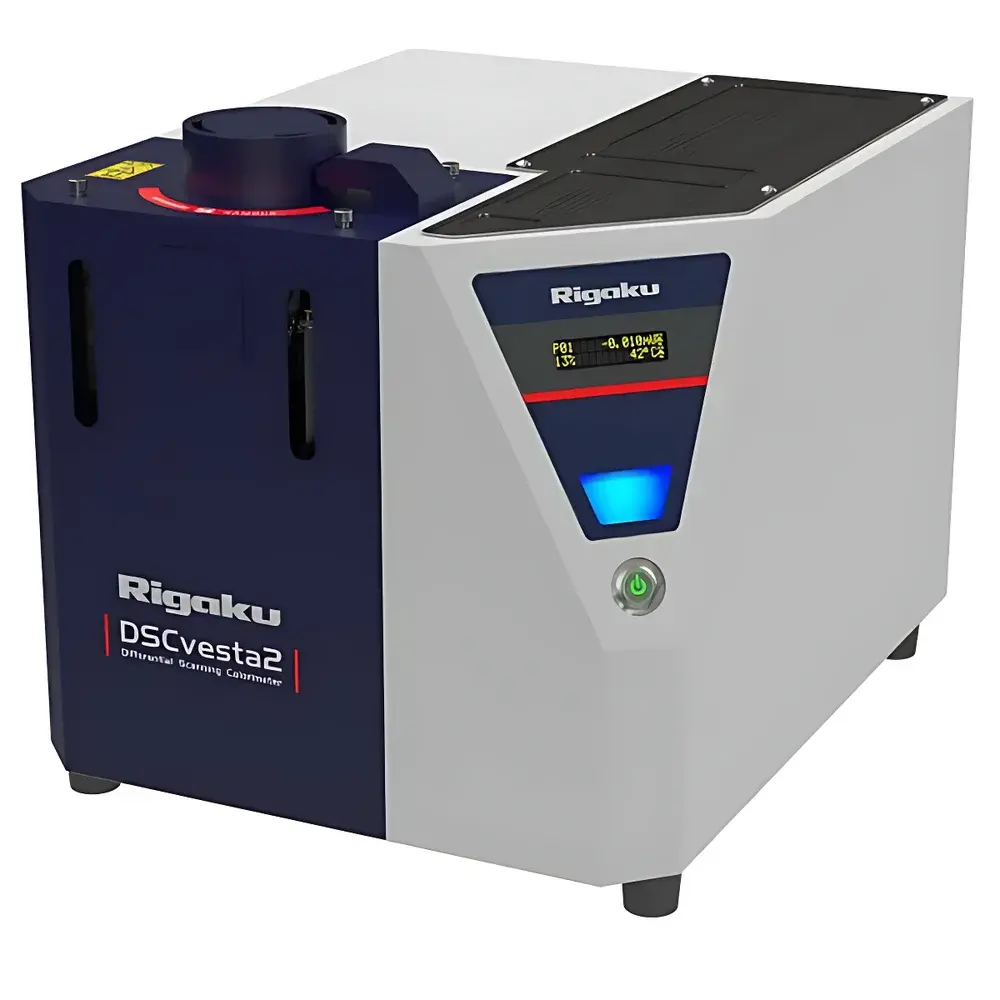
Rigaku DSCvesta2 Differential Scanning Calorimeter
| Brand | Rigaku |
|---|---|
| Origin | Japan |
| Model | DSCvesta2 |
| Temperature Range | –180 to 725 °C (atmospheric: RT to 600 °C |
| mechanical cooling | –95 to 725 °C) |
| Heating/Cooling Rate | up to 100 °C/min |
| Gas Flow Range | 0–250 mL/min (resolution: 1 mL/min) |
| Heat Flow Range | ±1000 mW |
| Noise Level | < 0.05 µW |
| Baseline Repeatability (–70 to 300 °C) | ≤ 10 µW |
| Enthalpy Sensitivity | 0.1 µW |
| Sensor Type | Heat-Flow-Type Metallic Sensor with vestaeye® Self-Diagnostic Function |
| Furnace Material | Pure Silver or Pure Platinum |
| Calibration Standards | ≥5 Certified Reference Materials (including Indium, Zinc, Tin, Bismuth, Lead) |
| Software Features | Dual-data logging (raw + corrected), LIMS integration support, export to Word, Excel, JPG, PDF |
Overview
The Rigaku DSCvesta2 is a high-performance heat-flow-type differential scanning calorimeter engineered for precision thermal analysis across academic research laboratories, pharmaceutical development centers, polymer R&D facilities, and quality control environments. It operates on the fundamental principle of measuring the differential heat flow between a sample and an inert reference as both are subjected to identical, programmable temperature profiles—typically under controlled gas atmospheres. By quantifying endothermic and exothermic transitions—including glass transitions (Tg), melting points (Tm), crystallization onset (Tc), oxidative induction time (OIT), and reaction enthalpies—the DSCvesta2 delivers quantitative thermodynamic data essential for material characterization, stability assessment, and process validation.
Key Features
- Wide operational temperature range: –180 °C to 725 °C, extendable to –95 °C using integrated mechanical cooling—enabling low-temperature polymer relaxation studies and high-temperature ceramic phase analyses.
- High-speed thermal programming: Programmable heating and cooling rates up to 100 °C/min, supporting rapid screening and kinetic modeling (e.g., isoconversional analysis per ASTM E698 or ISO 11357-3).
- Gas atmosphere control: Dual mass-flow controllers support precise regulation of inert (N2, Ar), oxidative (air, O2), or reactive gas environments at flow rates from 0 to 250 mL/min (1 mL/min resolution), critical for oxidation stability testing and decomposition mechanism studies.
- vestaeye® intelligent diagnostics: Embedded self-monitoring system continuously evaluates sensor integrity, furnace thermal uniformity, and gas line integrity—providing real-time alerts and traceable diagnostic logs compliant with GLP audit requirements.
- Ultra-low noise detection: Heat flow signal resolution < 0.05 µW and baseline repeatability ≤ 10 µW over –70–300 °C ensures reliable detection of subtle transitions in low-mass or low-enthalpy samples (e.g., thin films, biomolecules, or catalysts).
- Pure silver or pure platinum furnace construction: Minimizes thermal lag and enhances long-term calibration stability—critical for regulatory submissions requiring instrument qualification per ICH Q5C or USP <1225>.
Sample Compatibility & Compliance
The DSCvesta2 accommodates standard aluminum, gold-plated aluminum, or high-pressure stainless-steel crucibles (up to 100 µL capacity), supporting solids, powders, gels, and small-volume liquids. Its design conforms to international standards including ISO 11357 (Plastics — Differential Scanning Calorimetry), ASTM E794 (Melting and Crystallization Temperatures), and ASTM E2070 (Kinetic Parameters by DSC). All calibrations utilize NIST-traceable reference materials (Indium, Zinc, Tin, Bismuth, Lead), with automated correction routines embedded in firmware. The system supports 21 CFR Part 11-compliant electronic signatures and full audit trails when deployed with validated software configurations—meeting GMP requirements for pharmaceutical thermal analysis workflows.
Software & Data Management
Rigaku’s proprietary DSC Analysis Studio provides comprehensive data acquisition, processing, and reporting capabilities. It simultaneously archives raw sensor output and mathematically corrected thermograms—ensuring full traceability from acquisition to final report. Calibration parameters, gas flow logs, and diagnostic events are timestamped and embedded within each data file. Export options include native .dsc binary format, CSV, PDF reports with annotated peaks, and direct integration into Microsoft Office applications. LIMS connectivity is implemented via ASTM E1384-compliant HL7 or XML-based interfaces, enabling automated result transfer to enterprise laboratory systems without manual re-entry—reducing transcription errors and supporting ALCOA+ data integrity principles.
Applications
- Pharmaceutical solid-state characterization: Polymorph identification, amorphous content quantification, excipient compatibility screening, and lyophilized product stability profiling.
- Polymers & composites: Crystallinity determination (ΔHf), crosslink density estimation, aging behavior under thermal stress, and filler-matrix interaction analysis.
- Food science: Fat crystallization kinetics, starch gelatinization enthalpy, and shelf-life prediction via oxidative induction time (OIT) assays.
- Electrochemical materials: Solid electrolyte thermal stability, cathode/anode decomposition onset, and SEI layer formation energetics in battery R&D.
- Metallurgy & ceramics: Phase transformation temperatures, eutectic point validation, and sintering behavior monitoring.
FAQ
What types of calibration standards are included with the DSCvesta2?
The system ships with five NIST-traceable certified reference materials (Indium, Zinc, Tin, Bismuth, Lead) covering –39 °C to 660 °C, enabling full-range temperature and enthalpy calibration per ISO 11357-1.
Does the DSCvesta2 support Good Manufacturing Practice (GMP) compliance?
Yes—when configured with validated software and documented IQ/OQ protocols, it meets FDA 21 CFR Part 11 requirements for electronic records and signatures, including user access controls, audit trail generation, and data immutability features.
Can the instrument operate under vacuum or high-pressure conditions?
Standard configuration supports atmospheric and purged environments; high-pressure operation requires optional sealed crucibles and compatible gas delivery modules—not included in base configuration.
Is remote monitoring or networked operation supported?
The DSCvesta2 includes Ethernet connectivity and supports remote instrument status viewing and basic job queue management via secure HTTPS interface—full remote control requires on-site validation per IT security policies.
How is baseline drift compensated during extended runs?
The vestaeye® system performs real-time thermal symmetry correction using dual-sensor topology; additionally, software-based polynomial baseline subtraction algorithms are available for post-acquisition refinement of long-duration experiments.



