
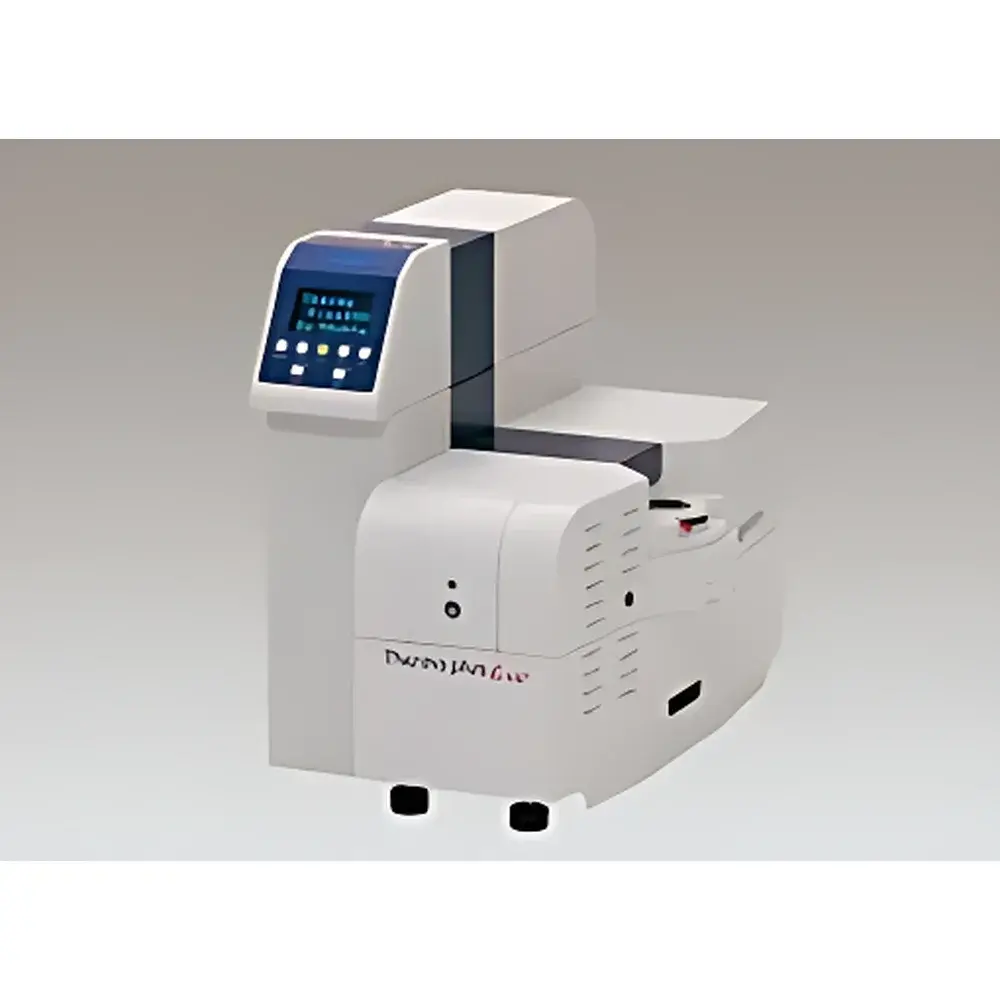
Rigaku Thermo Plus EVO TG/DTA Series Thermogravimetric Analyzer with Differential Thermal Analysis
| Brand | Rigaku |
|---|---|
| Origin | Japan |
| Model | TG-DTA |
| Heating Rate | Up to 100 °C/min |
| Cooling Rate | 1500 °C → 50 °C in ≤20 min |
| Balance Type | Horizontal Differential Triple-Coil Microbalance |
| Temperature Control | Pre-Compensated PID with Isothermal Overshoot Compensation |
| Calibration | Integrated Temperature & Mass Calibration Functions |
| Power Mode | ECO Standby (30% Energy Reduction) |
| Software | Multi-Station Control (Up to 8 Units), Auto-Diagnosis, Dual Data Backup, Remote Firmware Update |
| Sample Handling | Plug-and-Play Sample Holder, Front-Access Sample Placement, Drop-Tolerant Horizontal Design |
| Optional Accessories | ASC Automatic Sample Changer, TG-DTA/GC-MS Hyphenated Interface |
Overview
The Rigaku Thermo Plus EVO TG/DTA Series is a high-precision, dual-mode thermal analysis platform engineered for simultaneous thermogravimetric (TG) and differential thermal analysis (DTA). It operates on the principle of measuring real-time mass change (via microgravimetric detection) and heat flow differentials (via thermocouple-based differential sensing) as a function of temperature or time under controlled atmospheric conditions. Designed for rigorous R&D, quality control, and regulatory-compliant material characterization, the system integrates Rigaku’s proprietary horizontal differential triple-coil microbalance—eliminating mechanical drift through instantaneous, co-directional correction of thermal and electromagnetic perturbations. This architecture ensures exceptional baseline stability and mass resolution (<0.1 µg), critical for detecting subtle decomposition steps, solvent loss, oxidation onset, or phase transitions in polymers, pharmaceuticals, ceramics, and battery materials.
Key Features
- Horizontal differential triple-coil microbalance (Rigaku patent): Delivers ultra-low drift and high reproducibility across wide temperature ranges (RT to 1500 °C).
- Modular plug-and-play sample holder design: Enables user-replaceable crucibles without soldering, vacuum sealing, or field service intervention.
- Front-access sample loading mechanism: Minimizes exposure of internal components; drop-tolerant horizontal configuration prevents mechanical damage if sample dislodges.
- High-performance furnace system: Achieves heating rates up to 100 °C/min and rapid cooling from 1500 °C to 50 °C in ≤20 minutes via forced gas exchange and active thermal shunting.
- Advanced dynamic TG methodologies: Supports SIA (Stepwise Isothermal Analysis), DRC (Dynamic Rate Control), and CRC (Constant Reaction Rate Control) for kinetic modeling and reaction mechanism elucidation.
- Pre-compensated temperature control algorithm: Eliminates overshoot during isothermal holds without requiring pre-scan stabilization—reducing measurement cycle time and improving thermal fidelity.
- Integrated ECO power management: Reduces standby energy consumption by 30% via selective subsystem shutdown; configurable via front-panel toggle or software interface.
- Rotatable operator panel: Facilitates ergonomic installation in space-constrained laboratories or integrated analytical workflows.
Sample Compatibility & Compliance
The Thermo Plus EVO accommodates standard platinum, alumina, and graphite crucibles (up to 100 mg capacity), supporting solids, powders, thin films, and small-volume liquids. Its inert atmosphere capability (N₂, Ar, O₂, synthetic air, or custom gas blends) enables oxidative stability testing, pyrolysis studies, and moisture desorption profiling per ISO 11358, ASTM E1131, and USP . The system meets IEC 61000-6-3 (EMC) and IEC 61010-1 (safety) requirements. Full audit trail functionality—including user login logs, parameter change history, calibration timestamps, and measurement metadata—is compliant with FDA 21 CFR Part 11 when deployed with validated software configurations and network authentication protocols.
Software & Data Management
Thermo Plus EVO is operated via Rigaku’s Thermo Analysis Studio—a Windows-based platform supporting multi-instrument coordination (up to 8 units per host PC). The software provides full method scripting, conditional termination logic (e.g., auto-power-off, ECO activation, or forced cooling upon event trigger), automated mass/temperature calibration routines, and real-time fault diagnostics with actionable error codes. All raw and processed data are stored in vendor-neutral HDF5 format, with built-in dual-backup redundancy (local SSD + network-mapped drive). Over-the-air firmware updates ensure continuous alignment with evolving analytical standards. Remote monitoring and secure web-based access are supported via TLS-encrypted HTTP(S) endpoints.
Applications
This instrument serves core functions across multiple regulated and research-intensive domains: decomposition kinetics and activation energy calculation in energetic materials (per UN Test Series 3); residual solvent quantification in pharmaceutical APIs (aligned with ICH Q5C); thermal stability assessment of Li-ion cathode precursors; filler content determination in polymer composites; catalytic coke burn-off profiling; and simultaneous TG-DTA/GC-MS hyphenated analysis for evolved gas identification. Its precision and modularity make it suitable for GLP-compliant stability studies, GMP process validation support, and academic thermal kinetics research requiring high-fidelity mass-temperature correlation.
FAQ
What is the maximum operating temperature and cooling rate?
The furnace supports continuous operation up to 1500 °C, with cooling from 1500 °C to 50 °C achievable in ≤20 minutes using forced gas exchange.
Does the system support automated sample handling?
Yes—the optional ASC (Automatic Sample Changer) is field-installable and scalable; users may integrate it at any stage without hardware modification.
Is the software compliant with 21 CFR Part 11?
When deployed with validated user access controls, electronic signatures, and audit trail logging enabled, the Thermo Analysis Studio meets baseline technical requirements for Part 11 compliance.
Can TG-DTA data be synchronized with GC-MS output?
Yes—via the dedicated hyphenated interface module, enabling real-time coupling for evolved gas analysis (EGA) with compound identification.
How is temperature accuracy maintained over time?
The system includes onboard reference calibration routines using certified Ni, In, Sn, Zn, and Al standards, with automatic correction applied during measurement sequences.
Related Products



