
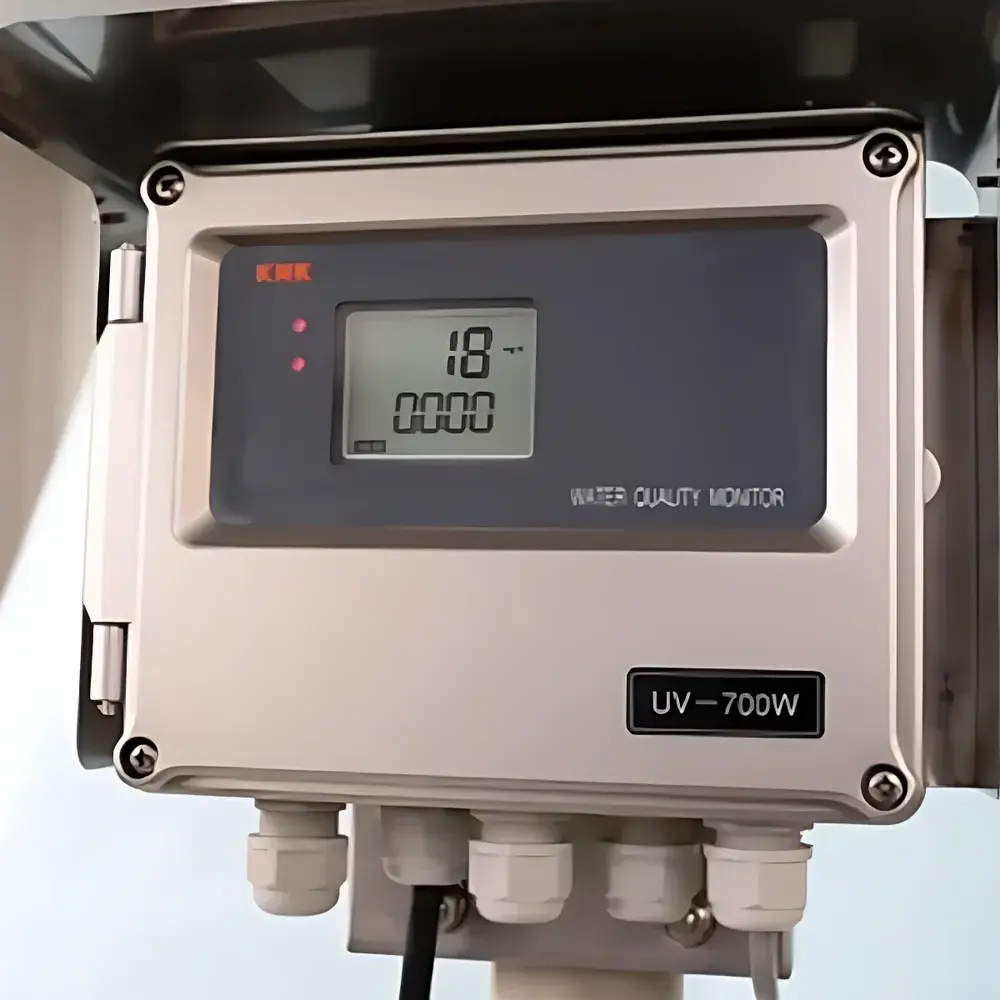
Rikorika UV-700W Online Chemical Oxygen Demand (COD) Analyzer
| Brand | Rikorika |
|---|---|
| Origin | Japan |
| Model | UV-700W |
| Instrument Type | Online Analyzer |
| Measurement Principle | Ultraviolet Absorption Spectrophotometry |
| Wavelength | 255 nm (UV) |
| Measurement Range | 0–200 mg/L COD (as KMnO₄ method equivalent) |
| Accuracy | ±2% of full scale |
| Repeatability | ≤2% RSD |
| Detection Limit | 1 mg/L COD |
| Measurement Interval | Continuous monitoring (24/7) |
| Optical Path Length | 10 mm |
| Display Resolution | 0.001 Abs/cm (UV absorbance), 1 mg/L (COD) |
| Output Signal | Isolated DC 4–20 mA (≤550 Ω load) |
| Enclosure Rating | IP65 |
| Operating Temperature | −5°C to +40°C (indoor, shaded installation) |
| Weight | ~2.5 kg (with sunshade cover) |
Overview
The Rikorika UV-700W Online Chemical Oxygen Demand (COD) Analyzer is an industrial-grade, in-situ water quality monitoring system engineered for continuous, reagent-free estimation of organic pollution load in municipal wastewater, influent/effluent streams, and surface water bodies. It operates on the principle of ultraviolet absorption spectrophotometry at a fixed wavelength of 255 nm—a spectral region where aromatic compounds, unsaturated hydrocarbons, and certain oxidizable organics exhibit strong and relatively stable absorbance. The instrument correlates measured UV absorbance (Abs/cm) with COD concentration via a user-configurable linear calibration function (y = a + bx), enabling traceable conversion to mg/L COD equivalents as defined by the potassium permanganate (KMnO₄) oxidation method (commonly referenced as “CODMn”). Unlike wet-chemistry analyzers, the UV-700W eliminates consumables, hazardous reagents (e.g., mercury-based lamps or dichromate), and complex fluidic manifolds—reducing operational risk, maintenance frequency, and total cost of ownership while delivering high reproducibility in real-time monitoring environments.
Key Features
- Reagent-free, non-destructive measurement using solid-state UV LED light source (255 nm) and sapphire optical windows—no mercury vapor lamps, no chemical waste generation.
- Integrated automatic wiper cleaning system with programmable cycle (30 min–12 h) and adjustable stroke count—ensures optical path integrity in turbid or biofouling-prone applications.
- Dual-display LCD interface showing simultaneous real-time values: top line = COD concentration (mg/L), bottom line = UV absorbance (Abs/cm) at 10-mm path length.
- Three selectable absorbance ranges (0–0.5 / 0–1.0 / 0–2.0 Abs/cm), each mapped to the same 0–200 mg/L COD output span—optimized for dynamic range flexibility without hardware modification.
- IP65-rated enclosure with polycarbonate housing and weather-resistant metallic finish—suitable for indoor mounting with optional sunshade; designed for unattended operation in ambient conditions from −5°C to +40°C.
- Configurable analog output (isolated 4–20 mA) with dual-channel capability, plus dry-contact alarm outputs for maintenance mode, sensor fault, or wiper activation status.
- Modular probe architecture: compatible with standard UVD-255-10 (10-mm path) or high-concentration UVD-255-5 (5-mm path) detectors—enabling application-specific sensitivity tuning.
Sample Compatibility & Compliance
The UV-700W is validated for use with low-to-moderately turbid aqueous matrices including secondary effluent, river intake water, and pre-treated industrial discharge. Its performance adheres to empirical correlation protocols aligned with ISO 15705:2002 (Water quality — Guidelines for UV-absorbance-based estimation of COD) and supports routine QA/QC practices per ISO/IEC 17025 requirements. While not a replacement for standardized titrimetric COD methods (e.g., ISO 6060 or EPA 410.4), it delivers statistically robust trend data for process control and early-warning detection when calibrated against reference laboratory measurements. The system meets electromagnetic compatibility (EMC) standards IEC 61326-1 and safety requirements IEC 61010-1. Its analog output and alarm relays are suitable for integration into SCADA systems compliant with IEC 62443 cybersecurity frameworks.
Software & Data Management
The UV-700W operates autonomously without embedded software or network connectivity. All configuration—including calibration coefficients, range selection, wiper timing, and hold logic—is performed locally via front-panel keypad and LCD menu. Analog output signals are directly recordable by PLCs, DCS historians, or third-party data loggers supporting 4–20 mA inputs. For auditability, users are advised to maintain calibration logs referencing certified potassium hydrogen phthalate (KHP) standard solutions (sold separately) and document periodic verification per internal GLP procedures. Though the device does not implement FDA 21 CFR Part 11 electronic signature functionality, its deterministic analog output and mechanical alarm contacts support paper-trail–based compliance workflows in regulated utilities.
Applications
- Real-time monitoring of biological treatment efficiency in activated sludge plants.
- Trend-based early detection of industrial slug loads entering municipal sewer networks.
- Performance verification of tertiary filtration or UV disinfection units via organic load tracking.
- Regulatory reporting support for discharge permits requiring continuous organic load surveillance.
- Research-grade longitudinal studies of seasonal organic matter variation in watershed monitoring stations.
FAQ
Does the UV-700W require daily reagent replenishment?
No. It is a reagent-free analyzer relying solely on UV absorbance; no chemical oxidants, catalysts, or colorimetric reagents are consumed during operation.
Can it be installed directly in open channels or pressurized pipes?
Yes—when paired with the optional flow-through detector assembly (UVD-FLH2 distributor + SAM-T tank), it supports both immersion and bypass configurations. Direct pipe insertion requires compatible flanged or threaded adapters (G1/2).
How often should the UV LED source be replaced?
Rikorika recommends inspection every 36 months under continuous operation; replacement is advised if absorbance drift exceeds ±1% of baseline during KHP standard verification.
Is temperature compensation applied to absorbance readings?
The instrument does not include active temperature compensation; therefore, consistent sample temperature (0–40°C liquid range) must be maintained per specification to ensure measurement stability.
What maintenance tasks are required beyond wiper operation?
Annual cleaning of the quartz/sapphire optical window with isopropyl alcohol and lint-free cloth; biannual verification using certified KHP standard solution; periodic inspection of O-rings and cable gland seals for integrity.







