
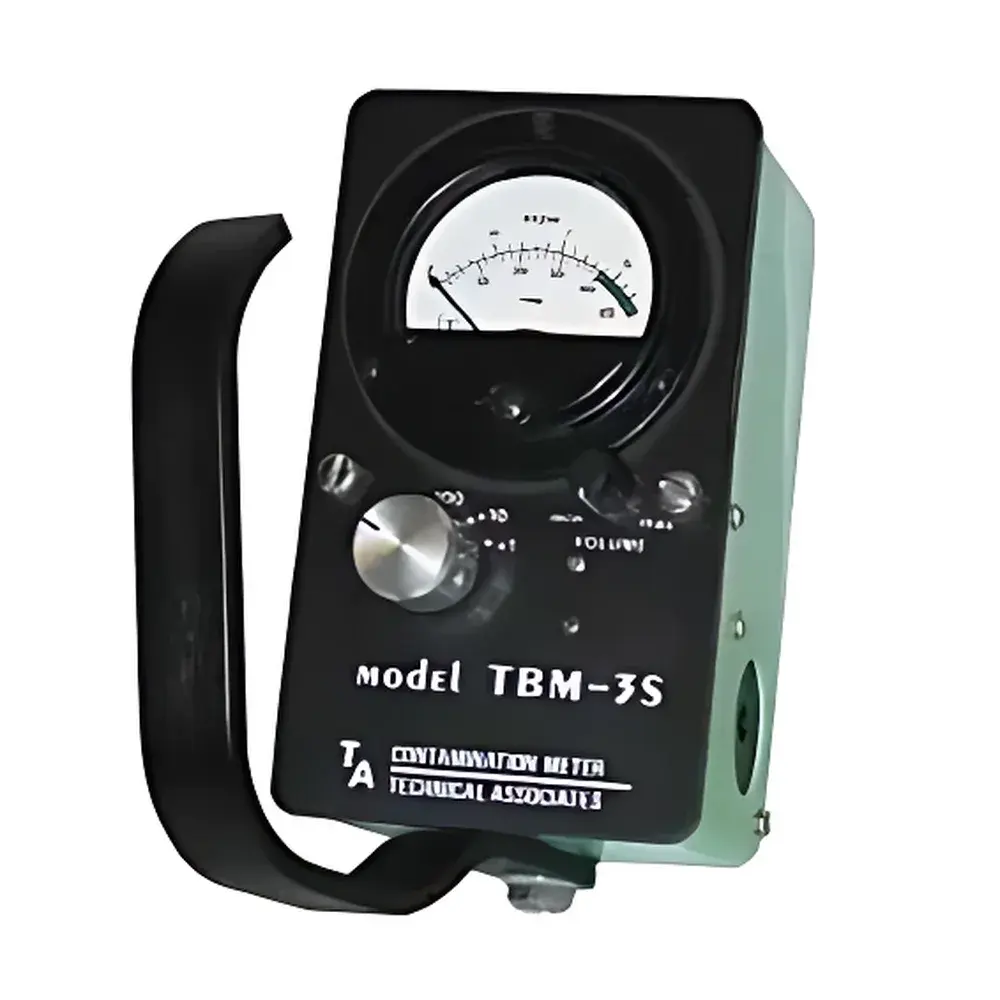
Yueweitang TBM-3S Alpha/Beta/Gamma Surface Contamination Monitor
| Brand | Yueweitang |
|---|---|
| Origin | USA |
| Manufacturer Type | Authorized Distributor |
| Product Category | Imported Instrument |
| Model | TBM-3S |
| Instrument Type | Radiation Survey Meter / Dose Rate & Contamination Monitor |
| Detection Capabilities | α, β, γ radiation |
| Detector | 2-inch flat pancake GM tube |
| Measurement Units | cpm (counts per minute) and mR/h (milliroentgen per hour) |
| Range Settings | 0–500 / 0–5,000 / 0–50,000 cpm (corresponding to 0–0.15 / 0–1.5 / 0–15 mR/h) |
| Housing | Ruggedized 2.5-inch form factor |
| Operation | Single-hand ergonomic design |
| Linearity | Full-scale linear response across all ranges |
Overview
The Yueweitang TBM-3S is a portable, hand-held surface contamination monitor engineered for rapid, reliable detection and quantification of alpha (α), beta (β), and gamma (γ) radiation emissions from contaminated surfaces. Designed in accordance with ANSI N42.17A and IEC 60846 standards for radiation survey instruments, the TBM-3S employs a large-area (2-inch diameter) pancake-style Geiger-Müller (GM) detector optimized for high-efficiency particulate detection—particularly suited for low-energy β emitters such as 3H, 14C, and 90Sr/90Y, as well as medium-energy γ sources like 137Cs and 60Co. Its dual-mode readout—simultaneously displaying counts per minute (cpm) and exposure rate (mR/h)—enables direct correlation between surface activity and ambient dose rate, supporting both contamination screening and area monitoring protocols in nuclear medicine, decommissioning, waste management, and radiological emergency response.
Key Features
- Ruggedized 2.5-inch compact housing with IP54-rated enclosure for resistance to dust ingress and incidental water splashing during field use
- Three manually selectable linear measurement ranges: 0–500 cpm (0–0.15 mR/h), 0–5,000 cpm (0–1.5 mR/h), and 0–50,000 cpm (0–15 mR/h), each maintaining ±10% full-scale accuracy per ANSI N42.20
- Ergonomic single-hand operation with tactile push-button controls and high-contrast analog meter + digital LCD display for real-time feedback under varied lighting conditions
- Energy-compensated GM tube with thin mica end-window (1.5–2.0 mg/cm² density) enabling efficient detection of α particles down to 4 MeV and β particles ≥150 keV
- Automatic background subtraction mode and audible/visual alarm thresholds configurable per regulatory action levels (e.g., DOE STD-1122, NRC Regulatory Guide 8.39)
- Battery-powered operation (9 V alkaline) with >200 hours of continuous use; low-battery indicator and auto-power-off after 5 minutes of inactivity
Sample Compatibility & Compliance
The TBM-3S is validated for qualitative and semi-quantitative assessment of removable surface contamination on stainless steel, concrete, vinyl flooring, gloves, lab coats, and filter papers. It meets performance criteria specified in ASTM D3648 (Standard Test Methods for Alpha and Beta Radioactivity in Water), ISO 7503-1 (Surface contamination — Part 1: General principles), and USNRC NUREG-1507 (Radiation Survey Instruments for Decommissioning). While not intended for absolute calibration traceable to NIST SRM 4241, the instrument supports routine verification using 241Am (α), 90Sr/90Y (β), and 137Cs (γ) check sources. Its design conforms to electromagnetic compatibility (EMC) requirements per IEC 61000-6-2 and -6-3, ensuring stable operation near MRI suites or RF-emitting equipment.
Software & Data Management
The TBM-3S operates as a standalone analog-digital hybrid instrument without onboard data logging or PC connectivity. However, its consistent cpm-to-Bq/cm² conversion factors (e.g., 0.35 cpm/dpm for 90Sr/90Y on stainless steel, per ANSI N13.12) enable seamless integration into laboratory LIMS or radiation safety databases via manual entry or barcode-assisted reporting workflows. For facilities requiring audit-ready records, optional external Bluetooth-enabled dataloggers (e.g., compatible with RadEye™ B20 or Thermo Fisher RadEye PRD-ER firmware) may be deployed alongside the TBM-3S to capture time-stamped readings with GPS metadata—supporting GLP-compliant documentation per 21 CFR Part 11 when paired with electronic signature-capable platforms.
Applications
- Pre- and post-decontamination verification in nuclear power plant maintenance zones
- Routine swipe testing in radiopharmaceutical synthesis labs (e.g., 18F-FDG production hot cells)
- Field screening of scrap metal, construction debris, and soil samples at legacy site remediation projects
- Personnel exit monitoring in low-risk radioisotope handling areas (e.g., university teaching labs, veterinary clinics)
- Emergency response triage for suspected orphan source discovery or transport incident scenarios
- Quality assurance audits of glovebox integrity and HEPA filter efficiency in alpha-handling facilities
FAQ
Can the TBM-3S detect radon progeny or airborne particulates?
No—the TBM-3S is designed exclusively for fixed surface contamination assessment. Air sampling requires dedicated air monitors with integrated filtration and alpha spectrometry (e.g., RAD7-based systems).
Is energy compensation applied across all three ranges?
Yes—the GM tube’s internal shielding and pulse-height discrimination circuitry provide consistent energy response for β/γ over 50–1,500 keV, though α detection remains highly dependent on window proximity and geometry.
Does the instrument require annual calibration by an accredited lab?
Per ANSI N323A, field instruments used for regulatory compliance should undergo functional testing before each use and full calibration at least annually—or after any physical shock, repair, or battery replacement—using traceable reference sources.
What is the minimum detectable activity (MDA) for 239Pu on stainless steel?
Using standard 100 cm² swipe and 1-minute count time, MDA ≈ 0.08 Bq/cm² (2.2 dpm/100 cm²) at 95% confidence, assuming background of 25 cpm and 30% detector efficiency.
Can the TBM-3S be used in explosive atmospheres?
No—it lacks ATEX or IECEx certification. Use only in non-hazardous locations per NEC Class I, Division 2 guidelines.







