
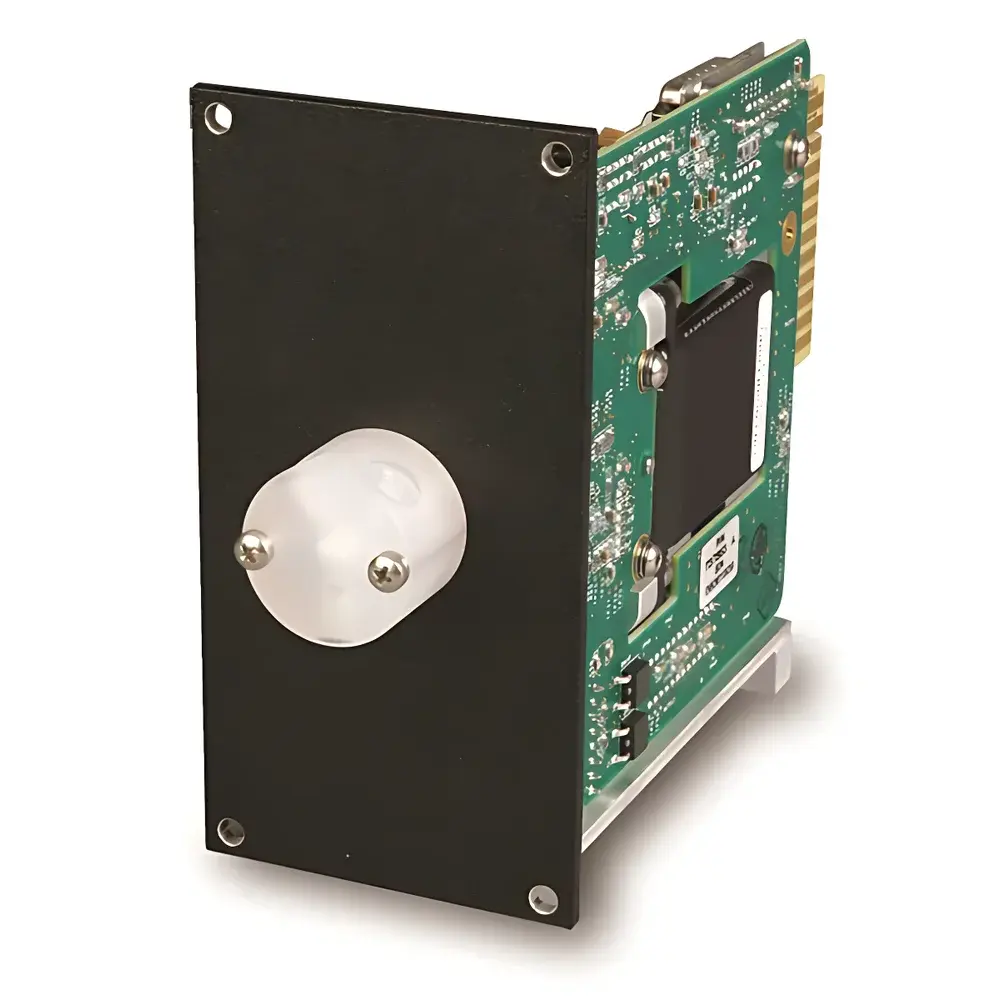
Tecan Cavro SVP Smart Valve Plus Multi-Position Rotary Selector Valve
| Brand | Tecan Cavro |
|---|---|
| Origin | Malaysia |
| Model | SVP |
| Valve Configurations | 3-, 4-, 6-, 9-, or up to 20-port options (ceramic or polymer rotor/stator) |
| Fluidic Interface | 1/4-28 UNF or M6 threaded ports |
| Control Interface | RS-232, RS-485, CAN bus |
| Power Supply | 24 VDC ±10%, 850 mA max |
| Dimensions | 52.9 × 25 × 50 mm |
| Operating Temperature | 5–40 °C |
| Operating Humidity | 20–95% RH (non-condensing at 40 °C) |
| Accuracy | <0.25% of full scale |
| Repeatability | <0.05% of full scale |
| Instrument Type | Precision Microfluidic Selector Valve for Syringe Pump Integration |
Overview
The Tecan Cavro SVP Smart Valve Plus is a high-integrity, multi-position rotary selector valve engineered for precise fluid routing in automated liquid handling systems. Unlike passive solenoid manifolds or low-cycle-life diaphragm valves, the SVP employs a precision-machined rotating ceramic or polymer stator-rotor assembly driven by a stepper motor with closed-loop position verification. Its operation is based on deterministic mechanical alignment—each port position is physically indexed and confirmed via internal optical or Hall-effect sensing—ensuring zero ambiguity in fluid path selection. Designed explicitly for integration with syringe pumps and peristaltic pump modules in analytical, clinical, and research instrumentation, the SVP enables unidirectional or bidirectional flow switching across up to 20 discrete channels without cross-contamination or carryover. Its compact footprint (52.9 × 25 × 50 mm), low power draw (24 VDC, ≤850 mA), and robust thermal stability (5–40 °C operating range) make it suitable for embedded OEM platforms—including HPLC sample injectors, ICP-MS sample introduction manifolds, and modular assay workstations—where long-term reliability, minimal maintenance, and regulatory traceability are mandatory.
Key Features
- True multi-port flexibility: Configurable as 3-, 4-, 6-, 9-, or custom up to 20-port variants with interchangeable rotor/stator cartridges—ceramic for aggressive solvents (e.g., DMSO, THF, concentrated acids/bases) or chemically resistant polymer for cost-sensitive aqueous applications.
- Sub-millisecond actuation timing with position confirmation: Each valve step completes in ≤120 ms, with real-time feedback confirming physical port alignment before downstream pump activation—critical for GLP-compliant sequence execution.
- Industry-standard digital control: Native support for RS-232 (ASCII command set), RS-485 (multi-drop daisy-chaining), and CAN bus (ISO 11898-2 compliant) ensures seamless interoperability with PLCs, motion controllers, and instrument host software stacks.
- Zero-dead-volume fluid path design: Internal channel geometry minimizes hold-up volume (<1.2 µL typical between inlet and active outlet), reducing reagent waste and improving wash efficiency in high-throughput assays.
- Extended service life: Rated for ≥1 million cycles under continuous operation at rated pressure (up to 100 psi / 6.9 bar with ceramic variant), validated per ISO 8536-4 for medical device fluid path components.
Sample Compatibility & Compliance
The SVP supports a broad spectrum of liquid types—including aqueous buffers, organic solvents, viscous glycerol-based reagents (up to 1,000 cP), and low-conductivity deionized water—without performance degradation. Rotor/stator material selection directly governs chemical compatibility: alumina ceramic (Al₂O₃, 96% purity) meets USP Class VI biocompatibility requirements and resists hydrolysis and abrasion; PEEK or ETFE polymer variants comply with FDA 21 CFR §177.2415 for food-contact surfaces. The valve’s construction adheres to IEC 61000-6-2 (immunity) and IEC 61000-6-3 (emissions) for industrial environments. While not a standalone medical device, its design supports integration into IVD platforms compliant with ISO 13485:2016 and EU MDR Annex II technical documentation requirements.
Software & Data Management
The SVP operates via ASCII-based command protocols (e.g., “POS=5”, “HOME”, “STATUS?”) enabling direct integration with LabVIEW, Python (pySerial), MATLAB, or proprietary C/C++ instrument firmware. All position transitions are timestamped and logged internally when used with Tecan’s iSWITCH driver firmware (v3.2+), supporting audit-trail generation for 21 CFR Part 11 compliance when paired with validated host software. No proprietary runtime or dongle licensing is required—configuration is performed via terminal emulation or embedded web interface (optional Ethernet bridge module). Firmware updates are delivered as signed binary packages verified via SHA-256 checksum, ensuring integrity during field deployment.
Applications
- HPLC/UHPLC autosampler manifolds requiring low carryover and rapid solvent gradient switching.
- Automated cell culture media exchange systems where sterility and positional repeatability are critical.
- Multi-analyte immunoassay platforms with parallel reagent dispensing and waste aspiration paths.
- Calibration standard delivery in environmental analyzers (e.g., TOC, IC, AAS) requiring certified volumetric accuracy.
- OEM diagnostic instruments needing CE-marked, RoHS-compliant fluidic switching under IEC 62304 Class B software safety classification.
FAQ
Can the SVP be operated in bidirectional flow mode?
Yes—the valve supports both inlet-to-outlet and outlet-to-inlet configurations depending on tubing orientation and pump polarity; no internal redesign is required.
Is firmware update capability available over serial interfaces?
Yes—firmware version 3.2 and later support in-field updates via XMODEM protocol over RS-232 or CAN bus, with CRC-32 validation prior to commit.
Does the SVP require external drivers or motion controllers?
No—it integrates a fully self-contained stepper motor driver, position sensor, and microcontroller; only DC power and a serial/CAN signal line are needed.
What is the maximum recommended backpressure for polymer rotor variants?
60 psi (4.1 bar) at 25 °C; ceramic variants sustain 100 psi (6.9 bar) continuously with proper sealing torque applied to M6/1/4-28 fittings.
How is positional repeatability verified during factory calibration?
Each unit undergoes 10,000-cycle endurance testing followed by 3-point angular error mapping using laser interferometry, with results documented in the Certificate of Conformance shipped with the device.



