
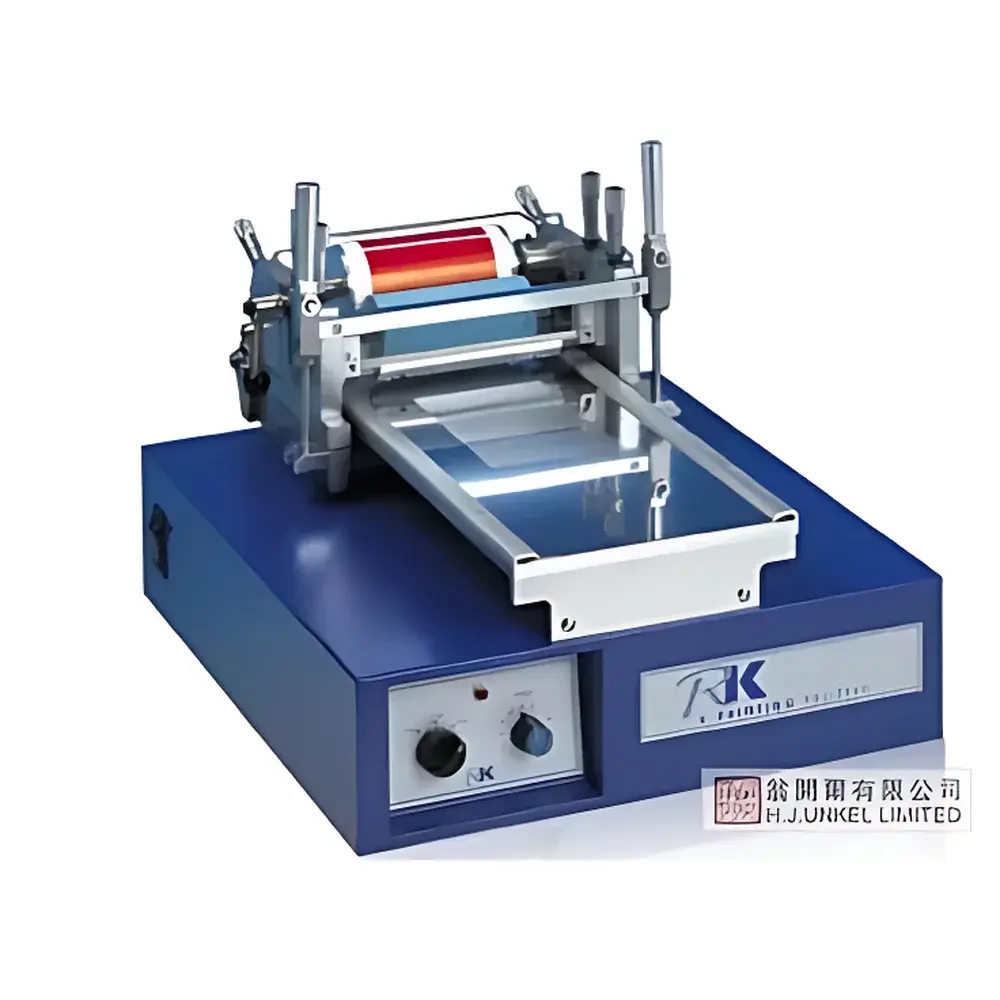
RK KPP Gravure Printing Proofer
| Brand | RK |
|---|---|
| Origin | United Kingdom |
| Model | KPP |
| Printing Speed | Up to 40 m/min |
| Substrate Compatibility | Films, paper, thin boards, aluminum foil, PVC |
| Engraved Cylinder Control | Micrometer-adjustable doctor blade pressure |
| Multi-ink Simultaneous Printing | Yes |
| Flexographic & Lamination Proofing Capability | Via interchangeable print head modules |
| Footprint | 400 × 500 mm |
| Standard Engraving Plates | Type A (solid), B (triple-pattern), C (1+4 gradient), D (dual-octave gradient) — all at 150 lpi (60 cm⁻¹) unless specified |
| Plate Line Screen Options | 100–200 lpi (40–80 cm⁻¹) |
| Solid Area Density Range | 60–100% |
| Gradient Resolution | Stepwise or continuous per plate type |
Overview
The RK KPP Gravure Printing Proofer is a precision-engineered laboratory-scale gravure printing system designed for reproducible, high-fidelity ink evaluation under controlled conditions. Operating on the fundamental principle of gravure offset transfer—where liquid ink is metered onto an engraved cylinder, excess removed by a micrometer-adjustable doctor blade, and transferred under calibrated nip pressure to a moving substrate—the KPP replicates production-line gravure behavior at speeds up to 40 meters per minute. This enables quantitative assessment of ink rheology, drying kinetics, pigment dispersion stability, and film formation characteristics across diverse liquid ink formulations including conventional gravure, indirect gravure, and flexographic (anilox-based) inks. Its modular architecture supports rapid configuration changes, making it suitable for R&D laboratories, quality control departments, and technical service centers requiring traceable, standards-aligned print trials.
Key Features
- High-speed printing capability up to 40 m/min, enabling realistic simulation of industrial gravure press dynamics and solvent evaporation profiles.
- Micrometer-controlled doctor blade assembly ensures repeatable ink metering and consistent cell-fill ratio across engraved cylinders—critical for inter-laboratory reproducibility.
- Modular print head design allows seamless transition between gravure, flexographic, and laminating proofing modes via field-replaceable components—no recalibration required.
- Simultaneous dual- or multi-ink printing capability with independent registration control; ideal for comparative ink performance testing and color interaction analysis.
- Compact benchtop footprint (400 × 500 mm) optimized for ISO 12647-compliant lighting environments and integration into GLP-aligned lab workflows.
- Integrated substrate handling system accommodates films (PET, OPP, BOPP), papers (coated/uncoated), thin boards, aluminum foil, and PVC—each with adjustable tension and tracking.
Sample Compatibility & Compliance
The KPP supports standardized test substrates compliant with ISO 12647-2 (graphic technology — process control for halftone colour separations, proofs and production prints) and ASTM D3950 (standard practice for evaluating ink adhesion). Engraved cylinders are manufactured to ISO 12647-7 tolerances for cell geometry, depth uniformity, and surface roughness (Ra < 0.4 µm). All standard plates (Types A–D) are supplied with certified line screen (100–200 lpi), engraving depth (15–35 µm), and solid area density specifications traceable to NPL (UK National Physical Laboratory) reference methods. The system meets CE marking requirements and conforms to EN 61000-6-3 (EMC emission) and EN 61000-6-2 (immunity) standards.
Software & Data Management
While the KPP operates as a hardware-dedicated proofer without embedded software, it is fully compatible with third-party digital documentation systems used in regulated environments. All operational parameters—including speed, blade load, substrate tension, ambient temperature/humidity (monitored externally), and plate identification—are recorded manually or via external logging devices compliant with FDA 21 CFR Part 11 requirements when paired with validated electronic lab notebooks (ELNs). Audit trails for plate usage, cleaning cycles, and maintenance intervals can be maintained in accordance with ISO/IEC 17025 and GLP principles.
Applications
- Development and validation of new gravure ink formulations, including VOC-reduced, water-based, and UV-curable systems.
- Raw material incoming inspection per ISO 2834-1 (inks for printing — specification for process inks) and customer-specific technical data sheets.
- Production of standardized color swatches and corporate color libraries aligned with ISO 12647-2 and ISO 13655 spectral measurement protocols.
- Computer-assisted color matching (CAM) sample generation using spectrophotometric feedback loops integrated with industry-standard software (e.g., X-Rite Color iMatch, Datacolor Match Pigment).
- Investigation of ink-substrate interaction phenomena such as strike-through, blocking, rub resistance, and gloss uniformity under accelerated aging conditions.
FAQ
What engraving depths are available for KPP standard plates?
Standard engraved cylinders are supplied with nominal depths ranging from 15 µm (Type A, low-viscosity inks) to 35 µm (Type D, high-solids or paste-like formulations), all verified via stylus profilometry per ISO 4287.
Can the KPP be used for GMP-regulated ink release testing?
Yes—when operated within a documented procedure, with calibrated instrumentation and defined acceptance criteria, the KPP supports IQ/OQ/PQ validation protocols required for pharmaceutical packaging ink qualification per USP and ISO 10993-12.
Is plate cleaning solvent compatibility documented?
RK provides a validated cleaning matrix covering common solvents (ethyl acetate, isopropanol, toluene, MEK) with residue limits verified by GC-MS per ISO 10545-11.
Does RK supply custom-engraved plates?
Yes—custom patterns, line screens, and depth gradients are available upon submission of vector artwork and technical specifications; lead time is typically 10–12 working days.
How is ink consumption measured during KPP operation?
Ink usage is determined gravimetrically before and after each run using analytical balances meeting OIML R 76 Class I specifications, with results reported as g/m² per ISO 2834-2.





